


PCIe 5.0 vs PCIe 4.0 for Video editing in 4k in SA
PCIe 5.0 vs PCIe 4.0 for video editing in 4k is mainly about fit, features, compatibility, cost, and upgrade path, not one automatic winner. SA buyers should match the choice to the setup.
Read moreA useful fightstick buying guide connects platform support, arcade layout, direction modes, safety and customisation to regular use. The R1,799 C2 supplies PS4 and Xbox One support, Sanwa Denshi parts, a Key Lock and artwork faceplate as one local example.
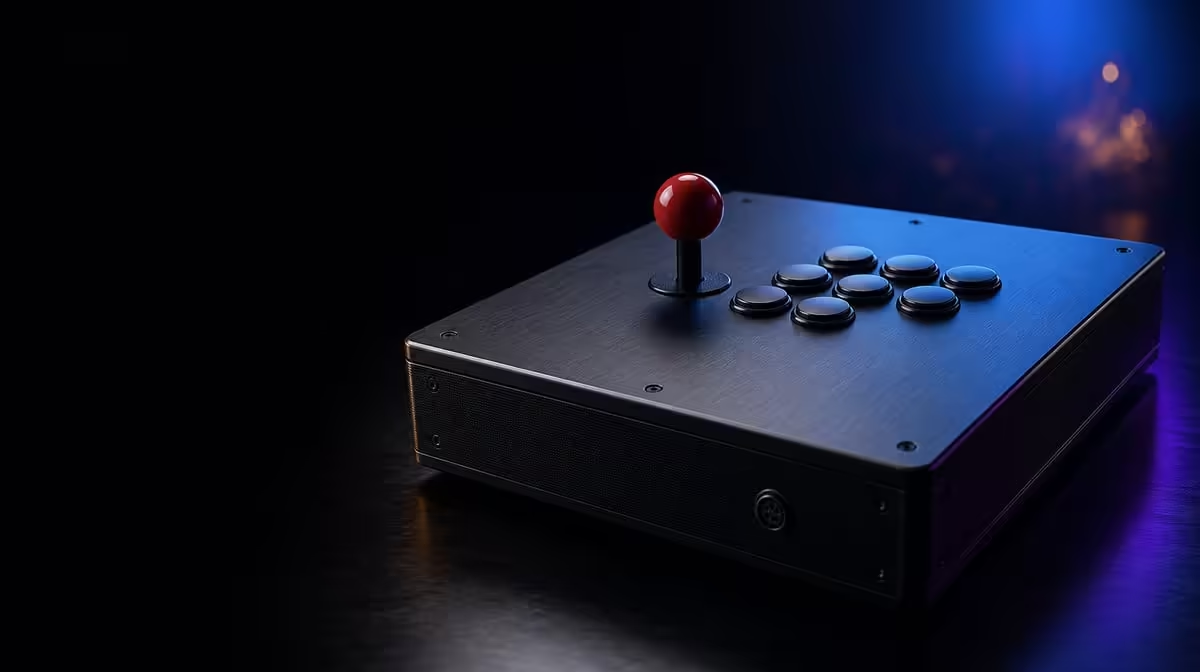
A fightstick guide should connect hardware to a real playing routine. Lists of buttons and console names are not enough. The arcade fightstick layout, parts and support have to work together: the host must recognise the device, the hands must reach the controls comfortably, and configuration must remain understandable under pressure.
Judge a fightstick in this order: platform and game support, physical layout, component identity, direction behaviour, match safeguards and customisation. At R1,799, the GameSir C2 joins Sanwa Denshi hardware and direction configuration with PS4/Xbox One coverage, Key Lock and an artwork-ready faceplate.
Compatibility is not a mood. Write down the console, computer or other host, then add the games that matter. The C2 explicitly names PS4 and Xbox One. That makes those two systems valid starting points, while PC or later-console use must be established separately.
Recognition in a console menu proves only the first layer. Enter the game, inspect its controller settings and test every direction plus action. If a title uses a different button map, document that arrangement instead of treating it as a hardware fault.
The gaming controllers available through Evetech can be compared by the systems and control style they serve. Rejecting an unsupported choice early leaves more time for meaningful physical evaluation.
The C2 uses Sanwa Denshi arcade controls. A named maker provides a useful baseline, but the complete layout determines whether those parts feel accessible. Set the base on the intended desk or lap position. Check lever reach, outer-button access, shoulder height and whether the enclosure shifts under quick changes.
Test the controls in layers. Press one button at a time, alternate between distant pairs, hold cardinal directions and trace each diagonal. Then perform common combinations. A reliable result should survive repeated attempts and a longer session without the hands becoming tense.
Do not infer exact component models, forces, restrictor shape or replacement fit from the Sanwa identity. If upgrades matter, establish the installed hardware, mounting and connectors first. General items in Evetech's gaming accessory department can support the station, but they cannot answer internal compatibility questions.
The directional toggle changes how the C2 presents lever commands for supported setups. Record its original position and run an eight-direction test before moving it. Change one setting, repeat the same test, then check the game command that prompted the adjustment.
This disciplined sequence separates a mode issue from technique, mapping or a physical activation problem. A diagonal that fails in every mode deserves a different investigation from one that returns after the toggle changes.
The Key Lock has a separate purpose: protecting selected functions from accidental activation. Enable it only after normal operation passes, confirm its boundary in a safe screen and rehearse a short pre-match check. Active arcade buttons still respond to careless contact.
Keep the configuration record specific to each game. A direction position that suits one title may not be the best starting point for another, and shared hardware can be moved between users. A label with game, mode and button map prevents memory from becoming the only source.
An artwork-ready faceplate lets the C2 carry a personal design. Get the proper template or measurements, print a draft and check how the lever, buttons and hands interrupt the composition. Follow the correct removal instructions rather than forcing a panel.
Hardware swaps carry more risk. Photograph every connection before removal, label leads, store fasteners by location and change only one component before retesting. Original parts and a change log preserve a route back to the working state.
At R1,799, the standard C2 already includes its named arcade controls and configuration features. Learn that baseline before assigning money to replacements. Modification is strongest when it solves an observed need, not when it is treated as compulsory ownership.
Keep a compact setup note containing platform, game, toggle position, button map and Key Lock state. Add photographs of the standard wiring only if the unit is opened appropriately. Precise records make future troubleshooting easier than a vague report that "nothing works".
When asking for help, describe the screen used for testing, the exact input that failed and whether the behaviour changed with lock or direction settings. Do not hide the sequence of modifications. A support conversation improves when someone else can reproduce the symptom from the note.
Evetech's best-selling accessories page offers another route for checking current availability around a gaming station. Keep that broader shopping step after the controller has passed the support, layout and configuration tests.
Storage deserves one line in the guide. Cover the controls when the unit is idle, keep moisture away and avoid placing weight on the lever or buttons. A quick input test after transport or long storage catches changed switch positions and physical issues before the next serious session.
When a symptom appears, reproduce it slowly. Note whether it happens in the system interface, one game or every game, and whether a lock or direction change affects it. That evidence determines the next sensible layer to inspect.
The strongest ownership plan is intentionally boring: known platform, stable surface, documented switches, gentle care and one change at a time. It keeps the interesting part focused on play rather than endless controller uncertainty.
Add a recovery drill to the guide. Begin from a deliberately changed but safe state, then use the setup note to restore the correct direction mode, lock condition and game map. If the process takes too long or depends on a forgotten detail, improve the note before competition.
The same guide should cover handover. A second player ought to understand which consoles are confirmed, which settings belong to the current game and how to test ordinary operation. Shared ownership exposes assumptions that a single user can carry silently for months.
Finally, keep the price attached to the complete controller. R1,799 includes the working baseline described here; custom work, storage and transport are separate decisions. This separation makes later comparisons fair and prevents an optional art or accessory budget from being mistaken for a weakness in the standard C2 layout.
An excellent layout cannot serve a host that does not recognise it. The C2 names PS4 and Xbox One, while any other pathway needs an exact check.
Check reach, spacing, wrist angle and consistency across single presses and combinations. Repeat the evaluation after enough time for fatigue to appear.
They provide the named joystick-and-button baseline for the arcade layout. They do not establish every internal model or upgrade dimension.
It lets a supported setup receive lever commands in a suitable mode. Record the starting position and retest all directions after an adjustment.
It can guard selected functions during a match. Players still need careful hand placement because active buttons remain live.
It creates a planned route for custom artwork. Exact template, material and removal guidance still matter.
The fightstick costs R1,799. Judge that number against the full platform, layout, configuration and ownership package.
Ready to assess a fightstick as one connected system? Use Evetech's controller category to compare exact platform support, then test the layout and match controls before planning custom work.
An excellent layout cannot serve a host that does not recognise it. The C2 names PS4 and Xbox One, while any other pathway needs an exact check.
Check reach, spacing, wrist angle and consistency across single presses and combinations. Repeat the evaluation after enough time for fatigue to appear.
They provide the named joystick-and-button baseline for the arcade layout. They do not establish every internal model or upgrade dimension.
It lets a supported setup receive lever commands in a suitable mode. Record the starting position and retest all directions after an adjustment.
It can guard selected functions during a match. Players still need careful hand placement because active buttons remain live.
It creates a planned route for custom artwork. Exact template, material and removal guidance still matter.
The fightstick costs R1,799. Judge that number against the full platform, layout, configuration and ownership package.
PCIe 5.0 vs PCIe 4.0 for video editing in 4k is mainly about fit, features, compatibility, cost, and upgrade path, not one automatic winner. SA buyers should match the choice to the setup.
Read more
Wi-Fi 7 vs Wi-Fi 6e for competitive esports comes down to router support, latency goals, device compatibility, and coverage. SA buyers should match the choice to the real network setup.
Read more
ATX 3.1 vs ATX 3.0 for mMO and live-service games buyers - what changes is mostly about compatibility, budget, upgrade path, and setup fit. SA buyers should check device support and real needs before expecting a clear win from either option.
Read more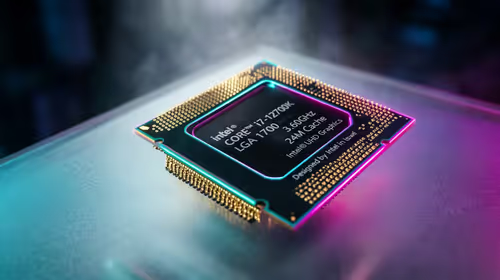
LGA 1851 vs LGA 1700 can affect Twitch and YouTube streaming when gaming and encoding share CPU resources. For SA creators, the real-world difference depends on encoder choice, memory support, motherboard cost, thermals, and upgrade plans.
Read more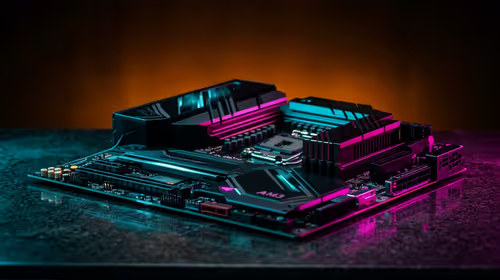
X870E vs X670E for aaa single-player gaming is mainly about fit, features, compatibility, cost, and upgrade path, not one automatic winner. SA buyers should match the choice to the setup.
Read more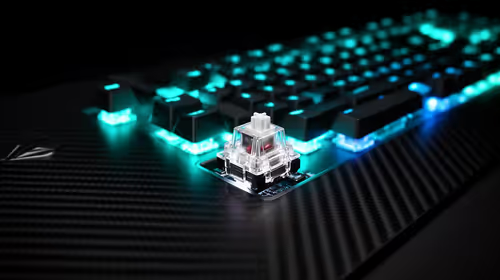
Hall Effect switches vs Mechanical switches for mMO and live-service games is mostly about compatibility, budget, upgrade path, and setup fit. SA buyers should check device support and real needs before expecting a clear win from either option.
Read more
A fake 113GB GTA VI ISO reportedly used empty padding around a small malware payload. SA gamers should delete unofficial builds, keep Windows security active and wait for official channels.

Wi-Fi 6E vs Wi-Fi 6 matters for 4K video editing when files move across a network. The real-world difference between Wi-Fi 6E and Wi-Fi 6 for video editing in 4K depends on NAS access, cloud uploads, router range, and SA creator workflows.

The difference between PCIe 5.0 and PCIe 4.0 for SA gamers is mostly bandwidth headroom. Compare GPU slot needs, NVMe speed, motherboard support, and upgrade timing before paying extra for a newer platform.

Gaming PC stuck pixel checks in South Africa should confirm the monitor fault first. Use colour tests, screenshot comparison, cable swaps, display menu checks, and clear photos before deciding on support.

Shokz OpenFit Air 2 earbuds weigh 7.2g each and use a redesigned dual-driver open-ear layout. SA buyers should choose them for comfort and awareness, not maximum isolation.

AMD's current driver now lists a Radeon RX 9050 4GB, while product coverage details a narrowed memory system. SA buyers should weigh the low VRAM ceiling against current local Radeon options.

Samsung Display has demonstrated a 16-inch 2.5K OLED laptop panel running at 300Hz. SA buyers should wait for a named notebook, full panel specifications and a local price before planning an upgrade.

Microsoft says some Windows 11 game crashes after recent updates are linked to RGB-related drivers. Affected SA gamers should confirm the update and driver before using the published registry workaround.
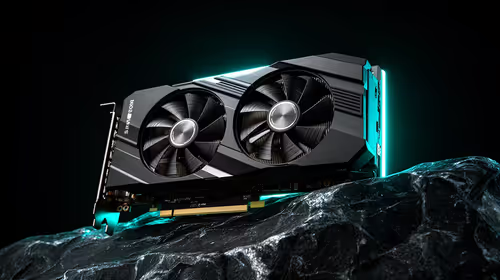
RTX 5090 on a 650W PSU is a tight pairing with very limited headroom. For SA gaming PCs, focus on total system draw, PSU quality, connector support, CPU choice, and avoid OC plans unless the full build is carefully power-limited.
PCIe 5.0 vs PCIe 4.0 for video editing in 4k is mainly about fit, features, compatibility, cost, and upgrade path, not one automatic winner. SA buyers should match the choice to the setup.
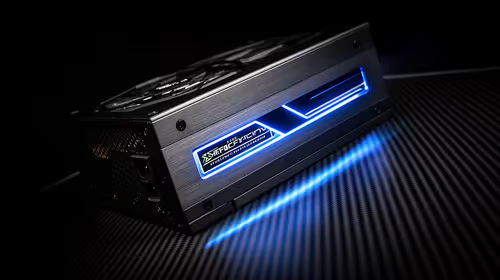
850W PSU safety for RTX 5090 is plausible with a quality unit and balanced parts. In SA, confirm connector support, CPU power draw, case airflow, PSU age, and spare capacity before building around 850W.
Wi-Fi 7 vs Wi-Fi 6e for competitive esports comes down to router support, latency goals, device compatibility, and coverage. SA buyers should match the choice to the real network setup.