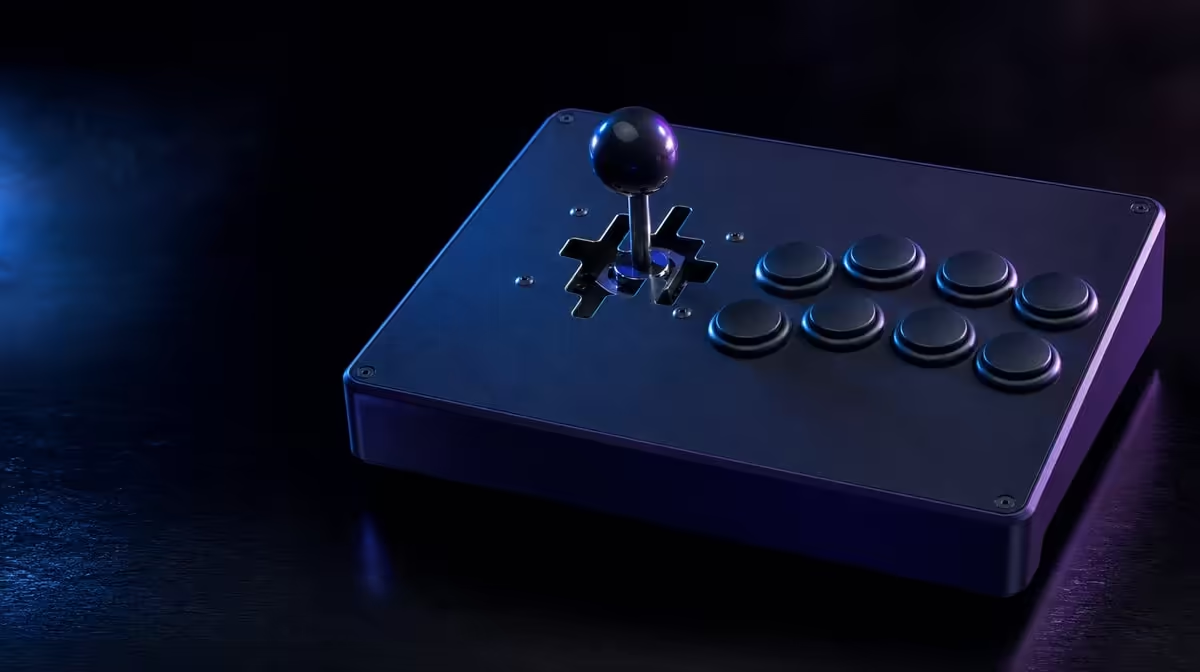
Fighting games and retro titles can ask the same lever to speak slightly different input languages. Fightstick direction modes exist to bridge that expectation, but they should be selected through a visible test rather than by repeatedly moving a switch until a character seems to behave.
Quick Answer
Use the GameSir C2 directional toggle to select the mode a supported fighting or retro game interprets correctly, then test every cardinal and diagonal. The R1,799 C2 keeps the same Sanwa Denshi joystick while changing direction presentation; it does not alter button assignments or repair a physical input fault.
🧭 Mode changes command presentation
The lever creates distinct directional activations. The C2 toggle controls how those commands are presented to a supported environment. That setting can matter when two games or host modes expect different directional input.
Moving the toggle does not change the joystick's mechanical travel, the shape of an unknown gate or the physical actuation points. The player's hand is still working the same Sanwa arcade control.
Record the initial position before experimentation. Label it with platform and game, not simply "good", because the result belongs to a specific software context. A photograph can preserve the physical state clearly.
The Key Lock should be noted separately. It protects selected functions and can create a dead-looking action, but it does not define direction mode.
Read the toggle state before opening software. This creates a true starting point and prevents the game launch itself from becoming part of an uncertain sequence. Keep the cable and base stable so physical movement does not cloud the comparison.
Use a label another player can understand. "Retro mode" may be too broad if several older titles behave differently. A host-and-game name beside the actual switch position is more dependable.
🧪 Fighting games need command-history tests
Open a training display and test up, down, left and right. Add the four diagonals, then perform a slow quarter circle, a charge transition and one real command. Watch the history rather than judging only whether the final move appears.
Repeat on both sides of the screen. Technique can make one hand direction less accurate, while a mode issue should follow the game and switch state. Keep the button map unchanged during this comparison.
After moving the toggle once, run the same sequence in the same order. Mark absent, unwanted and clean inputs. If the result improves, save the state beside the title name.
Several repetitions matter. One successful special move can occur despite an extra direction, and one failure can be timing. A visible sequence across ten attempts gives the setting a fair test.
Test neutral gaps between commands. Some moves fail because the previous direction remains active, not because the new one is missing. A deliberate pause exposes this timing layer before the mode receives blame.
Build speed in stages after accuracy appears. If the history breaks only at full pace, record the unwanted point and inspect hand path. The correct mode cannot compensate for a shortcut that skips a required direction.
👾 Retro games deserve their own baseline
A retro title may interpret arcade direction differently from a modern fighter. Begin with menu movement or a simple character walk, then test diagonals only if the game uses them. Avoid imposing a fighting-game drill on software with different control needs.
Record the working mode per game. If two titles use different positions, treat the toggle change as part of launching them. Read, set, validate one movement sequence and then play.
The supported-console line for the C2 specifies PS4 and Xbox One. A computer, emulation route or other host requires its own exact compatibility check; direction mode cannot create support for an unconfirmed pathway.
Evetech's gaming controller range allows buyers to compare named platform coverage. The gaming accessories section can support the station after host compatibility is settled.
Preserve distinct button maps too. Direction mode does not replace the assignment layer, and retro games may use fewer or differently named actions. A concise card can hold both without mixing their purposes.
If the game has no visible history, choose a simple repeatable movement and count outcomes. Ten identical walks, jumps or menu movements still provide a better comparison than changing modes after every uncertain animation.
🔍 Persistent faults need another path
If one diagonal fails in every mode across menus and games, preserve that evidence and stop random switching. The issue may involve technique, mapping or a physical input layer that the toggle cannot fix.
Check return to neutral and test the same corner at a slow pace. Note whether the symptom follows the player's weaker movement or remains attached to one physical lever position.
At R1,799, the C2's mode flexibility adds value when it reduces setup friction between games. An undocumented toggle can create the opposite effect, so keep the working states close to the controller.
Evetech's accessories best sellers page offers another route to check current availability for related pieces. Keep any purchase separate from the evidence gathered by the direction test.
Revisit the recorded mode after software or setup changes. The previous state remains a useful baseline but should not be assumed forever. Retest before replacing the note.
A calm workflow protects both genres: identify the host, load the correct map, read the switch and perform the game's own movement sample. That sequence makes one C2 easier to share across different eras of play.
Repeat it after transport or another player changes the setup.
Build a separate proof command for each title. A modern fighter might use a diagonal chain visible in training history, while a retro game may be better checked with a simple menu or character movement. The test should match the software rather than force every genre into one template.
Keep the action-button map beside the direction record even though the toggle does not control it. Launching the correct mode with the wrong profile can still produce a failed session, and the player needs to know which layer to restore.
After switching modes, return the lever to neutral before the proof sequence begins. Starting with an active direction can pollute the first result and make the new state appear unreliable.
Review saved entries after a game or host update. Mark the old state as historical, retest every required direction and date the replacement. This preserves useful evidence without treating yesterday's configuration as permanent.
For shared use, agree on a default position when no labelled game is active. A neutral handover state reduces surprises and gives every player the same place from which to load a title-specific mode.
Frequently Asked Questions
Why might fighting and retro games use different modes?
Games and host environments can interpret directional commands differently. The working state should be proved per title.
What remains unchanged when the toggle moves?
The physical Sanwa joystick, button hardware and player's lever path remain the same. Only command presentation changes.
How should a mode be validated?
Use a visible input or simple movement test, cover all required directions and repeat enough times to expose a pattern.
Does direction mode remap action buttons?
The toggle's role here is direction handling. Preserve button assignments during the comparison.
What if every mode misses the same corner?
Investigate technique, game mapping and the physical input path. Continuing to cycle settings will not repair a persistent fault.
What price includes these direction choices?
The GameSir C2 costs R1,799 with the directional toggle as part of its complete arcade layout.
Ready to give each game a known direction state?
Compare Evetech's controller options, then label the C2 toggle by title and prove it with a visible movement sequence.