Quick Answer
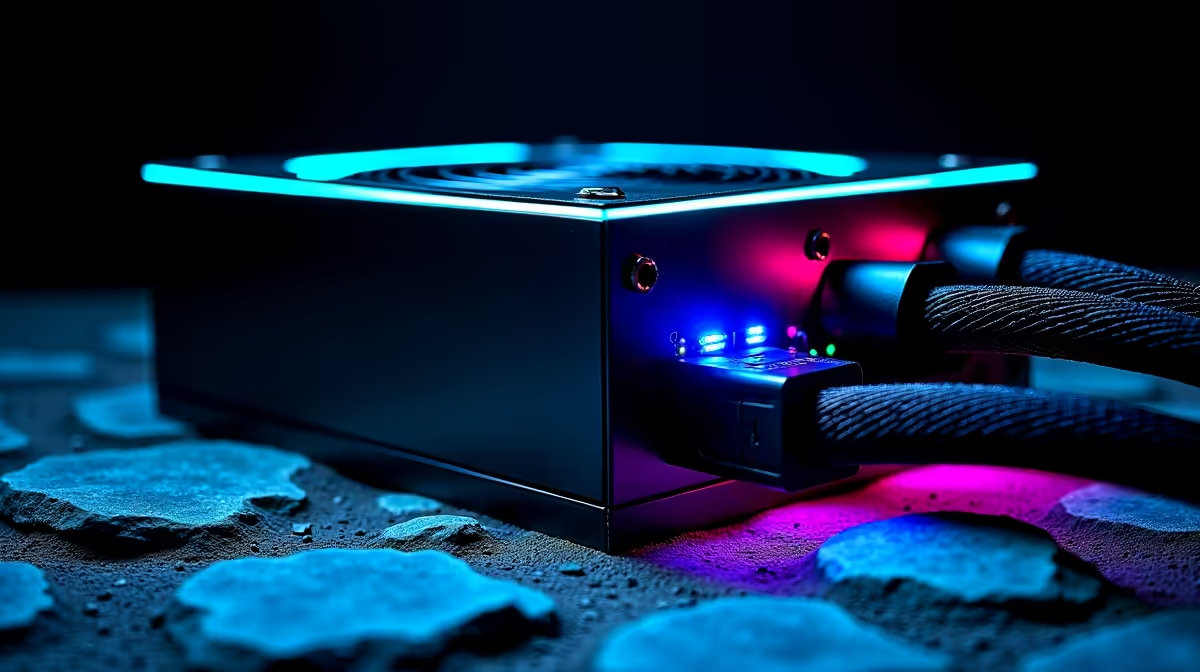
ATX 3.1 PSUs include native 12V-2x6 connectors rated for 600W continuous and handle 150% transient spikes without shutting down, making them essential for RTX 50-series and RX 9000-series cards. If your current PSU shipped before 2024, it almost certainly lacks this spec and risks connector heat damage with next-gen GPUs.
What Changed From ATX 3.0 to ATX 3.1 📡
Intel's ATX 3.0 specification introduced the 12VHPWR connector and a 200% transient excursion rule. ATX 3.1 tightened the connector to 12V-2x6, which adds two ground sense pins that confirm full seating before power flows, eliminating the partial-insertion arc events that caused melted connectors on early adopters' cards. The spec also lifted continuous power to 600W per connector and mandates that PSUs sustain 150% of rated connector current for at least 100 microseconds. For South African builders dropping R18,000 to R22,000 on an RTX 5090, using an ATX 3.1 native cable instead of a daisy-chained 8-pin adapter removes the single biggest reliability risk in the build.
PCIe Gen 5.1 and Slot Power Rules 🔌
PCIe Gen 5.1 doubles the per-slot bandwidth versus Gen 5.0 but the power delivery spec remains similar, capped at 75W from the slot itself. All extra GPU power still comes through the 12V-2x6 cable. What changes is that Gen 5.1 capable motherboards enforce stricter slot power monitoring and can flag a PSU that droops below 11.4V under transient load, which is another reason ATX 3.1 units with tighter voltage regulation (typically plus or minus 0.5%) matter. Motherboards like the ASUS ROG Crosshair X870E Hero communicate real-time power data to the PSU via the I2C sideband on premium ATX 3.1 builds.
Checking Compatibility Without an Upgrade 🖥️
If your PSU is ATX 2.x with only 8-pin connectors, manufacturers sell 8-pin-to-12V-2x6 adapters, but these carry risk under sustained high-current draws above 450W per card. The official guidance from NVIDIA for RTX 5090 installations is to use PSUs with native 12V-2x6 outputs. If your PSU is an ATX 3.0 unit with 12VHPWR, it is electrically compatible but lacks the sense pins of the 3.1 connector. Most ATX 3.0 units over 850W handle RTX 4090-class cards fine; for 5090-class the safer path is an ATX 3.1 unit.
Check the Label Before You Buy ⚡
Genuine ATX 3.1 compliance is printed on the PSU box and confirmed in the specification sheet with the phrase "12V-2x6 native output". Some retailers list ATX 3.0 units as "next-gen ready" because of included adapters; verify the spec sheet rather than relying on marketing copy alone.
FAQ
Will an ATX 3.1 PSU work with older PCIe 4.0 GPUs?
Yes, fully. ATX 3.1 units include standard 8-pin PCIe cables and are backwards compatible. You simply will not use the 12V-2x6 connector until you upgrade the GPU.
Do I need ATX 3.1 for an RX 9070 XT?
The RX 9070 XT draws around 304W TDP and ships with an 8-pin or 12V-2x6 cable depending on the board partner. An ATX 3.0 or quality ATX 2.x PSU handles it without issue; ATX 3.1 is more critical for 500W-plus cards.
What wattage ATX 3.1 PSU should I choose for a single RTX 5090 system?
A 1,000W to 1,200W ATX 3.1 Titanium or Platinum PSU is the sweet spot, giving ample headroom over the 575W GPU TDP plus a Ryzen 9 9950X CPU, which typically peaks around 230W.
Upgrading to next-gen GPU hardware?
Evetech stocks a range of ATX 3.1 certified power supplies from 850W to 1,600W, all with local warranty support and native 12V-2x6 cabling for RTX 50-series and RX 9000-series builds.