A child who finishes a block-coding course in an afternoon and asks "what's next" is telling you something: the drag-and-drop scaffolding has become a ceiling. For a gifted kid ready for real programming, the answer is to move to actual text languages early. A motivated nine-year-old can often handle MicroPython on a Raspberry Pi Pico or C on an Arduino two to three years before the usual age ten-to-twelve transition.
Quick Answer
For an advanced young learner, skip the blocks and start with MicroPython on a Raspberry Pi Pico, which teaches real Python syntax on cheap, forgiving hardware. The bare Pico board costs around R150 to R200 in SA, making a fried board a cheap lesson rather than a disaster. Pair it with an Arduino for C and electronics once they want lower-level control.
Why blocks become a ceiling
Block editors like Scratch are brilliant for teaching logic, loops and events without the friction of typing exact syntax. But a gifted learner internalises those concepts fast, and the visual blocks start hiding the very details they are now ready to grasp: how a variable is declared, how a function returns a value, how a typo breaks a program.
Moving to text coding is not about pushing a child harder; it is about removing an artificial limit once they have outgrown it. The signal to watch for is boredom paired with curiosity about "how the real thing works".
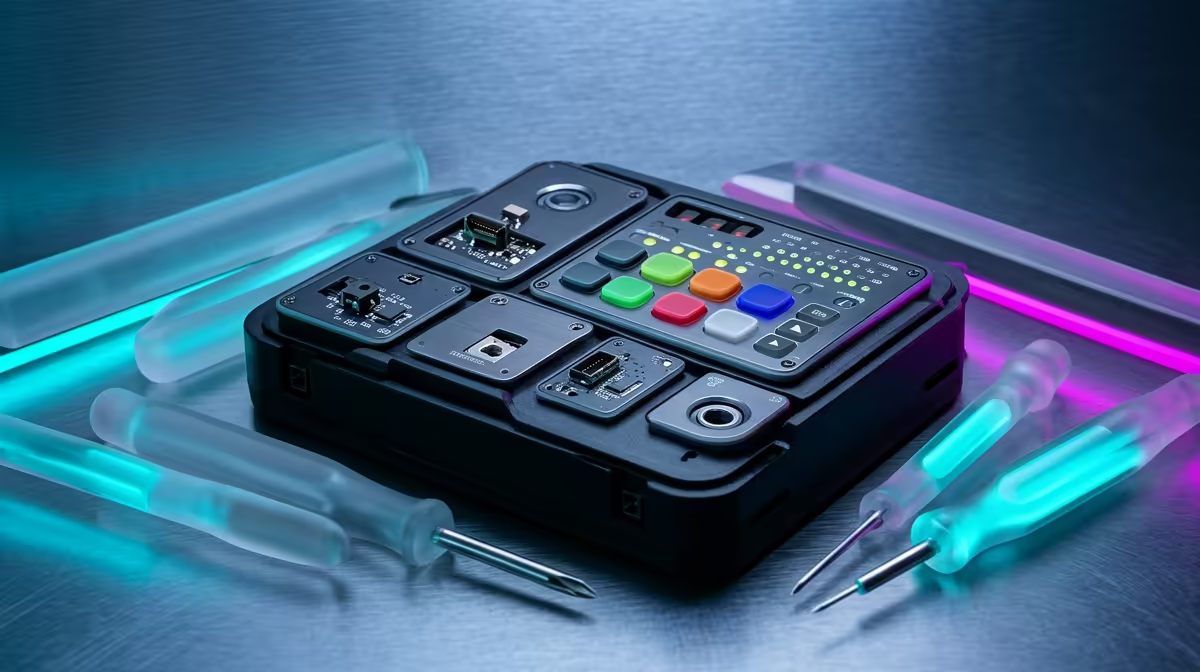
A capable kit is the foundation, and the smart home and maker components at Evetech include boards, sensors and modules that turn coding lessons into things that blink, beep and move.
Start with MicroPython on a Raspberry Pi Pico
The Raspberry Pi Pico is an ideal first text platform. MicroPython is genuine Python, so the skills transfer directly to school projects, data work and AI tooling later. The Pico runs on the RP2040 dual-core processor and costs roughly R150 to R200 for the bare board in SA, making it one of the most affordable serious entry points available. The Pico W adds Wi-Fi at only a slight premium if connected projects are on the horizon.
Begin with the classics: blink an LED, read a button, then a temperature sensor, then drive a small display. Each step introduces one real concept. Because the feedback is physical, an abstract idea like a loop becomes obvious the moment a light starts flashing on its own.
Good first projects
A reaction-timer game, a desk thermometer, or a simple plant-moisture alert each combine code with a sensor and an output. They are achievable in an afternoon and leave room for a curious child to add features unprompted, which is exactly what you want to see. More confident learners can try a clone of Snake or Tetris on a small OLED display, a project that pushes lists, timing and screen coordinates all at once.
Add Arduino and C when they want more control
Once Python feels comfortable, Arduino and the C language teach what is happening closer to the metal: data types, memory, and timing that Python smooths over. This is where a gifted learner starts to understand why one language is fast and another is convenient, a genuinely advanced insight.
C is stricter and less forgiving, which is a feature here. The error messages force precision, and precision is a skill worth building early. Keep projects motivating, like a small robot or a light show, so the discipline is in service of something fun.
Building a Learning Environment at Home
The physical setup matters more than most parents expect. A solderless breadboard and a set of jumper wires are non-negotiable: they let a child wire and re-wire circuits without soldering, which means an experiment can be torn down and rebuilt in minutes. A small box of resistors, LEDs, buttons, basic sensors and a servo motor gives months of material without a large outlay.
Free learning resources are excellent at this level. The Raspberry Pi Foundation's official "Introduction to Raspberry Pi Pico" course walks through MicroPython step by step. Once that feels comfortable, the "Getting Started with Raspberry Pi Pico W" guide brings in networking concepts. Both are completely free and progress at exactly the right pace for a self-driven young learner.
Choosing the Right Next Challenge
A gifted learner moves through guided material quickly, so having the next challenge ready before the current one is finished prevents the gap that leads to disengagement. A practical way to structure this is to keep one ongoing hardware project, one software-only puzzle, and one open-ended experiment running in parallel. The hardware project gives physical feedback and builds patience. The software puzzle, a logic game, a sorting algorithm, or a maths problem coded up from scratch, builds abstract reasoning. The open experiment is whatever the child decided to try on their own. Keeping all three active means that when one hits a wall, there is something else to pick up while the stuck idea sits and percolates.
Keeping the momentum going
The biggest risk with a gifted learner is not difficulty, it is boredom. Rotate between software puzzles and hardware builds, let the child chase their own project ideas, and resist over-structuring. The right peripherals and add-ons keep things fresh, and many of those parts appear in the best-selling accessories at Evetech, from sensor packs to cables and storage.
Frequently Asked Questions
Is nine too young to leave block coding behind?
Not for a gifted, motivated child. While the typical switch to text coding lands around age ten to twelve, advanced learners are often ready two to three years earlier, especially when the hardware gives instant physical feedback.
Should we start with Python or C?
Start with Python via MicroPython on a Pico. It is readable and forgiving, and the skills carry into real-world data and AI work. Introduce C through Arduino later, once the child wants lower-level control.
Is a Raspberry Pi Pico powerful enough for a serious young coder?
For learning real text programming and driving sensors and outputs, yes. The Pico's RP2040 processor is purpose-built for exactly this kind of physical computing, and its low price encourages fearless experimentation.
How do I keep a gifted child from getting bored?
Give them open-ended projects and let them add their own features. Alternate between code-only challenges and hardware builds, and follow their curiosity rather than forcing a rigid curriculum.
Will these skills matter at school later?
Very much so. Python in particular underpins school computing, data analysis and modern AI tools, so a head start in genuine syntax pays off well beyond the hobby stage.
Have a young coder who has outgrown the blocks? Build their first real text-coding kit with boards and sensors from the maker and smart home range at Evetech and let them start writing the real thing.