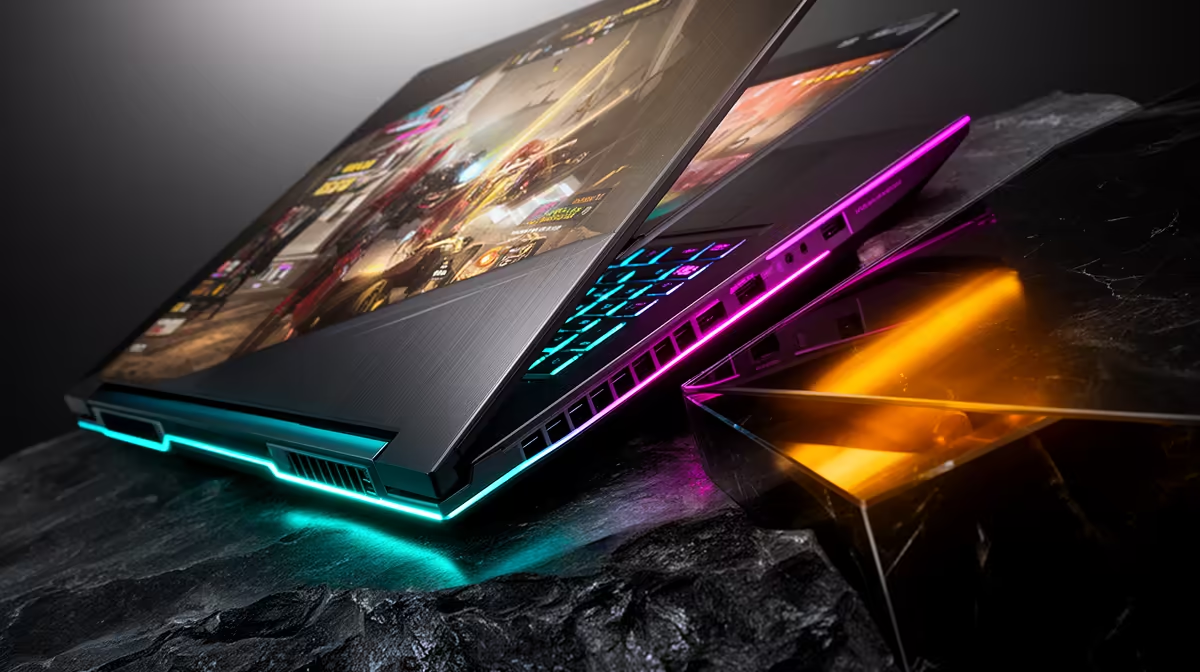
Marvel Rivals rewards a laptop that keeps its frame time calm when heroes, destruction and effects fill the screen. A mid-range mobile GPU can deliver a strong 1080p experience, but the exact result depends on graphics power, CPU cooling, memory and the panel. A 100 fps promise needs a tested configuration.
Quick Answer
Choose a gaming laptop with a measured fast 144 Hz or higher display, 16GB or more dual-channel memory and a dedicated GPU proven at your 1080p settings. Target a stable frame rate the machine holds during busy fights. Pay for a flagship GPU only when you also play heavier games, use higher resolution or need creator performance.
Start with the display target
A 144 Hz screen can show a new frame every 6.9 ms. A 165 Hz or 240 Hz panel asks the laptop for more consistent frames. Refresh rate alone is not enough: pixel response and overshoot decide whether movement stays clear.
Check exact-panel testing because one laptop family can ship with several displays. Brightness, colour and adaptive sync also affect daily use. A fast dim panel may be frustrating in a bright room.
Set a target from the panel and game. Stable 120 fps on a 144 Hz display can feel better than an average above 160 with deep drops.
Mobile GPU names need power context
Laptop graphics processors run across different power limits. Two machines with the same GPU label can perform differently after they warm. Cooling and firmware determine sustained power.
Use Marvel Rivals or comparable exact-model tests where available, stating resolution, preset, upscaling and frame generation. Do not compare one native result with another using performance upscaling.
Browse the laptop best sellers page and gaming notebook offers, checking the full GPU and panel specification.
The CPU protects busy-fight lows
Marvel Rivals still needs the CPU for game logic, draw calls and background tasks. A recent gaming processor with strong per-core performance is a sound match. A huge core count adds little when the GPU remains full.
Watch one-percent lows and CPU-thread behaviour in a busy match. Low total CPU use can hide one saturated thread. Voice chat, browser sources and recording add their own load.
A flagship processor in a thin chassis can lose its advantage when power and temperature pull clocks down. Compare sustained laptop results.
Memory layout matters
Sixteen gigabytes is a practical minimum for the game and normal background tools. A new all-round machine is more comfortable with 32GB when you stream, edit or keep many applications open.
Check whether memory uses two channels and whether it is upgradeable. Soldered capacity cannot be fixed later. A single module can hold back CPU-fed gaming until a matched upgrade is installed.
Tune for visual clarity first
Start at native 1080p and a high preset, then reduce expensive shadows, effects or reflections one at a time. Keep textures within VRAM and preserve character clarity.
Upscaling can recover GPU headroom. Use its cleaner modes first and inspect thin lines, particles and motion. Frame generation can make movement look smoother on supported hardware, while the base frame rate still decides input response.
Set a frame cap the laptop holds in a full team fight. This reduces heat and can keep clocks steadier than an uncapped menu or practice range.
Cooling must hold through several matches
Use the supplied adapter and intended performance mode. Set the laptop on a firm desk with its intakes open. A stand can help airflow when the bottom vents sit close to the surface.
After twenty minutes, record GPU and CPU clocks, temperatures, fan noise and one-percent lows. A brief benchmark cannot show a heat-soaked chassis.
Fan sound reaches a headset microphone. Balanced mode may be worth a few frames if it keeps voice chat clearer and the cap remains stable.
MUX and display routing
Hybrid graphics saves battery by routing through the integrated GPU. A MUX switch or Advanced Optimus can give the discrete GPU a more direct internal-display path, improving some game results.
Test the supported modes. Discrete-only mode drains battery faster away from the plug. An external monitor may connect directly to the GPU through one port, so read the laptop manual.
Network stability is a separate system
Use Ethernet for a baseline. Strong modern WiFi can work, but interference and retransmissions can make an online fight feel rough while local frame time stays clean.
Watch ping and packet loss beside the frame graph. Close cloud uploads and game downloads. A laptop upgrade cannot repair a poor route to the match server.
Keyboard, ports and desk comfort
Check key rollover around movement, ability and modifier keys. The keyboard deck should stay comfortable, and the exhaust should not blow hot air onto the mouse hand.
Place the wireless receiver close to the mouse through an extension where available. Avoid a crowded hub. Disable the touchpad during games if your palm triggers it.
Battery belongs to the rest of the week
Gaming on battery reduces CPU and GPU power and empties the pack fast. Judge unplugged life through classes, work and video, using hybrid graphics and a sensible refresh rate.
Include the adapter in travel weight. A laptop that wins the match benchmark can be the wrong study machine when its charger and battery do not fit the day.
A useful shortlist
Score warmed-up Marvel Rivals lows, display response, noise, memory layout, battery and support. Add current price after each model meets the gaming target.
Choose the mid-range system when it holds the monitor cap. Move higher for a 1440p display, heavier game library, streaming or creator work. The extra GPU should have a job beyond raising an already-unused counter.
Keep one stable replay or practice route for driver updates. The same camera path and fight sequence make a later change visible without relying on memory.
Frequently Asked Questions
Do I need a flagship laptop GPU for Marvel Rivals?
No. A proven mid-range configuration can deliver strong 1080p play. Check exact-model results.
Is 100 fps enough?
It can feel responsive on a high-refresh display. Stable frame time matters more than crossing one round number.
Should I choose 16GB or 32GB RAM?
Sixteen gigabytes can run the game; 32GB gives streaming and heavy multitasking more room.
Compare Marvel Rivals gaming laptops by warmed-up 1080p lows, panel response and memory layout before paying for a flagship GPU.