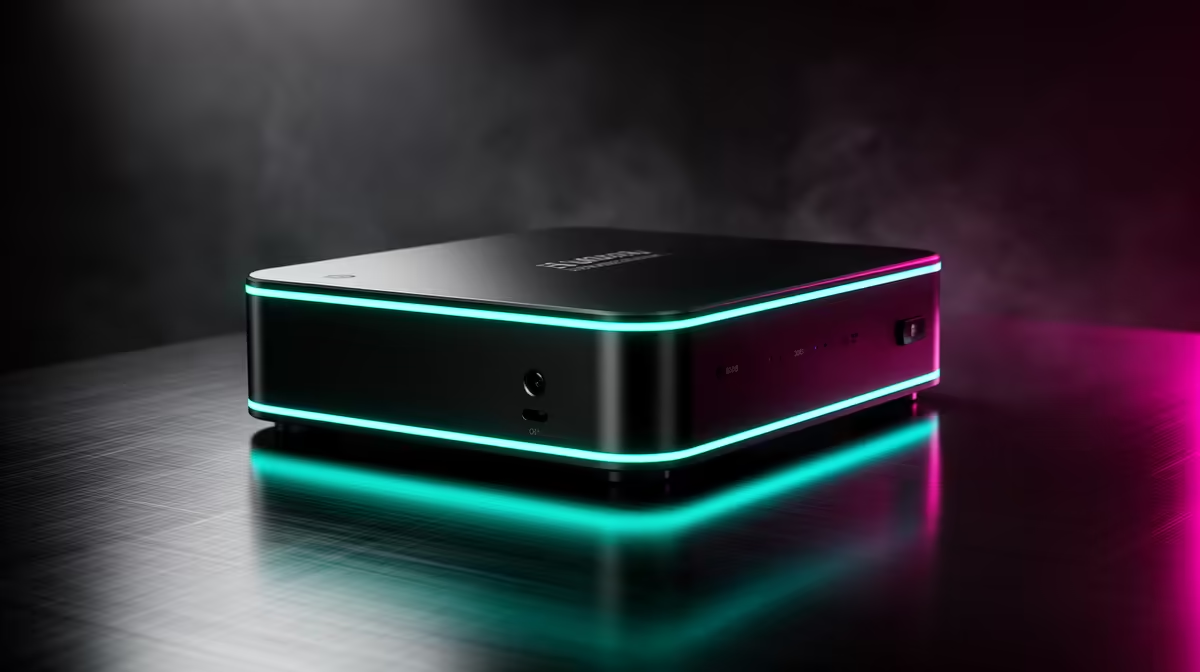
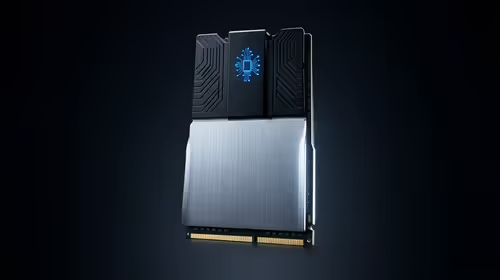
Running a 70-billion-parameter coding model on your own desk, with no cloud bill and no data leaving the room, used to mean a tower stuffed with GPUs. The arrival of unified-memory boxes changes that maths. The best mini-PC for local AI coding in South Africa right now is a unified-memory machine such as the DGX Spark class or an AMD Strix Halo box, both of which expose a large shared memory pool to the accelerator in a chassis the size of a thick paperback.
Quick Answer
For local AI coding you want a unified-memory mini-PC with at least 96GB to 128GB of shared memory, because a 70B model quantised to 4-bit needs roughly 40GB to 48GB just to load. DGX Spark and Strix Halo machines hit that target in a small box. The catch is supply: SA channel stock is thin, so treat availability as part of the decision.
Why Unified Memory Beats a Big GPU for This Job
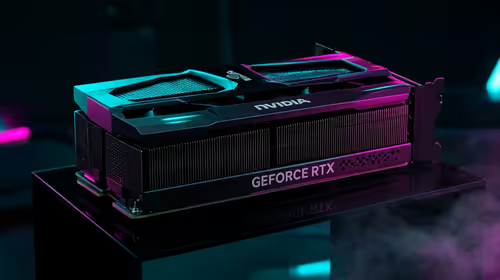
A normal gaming or workstation GPU keeps the model in its own VRAM. A 24GB card simply cannot hold a 70B model, no matter how fast it is, so the model spills into system RAM and inference crawls. Unified memory removes that wall by letting the processor and the accelerator address the same large pool.
That means a 128GB unified box can load a model that would need three or four high-end graphics cards to fit in VRAM, and it does so while drawing far less power and taking up almost no space.
What "unified" actually buys a coder
For software work the practical wins are concrete: you can keep a larger model resident, run it alongside your editor and a local vector database, and avoid the constant load-and-evict cycle that kills momentum. The bandwidth is lower than a discrete flagship GPU, so raw token speed is modest, but for code completion and refactoring suggestions the responsiveness is usually fine.
DGX Spark Class vs Strix Halo
The DGX Spark class leans on an NVIDIA stack, which matters because most local-inference and fine-tuning tooling targets CUDA first. If your workflow depends on libraries that assume NVIDIA, this is the smoother path, and the unified pool scales up toward the 128GB mark.
Strix Halo, AMD's large-APU approach, pairs a strong integrated GPU with a generous shared memory allocation. It tends to be the better value per gigabyte and runs the popular GGUF-based local runtimes well, though some bleeding-edge tooling lags behind the NVIDIA side. For a coder who lives in standard local LLM runners rather than custom CUDA kernels, it is a serious contender.
Memory sizing for real models
- A 7B to 13B model fits comfortably in 16GB to 32GB and runs fast on almost any of these boxes.
- A 34B model at 4-bit wants around 24GB, leaving headroom on a 64GB machine.
- A 70B model at 4-bit needs roughly 40GB to 48GB, which is exactly why 96GB and 128GB configurations are the sweet spot for serious local coding.
Size the memory for the largest model you genuinely plan to run, then add a margin for context window and the rest of your tooling.
Tooling, OS and the practical divide
The hardware specs of DGX Spark and Strix Halo class machines are close enough that the real decision is often made at the software level.
DGX Spark runs a Linux-based environment out of the box, which is a natural fit for the CUDA-first inference and fine-tuning ecosystem. If your workflow depends on CUDA-native libraries, custom kernels, or you plan to eventually push work to larger NVIDIA infrastructure, the DGX path is the smoother one. Prompt processing, the phase where the model reads your input, is notably faster on DGX Spark than on Strix Halo, which matters when you feed the model large file pastes or long context windows.
Strix Halo-based machines run Windows natively, which is a real advantage for SA developers whose full workflow, including proprietary tools and work-issued software, lives on Windows. Standard local LLM runners like Ollama work without modification, and AMD's inference stack handles mainstream GGUF-format models well. The per-gigabyte cost of memory is lower than the DGX Spark path, so you get more memory headroom for the same outlay.
Sizing the memory correctly
A useful frame: buy for the largest model you expect to run daily, not the largest model you might experiment with occasionally. If your coding assistant will be a 32B model most of the time, a 64GB machine is fine and keeps costs down. If you plan to run a 70B model as your primary coding companion, 96GB or 128GB is the right target, because the 70B model weights alone take 40GB and you need room for the context window, a running editor, a terminal, and any other processes.
The sweet spot for most developers in this category is a 128GB configuration for flexibility, since it lets you load a 70B model and still have memory for everything else, without needing to evict and reload every time you switch tasks.
The South African Reality
Supply is the honest constraint here. These are new-category devices and SA channel allocation is limited, so configurations and lead times move around. Rather than fixating on a single model, decide on your memory target first, then buy whatever credible unified-memory box is actually in stock when you are ready. It is worth tracking the AI PC category at Evetech so you can see what has landed locally instead of waiting on imports with uncertain timelines.
Who should actually buy one
This class of machine makes sense if you are doing genuine local inference: privacy-sensitive code, offline work, or heavy experimentation where cloud token costs would stack up. If you only occasionally call a model, a capable desktop with a single strong GPU and a smaller model is the cheaper, more flexible buy, and you can compare those against the unified boxes on the PC best sellers list before committing.
Frequently Asked Questions
How much unified memory do I need for a 70B model?
Plan for 96GB or more. A 70B model quantised to 4-bit consumes roughly 40GB to 48GB to load, and you still need room for the context window plus your operating system and editor running alongside it.
Are these mini-PCs fast enough to replace a cloud API?
For code completion, explanation and refactoring on small to mid models, yes, the responsiveness is comfortable. For very large models the token-per-second rate is modest because memory bandwidth is lower than a discrete flagship GPU, so set expectations around throughput rather than raw speed.
Is NVIDIA or AMD better for local coding?
NVIDIA-based boxes have the widest tooling support because most inference and fine-tuning libraries target CUDA first. AMD Strix Halo offers strong value per gigabyte and runs mainstream local runtimes well, so the choice comes down to whether your tools assume NVIDIA.
Why not just rent cloud GPU time instead?
Local hardware wins on privacy, offline availability and predictable cost with no per-token billing. Cloud still wins for occasional heavy training runs. Many developers use a local box for daily coding and reach for the cloud only for the rare large job.
Can a normal gaming PC do this instead?
A single 24GB gaming GPU cannot hold a 70B model, so it falls back to slow system RAM. It handles smaller models well, but the whole point of a unified-memory box is fitting the big models that gaming cards cannot.
Building a quiet, private local-AI workstation? See what unified-memory and AI-ready machines have landed in the AI PC range at Evetech and match the memory to the models you actually run.