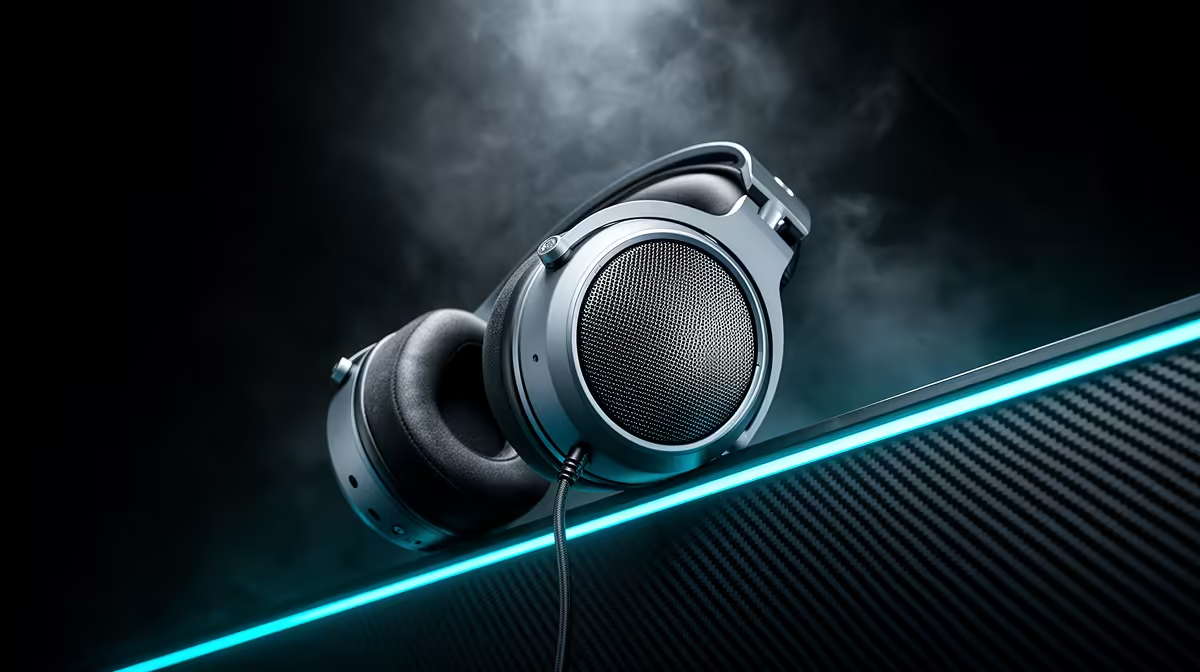
Hearing an enemy round a corner before you see them is often the difference between winning and losing a duel, and open-back headphones for competitive gaming give you that edge by widening the soundstage so directional cues sit precisely in space. The open earcup lets air move freely behind the driver, which spreads sound out instead of trapping it against your ears, making footsteps, reloads, and gunfire far easier to pinpoint than on a sealed gaming headset.
Quick Answer
For competitive FPS, open-back headphones like the Beyerdynamic DT 990 PRO, Sennheiser HD 599, DROP PC38X, or Audio-Technica AD700X give you a wider soundstage and sharper imaging than most closed-back headsets. Expect to spend roughly R2,000 to R6,000 depending on the model, with the AD700X and PC38X favoured specifically for positional accuracy.
Why open-back wins for positional audio
A closed-back headset seals the driver against your ear, which boosts bass and blocks outside noise but folds the soundstage inward so sounds feel close and stacked. An open-back design vents the rear of the driver, letting air and pressure escape so the stereo image opens up and gains depth. The practical result is that a footstep slightly behind and to your left reads as exactly that, rather than a vague "somewhere left." Imaging, the headphone's ability to place a single sound at a precise point, is what separates a good competitive can from a great one, and open-backs consistently lead here. The trade-off is that they leak sound both ways, so they suit a quiet room rather than a noisy shared space.
Soundstage versus imaging
These two terms get blurred but matter differently for gaming. Soundstage is the perceived width and space of the audio, the sense that sounds exist around you. Imaging is the precision of locating any one sound within that space. A huge soundstage with poor imaging tells you a sound is far away but not exactly where, which is useless for pre-firing an angle. The best competitive open-backs pair a wide stage with tight imaging, which is why models tuned for FPS often have a slightly brightened treble that makes footsteps and shell casings pop out of the mix.
The models worth your money
The Beyerdynamic DT 990 PRO is a long-standing favourite, with a bright, detailed sound and strong imaging that lets you place enemies accurately enough to pre-fire common angles in titles like CS2. Its treble lift makes high-frequency cues stand out, though some players find it sharp over long sessions. The DROP PC38X was tuned with direct input from the gaming community, pairing a wide open soundstage with a balanced signature and a built-in mic, which makes it one of the easiest all-in-one competitive picks. The Audio-Technica AD700X earns its reputation purely on positional accuracy, with a light, airy presentation built around locating sounds rather than impressing with bass.
Stepping up and stepping down
At the budget end, the Philips SHP9600 and Sennheiser HD 599 deliver genuine open-back staging and comfort for far less than the flagships, making them the smart entry point for a first competitive upgrade. At the top, the Sennheiser HD 800 S offers one of the widest soundstages available with reference-grade imaging, a choice for players who also want an audiophile listening headphone and have the budget for it. For most competitive players the sweet spot sits in the middle, where the PC38X and DT 990 PRO live.
What footsteps actually need from a headphone
Footsteps and other key cues sit in the upper-midrange and lower-treble, so a headphone that recesses those frequencies hides exactly the information you want. This is why bass-heavy closed headsets, however fun for music, can bury a creeping enemy under explosions and gunfire. Competitive open-backs lean the other way, keeping the midrange and treble forward so quiet cues survive in a busy mix. You do not need surround processing to benefit; clean stereo imaging on a good open-back outperforms most virtual surround on a sealed headset, because the hardware is doing the spatial work rather than software guessing at it.
Comfort over long sessions
Competitive play means hours on your head, so clamp force, earpad material, and weight matter as much as sound. Open-backs run cooler than sealed cups because air moves through them, which is a real advantage in a warm room. Velour pads stay more comfortable over long sessions than vinyl, and a lighter headphone reduces fatigue in extended matches. Try to weigh comfort alongside imaging, because the best-sounding headphone is no use if you take it off after an hour.
Picking the right one for your setup
Start with your room and budget. If you share a space or game near others, open-back leakage may be a problem, and you should weigh that honestly before buying. If you have a quiet room, decide between an all-in-one with a mic like the PC38X and a pure headphone you pair with a separate microphone, which is the route to the best raw audio. Most modern open-backs are easy to drive from a motherboard or controller, though the higher-impedance Beyerdynamic versions benefit from a small amplifier. Browse the full headphone and headset range to compare models side by side, and the headset best sellers are a fast way to see which competitive picks SA gamers are buying right now.
Frequently Asked Questions
Are open-back headphones really better for competitive gaming?
For positional audio, yes. The open design widens the soundstage and sharpens imaging, so footsteps and directional cues are easier to place than on most closed-back headsets. The trade-off is sound leakage and no noise isolation.
Do I need virtual surround sound with open-back headphones?
Usually not. Good stereo imaging on a quality open-back locates sounds more reliably than most virtual surround on a closed headset, because the spatial cues come from the hardware rather than software processing.
Which open-back is best purely for footsteps?
The Audio-Technica AD700X is widely praised for positional accuracy, and the Beyerdynamic DT 990 PRO's bright treble makes high-frequency cues stand out. The DROP PC38X balances strong imaging with an included mic.
Will people around me hear my open-back headphones?
Yes. Open-backs leak audio in both directions by design, so they suit a quiet, private room. In a shared space or noisy environment, a closed-back headset is the more practical choice.
Do open-back gaming headphones need an amplifier?
Most are easy to drive from a PC or controller. Higher-impedance models, such as the 250-ohm Beyerdynamic versions, reach their best volume and dynamics with a small headphone amplifier, while lower-impedance picks run fine straight off the motherboard.