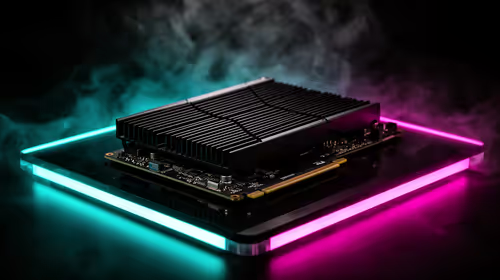
Building a machine for AI art is really a question about one number: how much VRAM the graphics card has. That figure decides which models you can run, at what resolution, and whether you can layer on the extras like ControlNet and LoRAs without running out of memory. Get the GPU right and the remaining components follow logically from that choice. Get it wrong and you will be staring at out-of-memory errors no amount of system RAM can fix.
Quick Answer
AI art builds scale by VRAM, not raw speed. A 12GB card is the practical entry point for SDXL, 16GB is the value sweet spot that runs quantised Flux comfortably, and 24GB or more unlocks Flux at full precision and local video work. For most SA buyers, a 16GB GPU paired with a modern CPU, 32GB to 64GB of RAM and a fast NVMe drive is the build that makes the most sense.
Why VRAM is the decision that matters
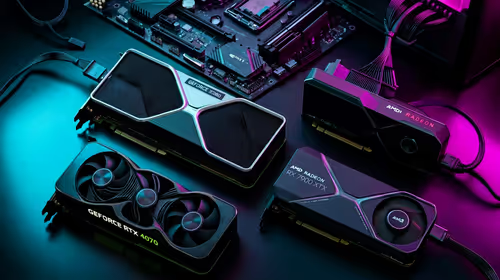
Image models load their weights into the graphics card's own memory. When the model weights and the image buffers together exceed that memory pool, you either cannot run the model or you fall back to painfully slow system-RAM workarounds. System RAM does not rescue you here, because the GPU needs the data on its own chip to work at speed. That is why a card's VRAM capacity, more than its clock speed, sets the ceiling on what you can create. The tiers below are built around that ceiling.
The budget tier: 12GB VRAM
A 12GB card is the cheapest starting point that lets you run local AI art honestly. It handles SDXL at 1024x1024 and the older SD 1.5 models without drama, which covers a huge amount of what people actually generate. The catch is speed and headroom: generations take longer, and you have less room for stacking heavy ControlNet and LoRA combinations at once. For a student or hobbyist testing the waters, it is a sensible, capable starting point rather than a compromise to regret.
Who the entry tier suits
This tier fits someone learning the tools, generating SDXL images for fun or side projects, and not yet running the newest, heaviest models. It is the lowest-risk way to find out whether local generation is for you before committing more budget.
The mid tier: 16GB VRAM
Sixteen gigabytes is the value sweet spot, and for good reason. It runs nearly every model worth using with room to spare for ControlNet, LoRAs and more involved workflows. Crucially, Flux in a quantised form drops to roughly 13GB, so a 16GB card opens the door to the Flux family that 12GB struggles with. Cards in this bracket give you meaningfully faster generations than the entry tier and enough headroom that you are rarely fighting memory limits.
Who the mid tier suits
This is the build for a serious hobbyist or working creator who wants Flux access, faster iteration and the freedom to run complex pipelines without constant memory juggling. For most people reading this, it is the recommended target.
The high tier: 24GB and beyond
At 24GB and up you stop compromising. This tier runs Flux at full FP16, handles multi-ControlNet pipelines, pushes to higher resolutions, and opens up local video generation, which is far hungrier than still images. The very top consumer cards now carry even more memory and the bandwidth to match, handling refiner pipelines and large outputs comfortably. This is professional territory, where the machine is part of your income rather than a curiosity.
Who the high tier suits
Full-time creators, studios and anyone doing local video or heavy batch work belong here. The cost steps up sharply, but so does the range of what you can produce without hitting a wall.
Building the rest of the machine
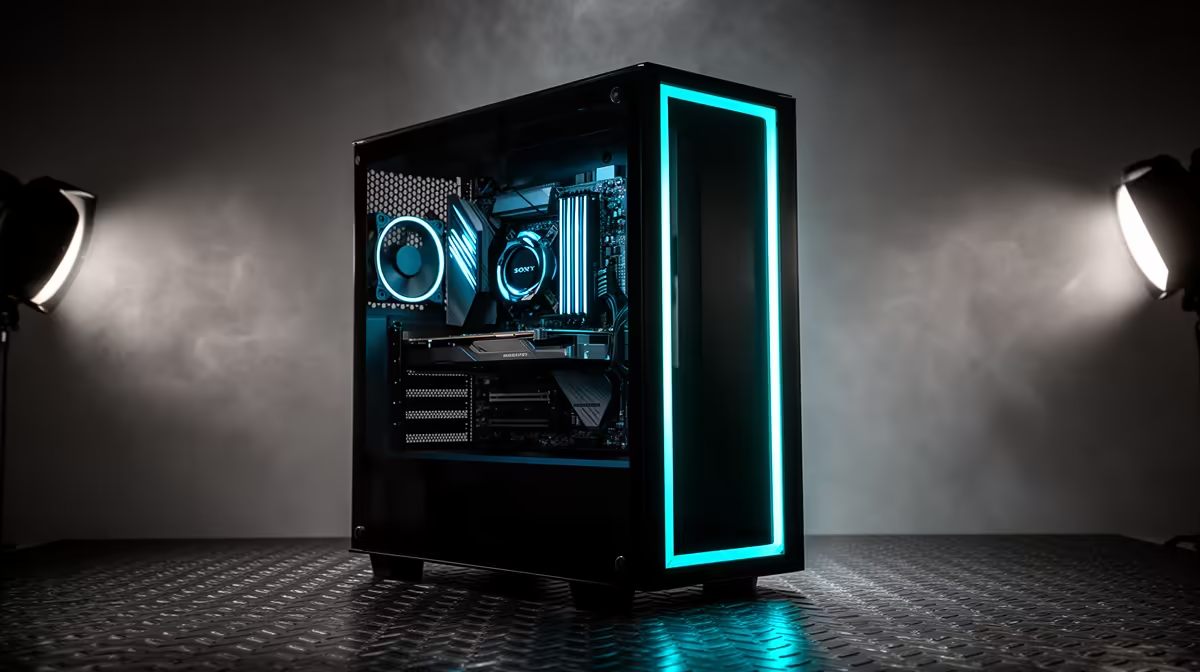
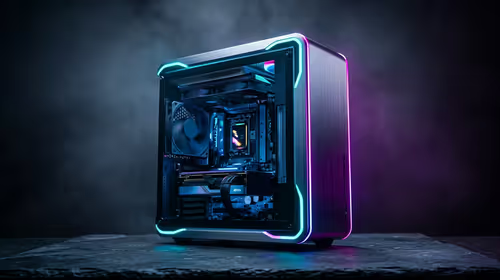
The GPU leads, but it needs support. Pair it with a current-generation CPU, 32GB to 64GB of system RAM so large workflows and the operating system are not starved, and a fast NVMe SSD because models are large files that load faster off quick storage. A properly rated power supply and a chassis with strong, active cooling close it out, since AI image workloads hold the GPU at close to full power for sustained periods. Every machine in the AI PC range at Evetech is specced with this GPU-first balance in mind, and the GPU best sellers list shows which cards SA creators are actually buying for the job.
What These Tiers Cost in SA
South African GPU pricing tracks the Rand-Dollar exchange rate, so figures shift with the currency, but the relative gap between tiers stays fairly constant. A 12GB entry card typically lands well under R15,000 for the GPU alone, making it accessible to students and hobbyists without stretching the budget. The 16GB mid tier sits in a broader band that varies by model and generation, but for current-generation cards with strong bandwidth the spend is noticeably higher than entry level. The 24GB-plus tier, the RTX 4090 and 5090, sits firmly in premium territory, where the price is a professional tool purchase rather than an enthusiast buy.
For a complete system rather than just the GPU, the total cost climbs with each tier as the power supply, cooling and case requirements scale up alongside the card. The most cost-effective way to build at each tier is to match the surrounding components to the GPU's requirements rather than over-speccing them. An 850W power supply is adequate for a 16GB mid-range card, whereas a 5090 build needs 1000W or more. Getting that right the first time avoids expensive swaps later.
Frequently Asked Questions
How much VRAM do I really need for AI art?
Twelve gigabytes is the practical minimum and handles SDXL. Sixteen is the recommended sweet spot and adds quantised Flux. Twenty-four or more is for professionals running Flux at full precision and local video. Match the tier to your workload, not the marketing.
Can I run Flux on a 12GB card?
It is a stretch. Flux is happiest from 16GB upward, where a quantised version fits comfortably around 13GB. On 12GB you will mostly be living in SDXL and SD 1.5 territory, which is still plenty for many users.
Does the CPU matter much for image generation?
Less than the GPU, but it still matters. A modern CPU keeps the pipeline fed and handles the surrounding work, and you want enough system RAM, 32GB to 64GB, so nothing chokes. The GPU does the heavy lifting, the rest stops it being held back.
Is local generation worth it over cloud services?
If you generate often, value privacy, and want to run any model and workflow you like without per-image costs, a local build pays off. For occasional, light use, the case is weaker. The break-even depends on how heavily you use it.
What about local video generation?
Video is far more demanding than stills and really wants 24GB or more of VRAM. If video is on your roadmap, build for the high tier from the start rather than upgrading later.
Decide your VRAM tier first, then build around it. Explore the AI PC range at Evetech for SDXL, Flux and video-ready configurations matched to South African buyers.