A million-polygon sculpt in ZBrush and a noisy Blender render that takes all night punish two completely different parts of a machine, and trying to save money by skimping on either one is how artists end up rebuilding their rig within a year. The best PC for 3D sculpting and rendering in South Africa balances a high-clock CPU, a generous RAM floor, and an RTX-class GPU with real VRAM, because sculpting leans on single-thread responsiveness and memory while GPU rendering hammers the graphics card and its onboard memory.
Quick Answer
For serious sculpting and GPU rendering, treat 32GB of RAM and an RTX GPU with 8GB or more VRAM as the floor, not the aspiration. A capable SA build sits above R20,000, and once you move into high-poly scenes or 4K texture work, a 16GB VRAM card and 64GB of system RAM become the sensible target. The single biggest mistake is buying a fast GPU paired with too little RAM.
Why sculpting and rendering stress different hardware
Digital sculpting in ZBrush or Blender's sculpt mode is largely about how quickly the machine responds when you drag a brush across a dense mesh. That responsiveness comes from a CPU with strong single-thread performance and from having enough RAM to hold the entire high-resolution mesh without spilling to disk. When you subdivide a model past a few million polygons, the working set grows fast, and a machine with only 16GB of RAM starts swapping, which turns a fluid brush stroke into a stutter.
GPU rendering is a different beast. Engines like Cycles, Redshift, and Octane push the scene onto the graphics card and let thousands of cores trace light in parallel. Here the two numbers that matter are raw GPU speed, which sets how fast each frame resolves, and VRAM capacity, which sets the ceiling on how complex a scene the card can hold at all. Run out of VRAM and the render either crashes or falls back to system memory at a fraction of the speed.
The RAM floor is non-negotiable
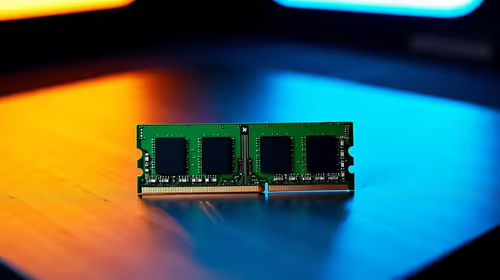
Thirty-two gigabytes is the practical minimum for a working sculpt-and-render machine. It lets you hold a dense mesh, keep reference images open, and leave a browser running without the system grinding. Sixty-four gigabytes is the upgrade that pays off the moment you composite multiple high-resolution sculpts in one scene or render with large texture sets. RAM is also one of the cheaper ways to extend a build's working life, so it is rarely the place to economise.
VRAM decides what you can render
An 8GB card comfortably handles single-character renders and moderate scenes. Push into environment work with high-resolution displacement maps and 4K textures and you will want 12GB to 16GB so the whole scene fits in graphics memory. A faster card with too little VRAM is a false economy for rendering, because the scenes you most want to render are the ones that overflow it.
Building the three tiers for SA budgets
Entry render rig, roughly R20,000 to R28,000
This tier pairs a current mid-range CPU with strong single-thread clocks, 32GB of RAM, and an RTX card carrying 8GB to 12GB of VRAM. It sculpts cleanly at a few million polygons and renders character work and product shots without complaint. It is the right starting point for a student, a freelancer finding their feet, or an artist whose scenes stay focused on single subjects rather than sprawling environments.
Mid tier, roughly R30,000 to R45,000
Step up to a higher core-count CPU, 64GB of RAM, and a 16GB VRAM GPU and the machine stops being a bottleneck for most commercial work. Sculpts hold their fluidity past ten million polygons, and renders that previously overflowed an 8GB card now stay resident in graphics memory. This is the sweet spot for a working professional who renders regularly and cannot afford to wait on the machine.
High tier, R50,000 and up
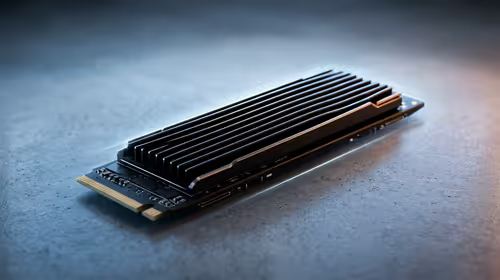
At the top you are looking at a flagship CPU, 64GB to 128GB of RAM, and a top-end RTX card with the most VRAM available. This tier suits studios, motion designers running long animation renders, and anyone whose scenes routinely push texture and geometry budgets to the limit. Storage matters here too, so a fast NVMe drive keeps scene loading and cache writes from becoming the new slow point.
CPU, cooling, and the parts buyers forget
The GPU gets all the attention, but a few supporting choices quietly decide how pleasant the machine is to use. The CPU should favour strong per-core performance, since most sculpting interaction and viewport work lean on a few fast cores rather than many slow ones. Cooling matters because long renders run the GPU and CPU at full load for hours, and a build that throttles under sustained heat loses real performance exactly when you need it.
Power supply headroom is the other overlooked detail. A high-VRAM GPU under a full render draws serious wattage, and a supply chosen with no margin leaves you no room to upgrade the card later. If you would rather skip the component-by-component decisions, the pre-configured desktops and workstations at Evetech are spec'd to hold up under sustained creative load, and pairing one with the right peripherals from the accessories and best sellers range rounds out a working studio setup.
Who each build is really for
A hobbyist learning Blender does not need a R50,000 machine, and pretending otherwise wastes money that would be better spent on training and reference. A freelancer billing clients, on the other hand, should treat render time as billable time, which makes the mid tier easy to justify. The studio tier earns its keep only when the machine is rendering most of the working day, since that is when the extra VRAM and cores convert directly into more finished frames.
Frequently Asked Questions
Is 16GB of RAM enough for 3D sculpting?
For light work and small models it scrapes by, but for serious sculpting it is not enough. Dense meshes and texture sets push past 16GB quickly, forcing the system to swap to disk and stutter. Treat 32GB as the floor.
Do I need a workstation GPU or is a gaming RTX card fine?
For most sculpting and rendering, a gaming RTX card delivers excellent value and speed. Workstation cards mainly add certified drivers and larger VRAM pools that matter for very large scenes, so the average artist is well served by a consumer RTX card with enough memory.
How much VRAM do I need for 4K texture rendering?
Plan for 12GB to 16GB once you work with 4K textures and high-resolution displacement. Scenes built around that level of detail overflow an 8GB card and force a slow fall-back to system memory.
Will more CPU cores speed up GPU rendering?
Not directly. GPU rendering runs on the graphics card, so extra CPU cores mainly help with scene preparation, simulation, and CPU-based render passes. Spend on the GPU first if rendering is your priority.
What is a sensible starting budget in South Africa?
A capable entry build that genuinely handles sculpting and rendering starts above R20,000. Below that you are compromising on either RAM or VRAM, both of which are the parts you least want to cut.
Spec the machine to the work you actually do, not the work you imagine, and let render time become billable time. Browse the render-ready desktops and workstations at Evetech and build a rig that holds its fluidity from the first brush stroke to the final frame.