


PCIe 5.0 vs PCIe 4.0 for Strategy and Sim Games in SA
PCIe 5.0 and PCIe 4.0 differ most in lane support, compatibility, and upgrade value for strategy and sim games. SA buyers should match the choice to their actual hardware and games.
Read moreThe best value 4K streaming webcams under R3000 in South Africa pair a 4K30 sensor with autofocus and a usable mic, skipping STARVIS and HDMI extras. At this price expect a standard CMOS 4K cam that shines in good light but needs lamps.
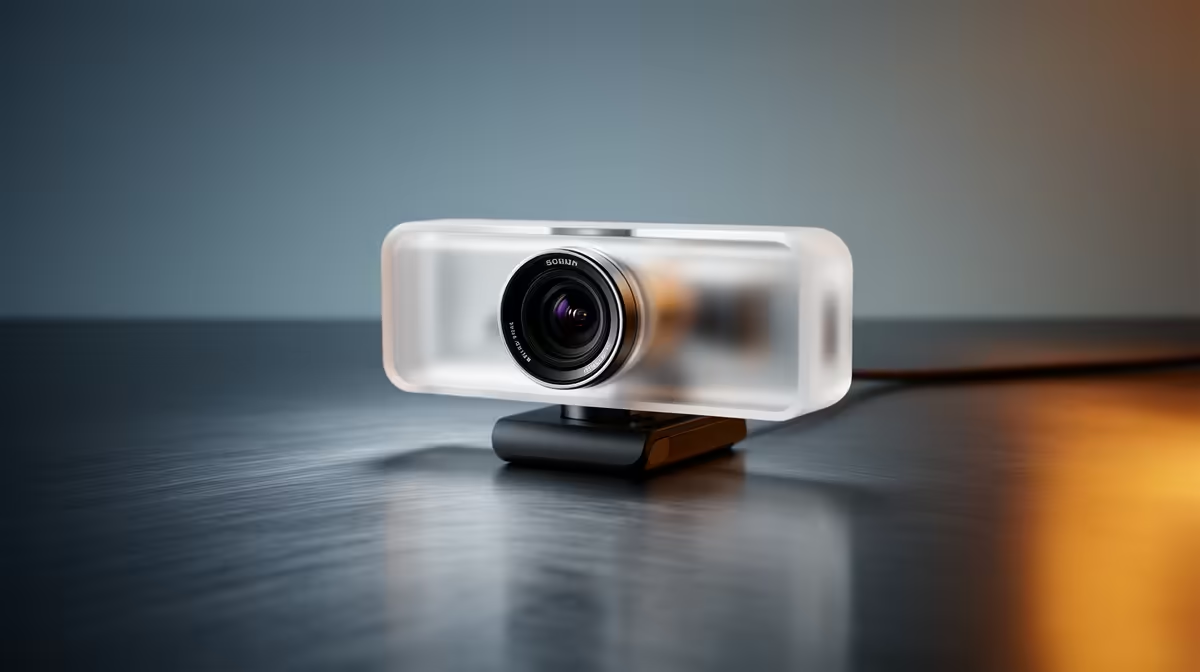
The 4K label on a sub-R3,000 webcam is not misleading exactly, but it does carry expectations the price tier cannot fully support. What you are buying at this range is a 4K30 sensor in a housing that skips the optical and electronic extras that make 4K genuinely useful in low light or fast motion. Knowing which compromises are acceptable and which will frustrate you is the difference between a smart buy and an expensive disappointment. Best value 4K streaming webcams under R3,000 in South Africa are real, and some perform impressively -- but they reward buyers who understand what the sensor needs to work well.
Under R3,000 you get a standard CMOS 4K30 sensor with autofocus and a basic integrated mic. Low-light performance is limited without added lighting. The STARVIS back-illuminated sensors and HDMI output options that unlock better low-light capability appear in higher price brackets. In good light this tier delivers genuine 4K detail at a strong price point.
At this price point the sensor itself is a standard CMOS chip capable of capturing 3840 x 2160 pixels at 30 frames per second. That resolves significantly more detail than a 1080p sensor, which matters for creators who want to punch in and crop to a tighter shot in post-production without losing sharpness, or for conference calls where text on a whiteboard behind you needs to be legible.
The autofocus system at this range is usually contrast-detection rather than phase-detection, which means it is accurate but takes a fraction longer to lock when you move. For a static or near-static talking head, that difference is unnoticeable. For a presenter who moves back and forward frequently, a touch more hunting is visible.
Built-in microphone quality at this tier is functional for calls and adequate for casual streaming, but the capsule size and placement are not built for recording. Expect a usable but thin sound that handles meetings well and falls short for podcast or voiceover work.
The frame at R3,000 and under will also typically be plastic, with a standard clip-and-swivel mount that sits on a monitor bezel or laptop screen. Tripod-thread mounts appear on some models, which is worth checking if your setup uses a dedicated camera position.
Standard CMOS sensors at this price tier require roughly 400 lux of incident light to produce a clean, low-noise image at 4K30. That is approximately the light level of a well-lit home office during the day, or a room with two desk lamps directed at the subject.
The sensors that perform better in dimmer conditions -- typically BSI-CMOS or Sony STARVIS variants -- add meaningful cost. Below R3,000, you will encounter standard CMOS designs that push the gain circuit hard in dim light, and pushing gain introduces the luminous grain that makes a face look muddy and undefined on screen.
The practical fix for a South African home setup where natural light is inconsistent, particularly in coastal cities where overcast skies are frequent, is a dedicated key light. The lux level a standard CMOS needs is well within reach of an affordable LED panel or ring light sitting between R400 and R700 -- enough output to lift the sensor out of noise territory without pushing the combined spend over R3,000. A R2,200 webcam plus a R600 key light is still under R3,000 and will produce a cleaner image than a R3,500 camera without any added light.
4K30 is a 4K capture at 30 frames per second. For a seated, largely static streaming or meeting use case this is fine -- head movements and gestures are smooth enough. For gaming facecams where fast reactions and expressions matter, 1080p60 on the same camera is often a better choice if the model supports it.
Most cameras in this range offer multiple output modes. The 4K30 and 1080p60 modes draw on the same sensor, but 1080p60 provides twice the temporal resolution, which means fast motion stays cleaner. If your content involves quick movements, checking whether the model allows switching between these modes is worth doing before purchase.
In well-lit conditions -- a north-facing room in Joburg getting full winter sun, or a home office with overhead lighting supplemented by a desk lamp -- a sub-R3,000 4K webcam can genuinely challenge cameras at much higher price points. The sensor captures the resolution, the autofocus keeps the face sharp, and the output file or stream is visibly sharper than a 1080p comparison at the same viewing size.
For creators building an audience at the beginning of their journey, this tier hits the meaningful quality threshold without the investment a higher-end camera requires. The 4K resolution gives you post-production flexibility: crop to a 1080p window within the frame, adjust the framing without touching the camera, or output at full 4K to a platform that supports it.
For remote work contexts -- the many South African professionals now working from home in Cape Town, Durban, or Pretoria -- a 4K webcam at this range elevates the professional impression on video calls without the price that previously made 4K hardware feel like a creative luxury.
When evaluating a sub-R3,000 4K webcam, look for the native sensor resolution in the spec sheet rather than relying on the headline 4K claim. Some cameras label their output as 4K but use interpolation from a lower-resolution native capture, particularly at 4K60. True native 4K30 on a standard CMOS is what you want at this price.
Given the constraints of this tier, the hierarchy of features that actually matter in practice runs roughly as follows.
Autofocus quality ranks highest. A reliable autofocus that keeps your face sharp through normal movement is more visible to your audience than any resolution difference. A 4K camera with poor or slow autofocus will look worse on stream than a sharp 1080p camera that locks instantly.
Field of view comes second. An 80 to 90-degree FOV suits most solo desk setups without distorting the edges of the image. Wider angles are available at this tier but often introduce noticeable barrel distortion at the corners, which is less flattering on a facecam.
Low-light performance ranks third. Knowing the sensor type helps here -- BSI-CMOS beats standard CMOS in dim conditions -- but at this price point planning to add a basic key light is more reliable than banking on a sensor specification you cannot easily verify.
Microphone quality is last. It will be adequate. If audio quality matters to you, a separate USB microphone is a better investment than paying more for a webcam with a marginally better built-in capsule.
Expect a native 4K30 capture at 3840 x 2160 pixels. Some models also offer 1080p60 and 720p modes using the same sensor, which is useful for switching between detail-focused and motion-focused outputs. Verify whether the 4K mode is native capture or interpolated, as interpolated 4K is a marketing label rather than a genuine resolution upgrade.
In most South African home setups, yes. Standard CMOS sensors at this price tier produce their best output at around 400 lux of even illumination. An affordable LED panel or ring light sitting between R400 and R700 delivers the illumination consistently and makes a larger visible difference than almost any other single upgrade at this stage.
For most streaming content, yes. Autofocus that keeps your face sharp as you move matters more to your viewer's experience than pixel count. Platforms also compress facecam feeds heavily, so the difference between 4K and 1080p is less visible after compression than it is on the raw capture.
A basic key light for dim rooms, and potentially a short desk stand or monitor clip depending on your setup. If audio quality matters, a separate USB microphone is a worthwhile addition. Beyond that, a webcam at this tier is genuinely standalone for casual streaming and meetings.
In well-lit conditions, yes. With adequate lighting around 400 to 500 lux, a good camera at this price point delivers a clean, sharp 4K30 feed that performs competitively against more expensive hardware. The gap widens in low light, where the missing BSI sensor or STARVIS technology becomes apparent.
Ready to step up your stream quality without overspending? Browse the 4K streaming webcam range for South African creators and remote workers, and find a model that gives you genuine resolution at a price that makes sense.
Expect a native 4K30 capture at 3840 x 2160 pixels. Some models also offer 1080p60 and 720p modes using the same sensor, which is useful for switching between detail-focused and motion-focused outputs. Verify whether the 4K mode is native capture or interpolated, as interpolated 4K is a marketing label rather than a genuine resolution upgrade.
In most South African home setups, yes. Standard CMOS sensors at this price tier produce their best output at around 400 lux of even illumination. An affordable LED panel or ring light sitting between R400 and R700 delivers the illumination consistently and makes a larger visible difference than almost any other single upgrade at this stage.
For most streaming content, yes. Autofocus that keeps your face sharp as you move matters more to your viewer's experience than pixel count. Platforms also compress facecam feeds heavily, so the difference between 4K and 1080p is less visible after compression than it is on the raw capture.
A basic key light for dim rooms, and potentially a short desk stand or monitor clip depending on your setup. If audio quality matters, a separate USB microphone is a worthwhile addition. Beyond that, a webcam at this tier is genuinely standalone for casual streaming and meetings.
In well-lit conditions, yes. With adequate lighting around 400 to 500 lux, a good camera at this price point delivers a clean, sharp 4K30 feed that performs competitively against more expensive hardware. The gap widens in low light, where the missing BSI sensor or STARVIS technology becomes apparent.
PCIe 5.0 and PCIe 4.0 differ most in lane support, compatibility, and upgrade value for strategy and sim games. SA buyers should match the choice to their actual hardware and games.
Read more
AM5 vs AM4 for video editing in 4K Difference explained is mostly about compatibility, budget, upgrade path, and setup fit. SA buyers should check device support and real needs before expecting a clear win from either option.
Read more
OLED vs QD-OLED for strategy and sim games buyers - what changes is mostly about compatibility, budget, upgrade path, and setup fit. SA buyers should check device support and real needs before expecting a clear win from either option.
Read more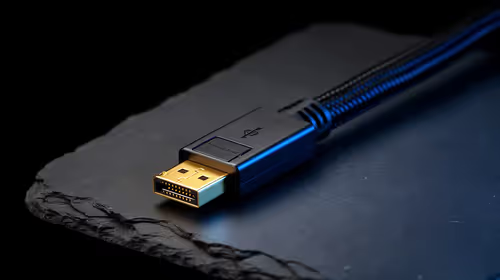
DisplayPort 2.1 and 1.4 differences matter when SA PC builders match GPUs, monitors, and refresh targets. Use this difference between displayport 2 1 and displayport 1 4 explained pc builders guide to avoid mismatched parts.
Read more
Ray tracing vs Path tracing depends on Strategy and sim games needs, platform limits, and budget fit. Compare compatibility, latency, upgrade path, and real setup constraints before choosing for an SA build.
Read more
wireless mouse guide for Gqeberha gamers should be shortlisted around the job it must do. South African buyers should compare sensor, shape, weight, and wireless latency, warranty path, and upgrade room before treating any pick as best.
Read more
From 1 October 2026, WhatsApp Business Platform service replies in South Africa are expected to cost about $0.0076, or 12 cents, per delivered message.
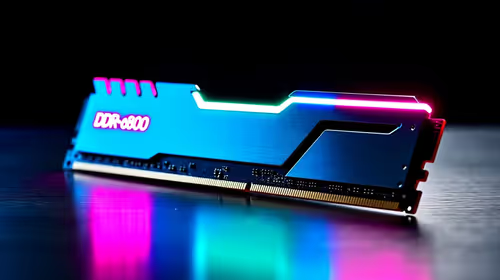
DDR5-8000 RAM Kits pros and cons depend on the build, budget, and workload. Weigh gaming needs, platform fit, power, cooling, warranty support, and South African pricing context before shortlisting it.
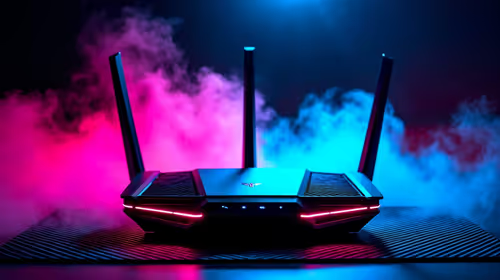
Wi-Fi 6E vs Wi-Fi 6 depends on AAA single-player gaming needs, platform limits, and budget fit. Compare compatibility, latency, upgrade path, and real setup constraints before choosing for an SA build.

Ryzen 9 9950X3D dead pixel checks should isolate the panel first. Run colour fills, inspect the monitor menu, test another cable or input, and capture proof before linking it to the SA CPU upgrade.

YouTube will count public views from the first frame across video formats from 24 August, while earnings and eligibility remain tied to engaged viewing.
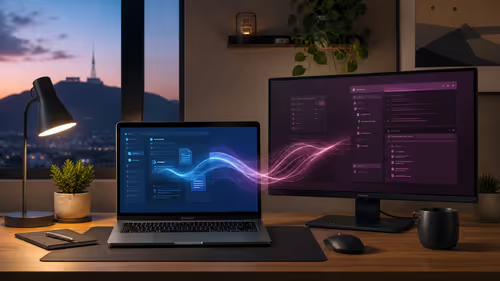
Canonical expects Ubuntu on WSL users to outnumber native Ubuntu desktop users before the end of 2026. The software is open source and runs inside supported Windows PCs.
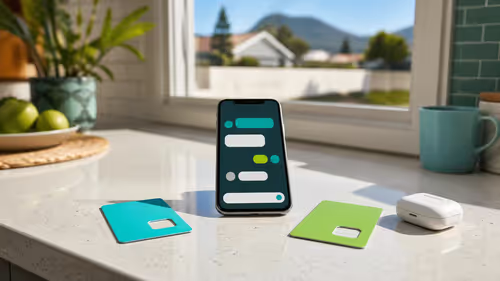
Telkom's daily bundles pair WhatsApp access with 10 all-network voice minutes. The R15 option includes 300MB, while the R17 option uses a fair-use threshold.

A 10,000-hour test found similar image retention across older and newer OLED TVs, while newer panels were brighter and more efficient. Local OLED monitors started at R9,999.

Windows 11 update KB5121003 is linked to crashes in several multiplayer games on versions 24H2 and 25H2. Check the build, report the fault and avoid risky file or update changes unless the problem is confirmed on your PC.

Comsol's standalone 5G network covers about one million Gauteng homes and starts commercial ISP service in September. Early packages range from R275 to R875 a month, but coverage and fair-use rules still decide the real value.

Sennheiser's Momentum True Wireless 5 adds user-replaceable batteries, 12-hour playback and a $299.95 launch price. There is no confirmed South African date, so compare longevity with live earbuds from R199 to R2,999.

AVerMedia's GC531 and GC535 are professional HDMI capture devices for continuous streaming, with RGB24 capture up to 2K30 and 4K30. South African creators should compare them with live 4K capture cards from R2,099.