Zoom numbers on streaming cameras have been climbing steadily, and 40X looks impressive on a spec sheet. What that figure actually means in terms of image quality depends entirely on understanding that 40X hybrid optical zoom is not a single optical achievement. It is two separate stages working in sequence, with the quality ceiling dropping sharply once the glass runs out of room and the electronics take over.
Quick Answer
A 40X hybrid zoom works in two stages: the glass lens groups move to about 12X optical magnification, then an AI processing layer extends the reach digitally toward 40X. Optical quality holds well through the first stage; sharpness decreases from the digital stage onwards because the AI is reconstructing detail the optics can no longer capture.
🔧 The Mechanical Stage: How Moving Glass Produces Optical Magnification
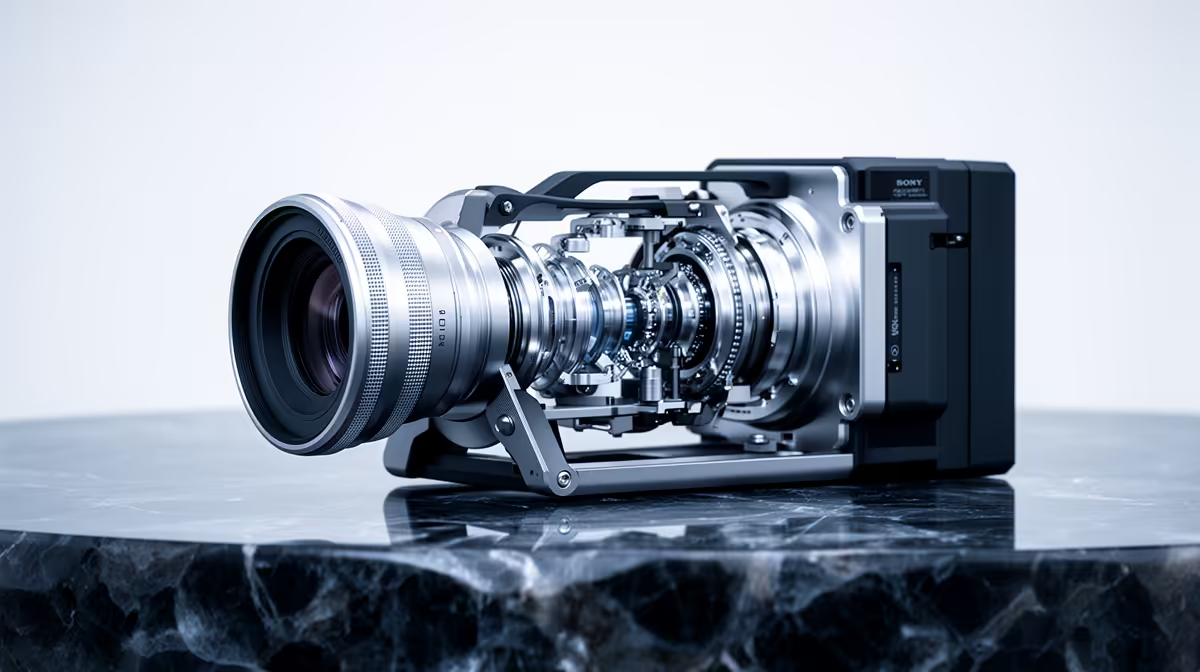
The optical part of the zoom is entirely physical. Inside the barrel are multiple groups of glass elements, each set of elements moving along a track as the zoom control is operated. When those groups slide toward each other, the effective focal length of the lens lengthens, and the angle of view narrows. The subject appears larger in the frame not because the image is being stretched, but because the lens is genuinely collecting a smaller slice of the scene.
This is the stage where zoom is essentially free of quality cost. The image the sensor receives is an optically magnified view, and the resolution, sharpness, and contrast are bounded only by the quality of the glass elements and how well the optical design handles the full range of focal lengths. For broadcast streaming cameras with a 40X hybrid specification, the pure optical travel typically extends to around 12X magnification.
A stepper motor drives the lens group movement, taking input from the zoom rocker on the camera body or from a remote control command. On a camera designed for streaming, the motor is calibrated to return to a saved zoom position reliably, typically within about a second. That recall speed matters for live production where a cut requires the camera to hit its mark without hunting.
Focus Behaviour Through the Optical Range
Continuous autofocus tracks the subject throughout the optical zoom range. As the focal length changes, the depth of field narrows and the focus distance shifts, and the autofocus system reruns its calculation to keep the subject sharp. On cameras designed for streaming, this relock typically happens within roughly 0.3 seconds of a zoom move, which is fast enough to stay transparent to a watching audience. The subject holds sharp through the optical range without the operator needing to intervene.
⚡ Where Optical Ends and AI Extension Begins
At around 12X, the physical lens groups reach the limit of their designed travel. The glass cannot magnify further without an optics redesign that would increase the size and cost of the lens significantly. From that point, the camera's internal processing takes over.
Digital zoom at its most basic is simply cropping the image and enlarging the crop to fill the frame. That process degrades image quality quickly because it throws away the pixels outside the crop rather than collecting more detail from the scene. A camera rated at 40X using basic digital zoom will look noticeably soft beyond 12X, and that softness compounds as the factor rises.
AI-assisted extension works differently. Rather than simply enlarging a crop, the AI processing analyses the image content and reconstructs texture and edge detail that the sensor data alone would not support at the requested magnification. It does not recover information the lens never collected, but it uses learned patterns to estimate what the missed detail should look like, producing an output that retains perceived sharpness further into the digital range than a simple enlargement would.
The result is that image quality in the 12X to 40X range is real and usable for streaming, particularly at 1080p output where the AI reconstruction has a relatively low resolution target to hit. At the far end of 40X, fine detail is estimated rather than optically resolved, which is why scrutinising a still frame at maximum zoom looks softer than the optical range does.
Pro Tip ⚡
For broadcasting stage events or presentations in a large Cape Town or Joburg venue, use the optical range for your primary cuts and reserve 30X to 40X for reaction shots or brief detail moments. The audience on a stream never sees the softness in a short-duration close-up, but a sustained 40X shot gives the AI stage more time to show its limitations.
🚀 Focus Tracking Through the Full Range
The autofocus system runs across both stages, but its confidence changes as the AI layer engages. In the optical range, the system works from a clearly resolved image and tracking is fast. In the digital extension range, the reconstructed image data is less definitive, and the system can hunt slightly on fine edges or low-contrast subjects at maximum magnification.
For broadcast subjects with clear contrast against their background, such as a presenter on stage or a competitor at a desk, the autofocus tracks reliably through to 40X. Low-contrast or fast-moving subjects at maximum zoom are edge cases for most streaming scenarios, but worth knowing before relying on autofocus at full extension for a demanding event.
🎯 Practical Streaming Applications for Each Zoom Stage
Understanding where the optical and digital stages sit changes how a camera is positioned for a broadcast.
For a stage event at a medium venue, the optical range to about 12X handles most of the work: wide establishing shots, medium speaker coverage, and close-in reaction frames. The camera sits further back from the stage and still reaches it comfortably in the optical range, keeping quality at its peak for the angles that carry the most broadcast time.
The digital extension range earns its place for brief detail shots or distant subjects outside comfortable optical reach. Those are punctuation moments in a broadcast, not continuous coverage. For a camera mounted at the back of a large Joburg or Cape Town venue, the full 40X reach provides options a fixed lens simply cannot offer, and the AI reconstruction makes those shots broadcastable rather than just technically available.
Frequently Asked Questions
What is actually moving inside a 40X hybrid optical zoom?
Groups of glass lens elements travel along a barrel track, changing the effective focal length as they move. A stepper motor takes commands from the zoom control or from remote input. This physical glass movement is the optical stage, typically running to about 12X before reaching the end of its designed travel.
At which point does the digital AI stage take over?
At roughly 12X, the lens groups reach their physical limit. Past that point, the camera's AI processing extends magnification digitally, reconstructing detail the glass can no longer resolve. The transition is gradual and the camera presents a continuous zoom feel throughout the full range.
Why does the image soften at maximum zoom?
Beyond 12X, the AI generates texture and edge detail from learned patterns rather than optical data the sensor actually captured. The reconstruction is convincing at typical streaming resolutions and for brief shots, but it is an estimate. Scrutinising a still frame at 40X shows the limits more clearly than watching motion video does.
Does the autofocus work reliably at maximum digital zoom?
For subjects with clear contrast against their background, yes. The system relocks within roughly 0.3 seconds of a zoom move. At maximum magnification with low-contrast subjects, some hunting can occur because the AI-reconstructed image is less definitive than optical data. For typical stage and broadcast subjects, the system performs well in practice.
Does a hybrid zoom camera weigh more than a fixed lens?
Slightly. Moving glass groups and the stepper motor add weight compared to a fixed prime. For streaming where the camera sits on a tripod, that extra mass is not a practical concern, and tripod mounting is the natural home for a zoom camera of this reach anyway.
Ready to cover a venue from any distance?
Browse the streaming camera range featuring hybrid optical zoom and see which focal length reach suits your broadcast position, whether you are front of stage or back of room.