


PCIe 5.0 vs PCIe 4.0 for Video editing in 4k in SA
PCIe 5.0 vs PCIe 4.0 for video editing in 4k is mainly about fit, features, compatibility, cost, and upgrade path, not one automatic winner. SA buyers should match the choice to the setup.
Read moreFor wireless recording, a built-in battery streaming light frees you from outlets and cables, typically running 1 to 3 hours on a 2000mAh cell. An AC powered light never dies mid-take and holds full brightness, so it suits long static desk streams.
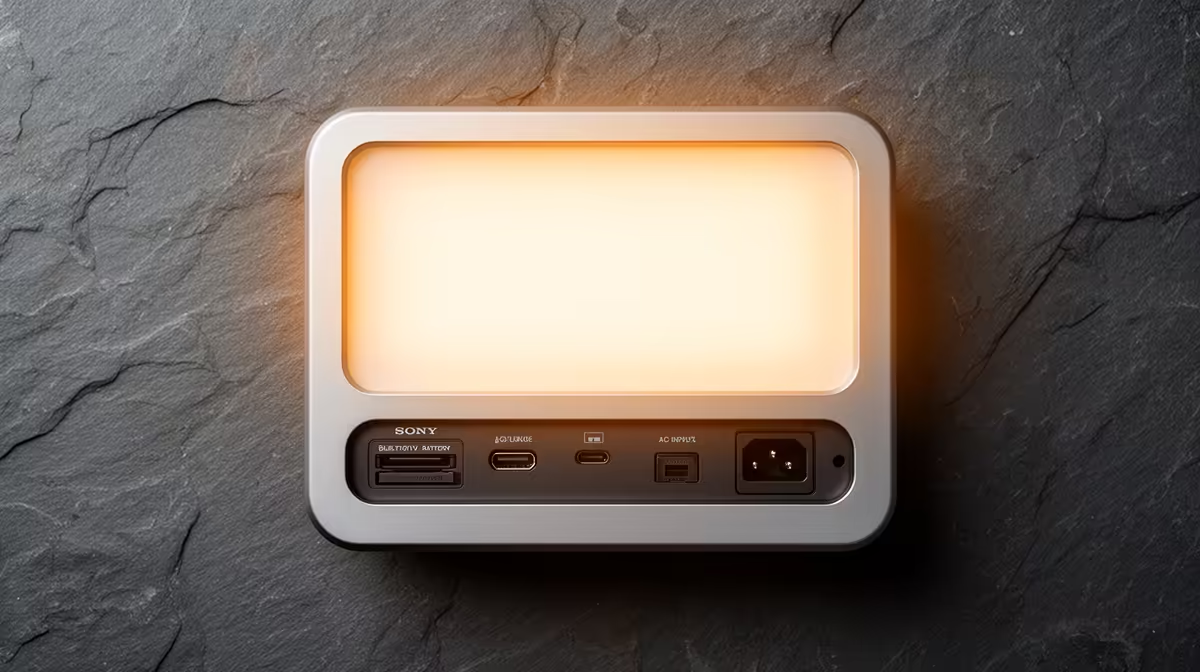
The power cable that runs from your desk light to the wall socket is invisible until it matters. On a short gaming stream it is not an issue. On a four-hour creative session, a remote shoot, or a vlog day out in the field, it becomes the detail that determines whether you get the content or come home with half a shoot and a depleted cell. Built-in battery versus AC powered streaming lights for wireless recording is a genuine trade-off, and the right side of it depends almost entirely on how long you record and where.
Battery-powered streaming lights free you from any fixed power source and suit roaming, outdoor, and travel shoots. AC-powered lights hold full brightness without interruption, making them the better pick for long desk streams or static studio setups where a mains outlet is always within reach.
A built-in battery on a compact streaming light typically measures between 2000mAh and 4000mAh depending on the panel. At 1080p-level brightness for a talking-head distance of 60 to 90 centimetres, a 2000mAh cell provides roughly one to two and a half hours of useful runtime at full power. Half-power operation often stretches that to two to four hours, which covers most vlogging sessions, short-form video shoots, and single-subject interview setups.
The freedom this buys is worth something concrete. A battery light on a cold shoe mount or small gorilla-style tripod travels without requiring a power outlet, an extension lead, or a nearby wall. For a South African creator shooting at a market in Joburg, a coffee shop in Sea Point, or a client's office in Durban, the ability to set up and shoot anywhere is the entire value proposition. There is no negotiating with the venue about outlet availability or trailing cables through a customer area.
Battery lights also suit outdoor shoots where AC is not an option. Overcast daylight handles most exterior footage, but a small battery fill pointed at a subject's face removes harsh contrast from uneven cloud cover and holds natural skin tones across the shot.
The practical constraint is that the cell has a finite charge, and a depleted panel mid-shoot is not recoverable on location. Managing this means knowing your runtime at the brightness level you actually use and building a shooting schedule that either stays within that window or includes a charging break.
Many battery streaming lights support pass-through charging via USB-C, which changes the calculation. A power bank in a bag connected to the light via a short cable keeps the panel powered indefinitely while also maintaining the cell charge. This effectively turns a battery light into an AC-powered light anywhere a USB-C power bank reaches, which is most locations in practice.
For a fixed desk setup running a gaming stream or live broadcast for three or more hours, mains power is the correct choice and the discussion largely ends there. A 2000mAh cell at full brightness cannot cover a three-hour session, and the workarounds required to extend it add complexity to a setup that should be as reliable as possible during a live broadcast.
An AC-powered panel draws from the mains continuously and holds its full rated brightness from the first minute to the last. There is no voltage sag, no brightness reduction as charge drops below 20 percent, and no mid-broadcast interruption to address a depleted battery. For a streamer whose setup does not move, those properties are simply more valuable than portability.
AC lights are also typically brighter at equivalent wattage because they are not constrained by what a battery can deliver. A panel drawing directly from mains power has consistent, unrestricted energy available and can run higher-output LEDs than a battery-fed equivalent at the same price point.
If you run a fixed desk stream and also want a portable option for occasional location work, consider an AC panel for the desk and a small, separate battery panel for field use rather than a compromise product that does both moderately. Desk lighting and location lighting have different requirements, and two purpose-suited tools outperform one general-purpose one in both scenarios.
Several streaming lights occupy a middle position by including both a built-in battery and a USB-C input that allows simultaneous charging and operating. This means the panel can run on mains via a USB-C power adaptor with no battery involved, and when you disconnect it for a mobile shoot, the charged cell takes over immediately.
This is genuinely useful if you want one piece of hardware that transitions between a desk setup and location work. The ceiling on the battery runtime is still defined by the cell size, so a 2000mAh pass-through model on a long stream will eventually rely on the adaptor. But for a creator who does some desk work and some location work, the pass-through option removes the need to own two separate panels.
The trade-off is that pass-through models cost slightly more than battery-only or AC-only panels, and the cell ages with use, so battery capacity will reduce over time even if the AC input remains unaffected.
A live esports commentator at a desk for five hours needs AC. A vlogger covering Cape Town street food markets for an afternoon needs battery. A content creator who does two tutorials per week from a home setup and one interview per month at a client's office is the pass-through case.
Cable management on a desk is a separate argument for battery power even in AC-range situations. A battery panel on a small mount or arm can position freely without a power cable routing concerns, which matters when a compact desk has multiple peripherals already occupying cable real estate. For some setups, the battery is not about location freedom but about keeping the desk tidy.
A 2000mAh cell at full brightness typically delivers one to two and a half hours of runtime. Half brightness extends this to roughly two to four hours. The exact figure depends on the panel's power draw and LED efficiency. For sessions beyond three hours, AC power or a USB-C power bank on a pass-through-capable light is more reliable than relying on the cell alone.
Yes, consistently. Mains power provides unrestricted energy throughout the session, while a battery panel can show a slight brightness reduction as the cell charge drops toward 20 percent. The difference is often subtle until the cell is low, but for precise lighting setups where output consistency matters, AC avoids the variable entirely.
On panels that support pass-through charging, yes. The light operates on the incoming USB-C power while the cell simultaneously charges or maintains charge. Not all battery streaming lights support this; check the specification before assuming it is available. On panels without pass-through, the light typically cannot be used while charging.
Battery power. An AC light adds a power cable from the panel to a wall outlet or power strip, which is one more cord in a desk environment that often already has multiple peripherals, cables, and data connections. A battery panel adds no cable at all during operation, and only a short USB-C cable during charging that can happen off-desk between sessions.
Yes, with the caveat that heat accelerates battery self-drain and capacity degradation over time. Store the panel in shade between shots rather than in direct sun, and avoid leaving the light in a hot car before a shoot. At typical outdoor operating temperatures, the cell performance is normal. The risk is prolonged storage in high heat, not short-term use.
Ready to choose the streaming light that fits how you actually shoot? Browse the streaming light range to compare battery and AC-powered panels across output, runtime, and price points suited to South African creators.
A 2000mAh cell at full brightness typically delivers one to two and a half hours of runtime. Half brightness extends this to roughly two to four hours. The exact figure depends on the panel's power draw and LED efficiency. For sessions beyond three hours, AC power or a USB-C power bank on a pass-through-capable light is more reliable than relying on the cell alone.
Yes, consistently. Mains power provides unrestricted energy throughout the session, while a battery panel can show a slight brightness reduction as the cell charge drops toward 20 percent. The difference is often subtle until the cell is low, but for precise lighting setups where output consistency matters, AC avoids the variable entirely.
On panels that support pass-through charging, yes. The light operates on the incoming USB-C power while the cell simultaneously charges or maintains charge. Not all battery streaming lights support this; check the specification before assuming it is available. On panels without pass-through, the light typically cannot be used while charging.
Battery power. An AC light adds a power cable from the panel to a wall outlet or power strip, which is one more cord in a desk environment that often already has multiple peripherals, cables, and data connections. A battery panel adds no cable at all during operation, and only a short USB-C cable during charging that can happen off-desk between sessions.
Yes, with the caveat that heat accelerates battery self-drain and capacity degradation over time. Store the panel in shade between shots rather than in direct sun, and avoid leaving the light in a hot car before a shoot. At typical outdoor operating temperatures, the cell performance is normal. The risk is prolonged storage in high heat, not short-term use.
PCIe 5.0 vs PCIe 4.0 for video editing in 4k is mainly about fit, features, compatibility, cost, and upgrade path, not one automatic winner. SA buyers should match the choice to the setup.
Read more
Wi-Fi 7 vs Wi-Fi 6e for competitive esports comes down to router support, latency goals, device compatibility, and coverage. SA buyers should match the choice to the real network setup.
Read more
ATX 3.1 vs ATX 3.0 for mMO and live-service games buyers - what changes is mostly about compatibility, budget, upgrade path, and setup fit. SA buyers should check device support and real needs before expecting a clear win from either option.
Read more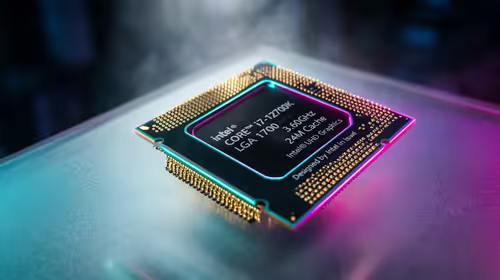
LGA 1851 vs LGA 1700 can affect Twitch and YouTube streaming when gaming and encoding share CPU resources. For SA creators, the real-world difference depends on encoder choice, memory support, motherboard cost, thermals, and upgrade plans.
Read more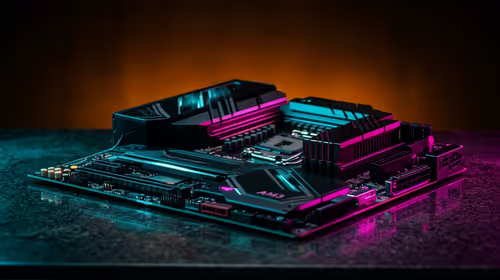
X870E vs X670E for aaa single-player gaming is mainly about fit, features, compatibility, cost, and upgrade path, not one automatic winner. SA buyers should match the choice to the setup.
Read more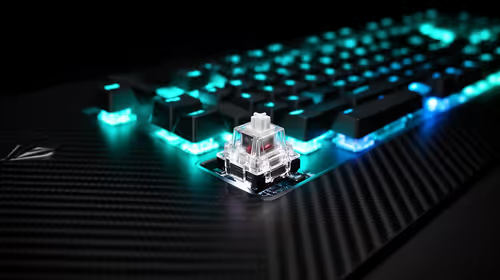
Hall Effect switches vs Mechanical switches for mMO and live-service games is mostly about compatibility, budget, upgrade path, and setup fit. SA buyers should check device support and real needs before expecting a clear win from either option.
Read more
A fake 113GB GTA VI ISO reportedly used empty padding around a small malware payload. SA gamers should delete unofficial builds, keep Windows security active and wait for official channels.

Wi-Fi 6E vs Wi-Fi 6 matters for 4K video editing when files move across a network. The real-world difference between Wi-Fi 6E and Wi-Fi 6 for video editing in 4K depends on NAS access, cloud uploads, router range, and SA creator workflows.

The difference between PCIe 5.0 and PCIe 4.0 for SA gamers is mostly bandwidth headroom. Compare GPU slot needs, NVMe speed, motherboard support, and upgrade timing before paying extra for a newer platform.

Gaming PC stuck pixel checks in South Africa should confirm the monitor fault first. Use colour tests, screenshot comparison, cable swaps, display menu checks, and clear photos before deciding on support.

Shokz OpenFit Air 2 earbuds weigh 7.2g each and use a redesigned dual-driver open-ear layout. SA buyers should choose them for comfort and awareness, not maximum isolation.

AMD's current driver now lists a Radeon RX 9050 4GB, while product coverage details a narrowed memory system. SA buyers should weigh the low VRAM ceiling against current local Radeon options.

Samsung Display has demonstrated a 16-inch 2.5K OLED laptop panel running at 300Hz. SA buyers should wait for a named notebook, full panel specifications and a local price before planning an upgrade.

Microsoft says some Windows 11 game crashes after recent updates are linked to RGB-related drivers. Affected SA gamers should confirm the update and driver before using the published registry workaround.
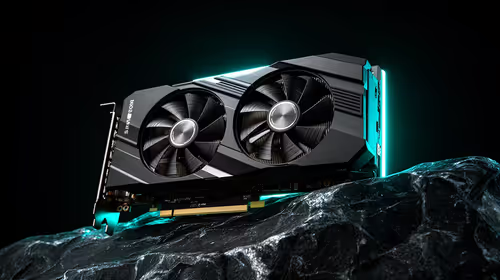
RTX 5090 on a 650W PSU is a tight pairing with very limited headroom. For SA gaming PCs, focus on total system draw, PSU quality, connector support, CPU choice, and avoid OC plans unless the full build is carefully power-limited.
PCIe 5.0 vs PCIe 4.0 for video editing in 4k is mainly about fit, features, compatibility, cost, and upgrade path, not one automatic winner. SA buyers should match the choice to the setup.
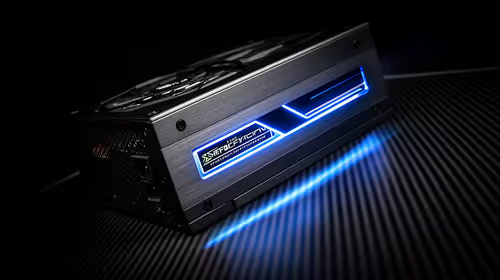
850W PSU safety for RTX 5090 is plausible with a quality unit and balanced parts. In SA, confirm connector support, CPU power draw, case airflow, PSU age, and spare capacity before building around 850W.
Wi-Fi 7 vs Wi-Fi 6e for competitive esports comes down to router support, latency goals, device compatibility, and coverage. SA buyers should match the choice to the real network setup.