Buying a productivity mouse on a ZAR budget is not about finding the cheapest option that works. It is about understanding which specifications genuinely affect eight hours of daily use and which ones are padding the price for features that never help you finish a spreadsheet faster. The good news for South African buyers is that the market at R400 to R800 has matured considerably, and the compromises required at that price are smaller than they were three years ago.
Quick Answer
Prioritise ergonomic shell shape, durable switches, and a reliable 2.4GHz wireless connection. A capable wireless productivity mouse starts around R400 in SA. Spend the extra budget on comfort and button count rather than DPI ceiling or RGB. Those two features add to the price without improving a single office workflow.
🔧 Ergonomics Before Everything
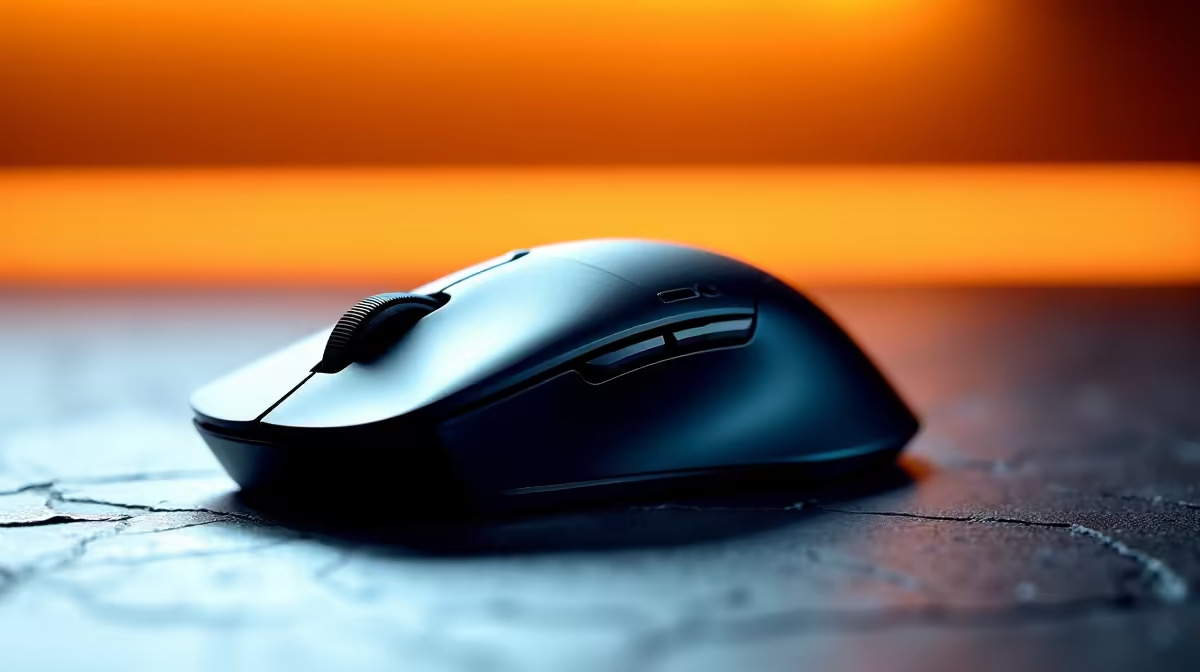
Wrist fatigue is cumulative. A mouse that feels fine during a one-hour session can cause significant forearm discomfort by hour six, and an uncomfortable mouse also slows your work down as you compensate for a grip that does not fit your hand. Shell shape is the highest-return investment on a productivity mouse budget.
Full-size right-handed ergonomic shells suit most SA users with average to large hands and provide the thumb contour and pinky ledge that keep the grip relaxed. Ambidextrous symmetrical shapes suit smaller hands and left-handed users but offer less lateral support. If you can handle the mouse before buying, spend a minute holding it the way you actually grip it during work, not the showroom pinch. The shape that keeps your fingers relaxed and your palm fully supported without straining is the right one.
For ZAR budgets around R400 to R600, expect a textured rubber thumb grip and a slightly contoured top shell. Full sculptured ergonomic shaping becomes more consistent at R800 and above, but even the R400 entry point is a meaningful step up from a cheap flat shell.
⚡ Switch Durability at Budget Price Points
Budget mice save money somewhere, and switches are a common place manufacturers economise. An entry-level switch rated for 3 to 5 million clicks is functional but will show wear within two to four years of daily heavy clicking. Paying R100 to R150 more for a model that advertises 10 million-cycle switches extends the usable life of the mouse substantially and avoids the double-clicking and mushy-button symptoms that come from switch degradation.
Read the product specification rather than relying on price alone as an indicator. Some mid-range mice in the R600 to R900 range carry premium switch ratings, and some more expensive-looking mice are padded by RGB and DPI ceiling rather than mechanical quality. The switch rating is often listed in the spec sheet under "button life" or "click durability."
🌐 Wireless vs Wired at This Budget Level
Wired mice at the R400 range are slightly more reliable in pure signal terms and need no batteries or charging, but cable drag introduces a physical friction to movement that compounds over a full day of productivity work. The resistance of dragging a stiff cable adds a small but constant resistance to every mouse movement, particularly on budget cables that are less flexible.
A 2.4GHz wireless mouse with a USB dongle removes that friction for roughly R100 to R200 over an equivalent wired model. The latency of a 2.4GHz connection is under 8ms, which is imperceptible for any office task. Battery life on AA-powered office mice commonly runs 12 to 18 months on a single cell, so the running cost of wireless is low.
Bluetooth is available on some budget mice and eliminates the need for a USB port, which is useful on a thin laptop or when the USB slots are occupied. The trade-off is that Bluetooth polling can be less consistent in an office with several competing Bluetooth devices and may occasionally stutter in a dense wireless environment.
Pro Tip ⚡
If you are buying for a university res room or a flat in Joburg where USB ports are shared across keyboard, headset, and other peripherals, a Bluetooth mouse that pairs to your laptop directly saves a port. Just test the connection in a device-dense environment first, since multiple Bluetooth devices on the same 2.4GHz band can introduce occasional cursor hesitation.
💰 Features That Drain Budget Without Adding Productivity Value
RGB lighting is the clearest budget drain to avoid. On a productivity mouse it illuminates the underside scroll wheel and sometimes the side accents. It draws battery power, contributes to component cost, and improves nothing about navigating a spreadsheet or editing a document. Every RGB-equipped mouse at R500 is a mouse that could have had better switches or a more refined shell shape at the same price.
A peak DPI number above 2000 is similarly irrelevant for most office work. Admin, writing, and data entry tasks run comfortably below 1600 DPI, and most users settle near 1000 DPI for precision work. A sensor rated to 16000 DPI that tracks accurately at 1000 DPI serves you well; a sensor rated to 4000 DPI that also tracks accurately at 1000 DPI serves you identically. The ceiling is not the useful measurement.
🎯 Features Worth the Stretch Budget
Mappable side buttons return real productivity value at the price step they require. Two or three programmable thumb buttons that can be bound to browser navigation, copy-paste, or frequently used application shortcuts eliminate dozens of keyboard reaches per hour. For power users who live in Excel, binding Ctrl+Page Down and Ctrl+Z to thumb buttons alone is worth the R100 to R200 extra over a basic two-button scroll model.
Horizontal scroll tilt on the scroll wheel helps users who work in wide spreadsheets or panoramic documents regularly. Many budget mice include a standard scroll wheel only. At the R500 to R700 range, tilt-scroll becomes more common and is worth checking the spec sheet for if side-scrolling is a daily task.
Frequently Asked Questions
How much should I expect to spend on a solid productivity mouse in SA?
A wireless ergonomic model starts around R400. The R600 to R800 range adds better switch ratings, programmable buttons, and more refined shaping. Premium options reach R1,200 to R1,500 locally, but R600 to R800 is the practical sweet spot for most SA office buyers.
Should I prioritise ergonomic shape over DPI ceiling on a budget?
Yes, without question. A well-shaped shell that keeps your grip relaxed prevents the kind of cumulative forearm fatigue that affects productivity by the end of the afternoon. DPI above 1600 changes nothing about completing admin tasks and is the first spec you should discount when comparing models at the same price point.
Is wireless worth the extra cost at this price range?
For most users, yes. The step up from wired to 2.4GHz wireless is modest in ZAR terms and eliminates cable drag over an eight-hour session. Battery life on AA-powered office mice is long enough that recharging or battery replacement is a minor inconvenience measured in months rather than days.
Which feature is the easiest to skip when the budget is tight?
RGB lighting. It does not improve tracking, ergonomics, or durability. At the R400 to R600 range it adds component cost that would be better allocated to a better switch or a more supportive shell shape.
Do extra programmable buttons justify a higher spend?
For users with high-repetition workflows, yes. Two to five mappable buttons that eliminate menu navigation or keyboard reaches pay back the price difference quickly in saved time. For users with lighter daily usage who primarily point and click without repetitive shortcut use, the standard two-button scroll wheel is sufficient and the saved budget is better spent on ergonomics.
What battery type suits a budget office mouse?
A single AA alkaline cell typically runs 12 to 18 months in a 2.4GHz office mouse, keeping ongoing costs minimal. Built-in rechargeable models at the budget end sometimes use smaller cells with shorter cycles, so check the rated battery life against an AA-powered option before deciding.
Ready to find a productivity mouse that fits your budget and your workday?
Browse the full wireless and ergonomic mouse range at Evetech and find the combination of comfort, durability, and button count that makes eight hours at a desk easier.