Quick Answer
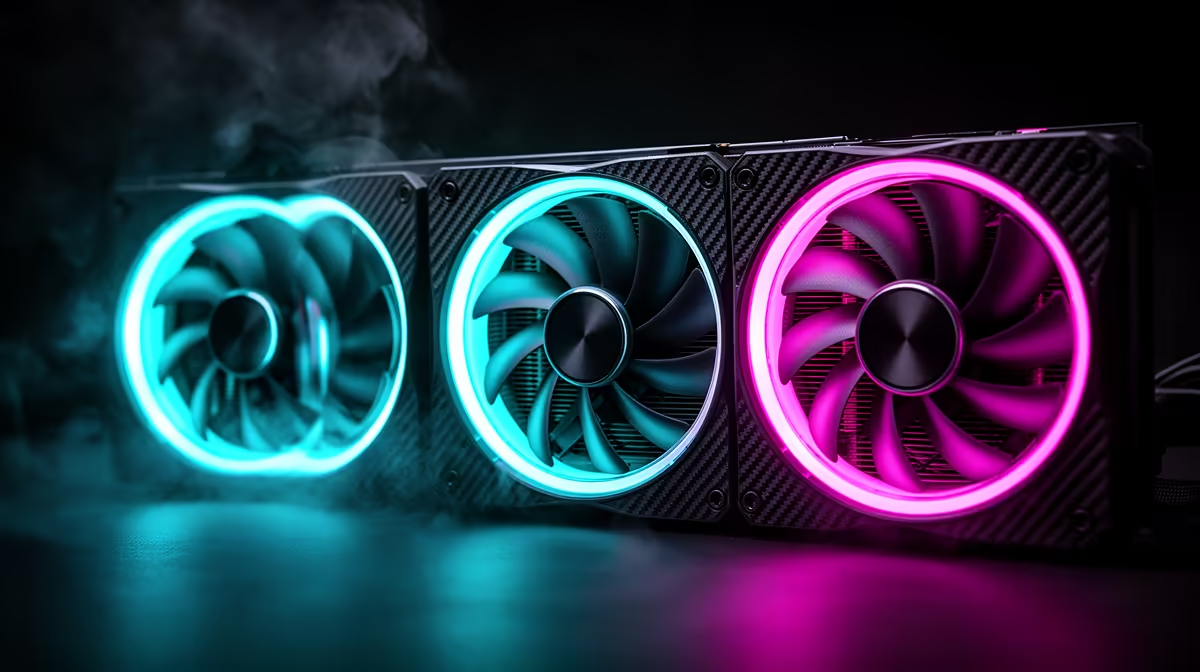
Yes, four ARGB case fans provide adequate airflow for high-performance gaming builds when configured correctly, as long as the CPU has a dedicated AIO cooler. A three-front-intake plus one-rear-exhaust layout moves sufficient air for a system with an RTX 5080 and Ryzen 9 9900X, keeping GPU temperatures within acceptable range for sustained gaming sessions.
Why Four Fans Works for Most Builds 💨
A high-performance gaming build with a 360mm AIO already has three dedicated radiator fans handling CPU cooling. The case body fans handle GPU cooling and general case airflow. Three 120mm fans at the front intake pushing air across the GPU heatsink, combined with one rear 120mm exhausting hot air, creates a positive-pressure flow path that covers the main chamber effectively. At typical gaming loads where a Radeon RX 9070 XT or RTX 5080 pulls 200 to 220W, this four-fan configuration maintains GPU temperatures between 75 and 85 degrees Celsius, which is within the normal operating window and does not trigger thermal throttling on current-generation cards.
When Four Fans Might Not Be Enough 🔥
Four case fans begin to fall short when the build combines a very high-TDP GPU above 300W, a hot-running CPU without a dedicated AIO, and an enclosed or semi-enclosed case design with restricted intake. A system with an RTX 5090 at 575W TDP paired with a large air-cooled CPU produces significantly more heat per cubic volume than a moderately powered build. In these extreme configurations, adding two top-mounted 120mm exhaust fans increases heat removal substantially. For South African summers where ambient room temperatures can reach 30 to 32 degrees Celsius without air conditioning, adding a top exhaust fan is a sensible buffer for RTX 5090-class systems even if four fans seem adequate in winter.
Fan Placement Strategy for Maximum Effect 🔧
Fan effectiveness depends as much on placement as on fan count. Three intake fans at the front and one exhaust at the rear creates positive pressure. This configuration pushes slightly more air into the case than it removes, which ensures air exits through case gaps in a controlled direction rather than pulling dust in through unfiltered openings. For a South African home environment where doors and windows are open for ventilation during warmer months, positive pressure is particularly valuable at reducing dust ingress on the GPU shroud and motherboard heatsinks between cleaning sessions.
Point Fan Labels Toward Airflow Direction ⚡
PC fan has a sticker label on one side and an open hub on the other. Air flows in the direction the sticker faces: label side is the exhaust side, open hub side is the intake side. For front intake fans inside the case, the fan label should face toward the front panel, meaning air is drawn from outside and pushed into the case. Getting fan direction wrong on even one fan creates a short-circuit airflow loop that significantly reduces cooling efficiency.
FAQ
Do ARGB fans have lower airflow than non-ARGB fans?
No, ARGB lighting is integrated into the hub and does not reduce blade area or airflow volume.
Should I add a fifth fan for a high-end GPU build?
For a GPU rated above 300W TDP, adding a fifth fan as a top exhaust measurably reduces case ambient temperature and GPU intake temperature. The improvement is typically two to five degrees Celsius at GPU level, which is worthwhile for a flagship GPU that cost R25,000 or more.
What CFM should case fans have for a high-performance build?
Look for 120mm case fans rated at 50 CFM or above for intake positions, and 140mm fans at 70 CFM or above if your case supports that size. Static pressure ratings above 2.5mm-H2O are useful for fans mounted directly against a radiator or dense mesh panel.
Building a high-performance gaming rig and need the right cooling fans?
Evetech stocks ARGB case fans in 120mm and 140mm sizes with full airflow specs, browse the fan range to complete your cooling setup.