More Than Just a Box: What a PC Case Actually Does 🏗️
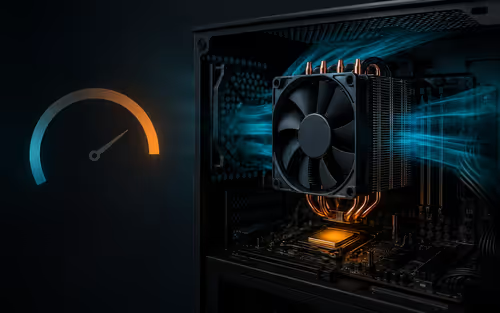
PC cases get overlooked in the excitement of choosing GPUs and CPUs, but they're actually critical to your build's lifespan and performance. A quality case manages airflow to prevent thermal throttling, dampens noise so your gaming rig doesn't sound like a turbine, protects your components from accidental damage and static electricity, and provides mounting flexibility for future upgrades. In South Africa's warm climate and dusty conditions, a case with good dust management becomes even more important. This guide helps you navigate the overwhelming choice and pick a case that actually suits your needs rather than just looking cool.
Case Sizes: ATX, Micro-ATX, and Mini-ITX Explained
Full ATX: The standard desktop case for most builders. Supports full-size motherboards, easy component installation, excellent cooling due to larger internal volumes. If you're unsure, this is the safe choice.
Micro-ATX: Compact but not cramped. Fits smaller rooms, easier cable management, still accommodates most modern components. Perfect for living in digs where space is premium.
Mini-ITX: Genuinely small—perfect for LAN party builds or space-constrained setups. Building here requires more planning (shorter GPUs, specific PSU models), and thermals are tighter.
Most SA builders choose ATX for flexibility; Micro-ATX for dorms where desk space matters.
Airflow: Front Intake, Rear Exhaust
The golden rule of PC airflow is simple: cool air in front, hot air out back. Quality cases facilitate this with dedicated fan mounting points (typically 2–3 front intake, 1 rear exhaust). When shopping, check:
- Front mesh quality: Fine mesh blocks dust without chocking airflow. Coarse mesh flows better but collects dust faster (problematic in SA's dusty conditions).
- Fan mounting flexibility: Can you add more front fans if thermals become an issue?
- Cable routing: Good cases have routes behind the motherboard tray, hiding cables and maintaining airflow efficiency.
Dust Management in South Africa's Conditions
SA's dust and dry climate creates two problems: static electricity buildup and accelerated dust accumulation. Look for cases with:
- Dust filters on intake fans: Replaceable or washable, not glued on. Cleaning shouldn't require disassembly.
- Sealed cable pathways: Open grilles mean dust infiltrates everywhere.
- Static-resistant materials: Most cases use this, but cheap models sometimes skip proper grounding.
Budget 2–3 hours per year for cleaning if you're in urban areas; weekly if you're near construction zones or gravel roads.
Build Quality: Materials and Thermals
Steel cases (R1,200–R2,500): Standard, reliable, heavy. Excellent thermal properties due to mass. Noise insulation is decent. The workhorse choice.
Aluminium cases (R2,000–R4,000): Lighter than steel, modern aesthetics, excellent cable management. Thermals depend on design (more ventilation usually). Quieter operation is possible but costs more.
Tempered glass and wood hybrids (R2,500–R5,000): Trend-driven, visually impressive, variable thermals. Only choose if your build location displays the case (streaming setup, content desk).
Noise Considerations: The Underrated Feature
A quiet PC is worth the investment if you're gaming late into the night or streaming. Quality cases add sound dampening (thick walls, acoustic foam) that reduces fan noise by 5–10dB. For comparison, stock cases often hit 40dB under load; damped cases sit at 30–35dB. This matters more than specs suggest—sustained high noise creates fatigue.
Liquid Cooling Compatibility
If you're considering AIO (all-in-one) liquid cooling, verify the case supports your radiator size before purchasing:
- 240mm radiators: Most cases accommodate these.
- 360mm radiators: Need dedicated mounting (top or front). Check case specifications.
- 420mm+ radiators: Rare; only certain Micro-ATX and full ATX cases support them.
Air cooling (traditional fans on CPU heatsinks) is simpler and works in virtually any case. Liquid cooling is overkill unless you're overclocking or running high-end CPUs consistently.
Case Buying Pro Tip ⚡
Watch build logs and unboxing videos on YouTube before deciding. Photos don't capture ease of installation or cable routing difficulty. A case that looks great in marketing might have a nightmare build experience. Real builders' experiences matter more than marketing claims.
Cable Management: The Hidden Challenge
Good cases provide multiple cable routing holes (not just behind the motherboard tray). If you plan custom cables, sleeved PSU cables, or RGB wiring, check if the case supports these without looking like spaghetti. Cable management affects thermals directly—bundled cables restrict airflow.
Upgrade Flexibility and Longevity
Buy a case that supports your current build plus one generation of upgrades. If you're building with a single 2.5-inch SSD now, your case should support 3–4 more. If you choose a 240mm AIO today, your case should fit a 360mm someday. This forward-thinking prevents needing a new case in three years.
Brand Considerations in SA
Reliable case manufacturers (NZXT, Corsair, Lian Li, Fractal Design) are widely available through local retailers. Avoid ultra-cheap no-name cases—poor thermals and sharp edges aren't worth the R300 saving. Mid-range cases (R1,500–R3,000) offer the best value-to-performance ratio.
Budget Stratification
R800–R1,500: Basic functionality, limited cable management, typical thermals. Fine for compact builds or first-timers not planning upgrades.
R1,500–R2,500: Better airflow, decent cable management, adequate dust filters. Sweet spot for most SA builders.
R2,500–R4,000: Premium thermals, excellent cable management, possibly tempered glass, lower noise. Worth the investment if your build is expensive (high-end GPU/CPU).
R4,000+: Luxury territory—premium aesthetics, excellent build quality, noise dampening. Choose here if your PC is a content showcase.
Putting It Together: Case Selection Framework
Ask yourself:
- Where's my build living? (Space-constrained digs = Micro-ATX; bedroom = ATX for upgrade flexibility)
- Do I prioritise silence? (Yes = Damped case, budget R3,000+ ; No = Standard case, R1,500–R2,000)
- Will I upgrade in 3 years? (Yes = Flexible mounting, multiple bays; No = Basic functionality is fine)
- Dust management critical? (Urban SA = important; rural = less critical)
Answer these, and your perfect case becomes obvious. Explore our case selection to see current stock and find the right home for your components.
Ready to build your perfect PC home?
Browse our full range of PC cases designed for SA conditions, with options for every budget and build style from compact to enthusiast setups.
Shop PC cases