Running local AI and Stable Diffusion on a laptop is mostly a VRAM question, not a raw speed one. The frame buffer on the graphics chip decides which models you can load at all, so that is where to start.
Quick Answer
For local AI and Stable Diffusion on a gaming laptop, prioritise a GPU with at least 8GB of VRAM, and ideally 12GB or 16GB, because the model has to fit in that buffer. An NVIDIA RTX laptop GPU is the safe pick thanks to CUDA support. Expect to spend from around R28,000 for a capable 8GB machine and R40,000-plus for 16GB headroom.
VRAM Is The Deciding Spec
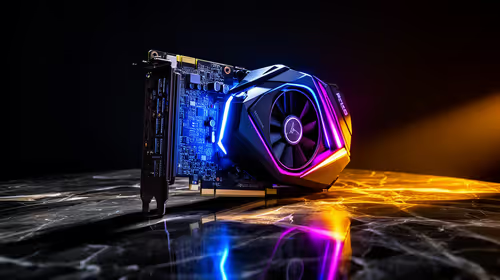
Stable Diffusion and most local models load weights into graphics memory, so an 8GB laptop GPU runs standard image generation while a 12GB or 16GB card handles larger models, higher resolutions and bigger language models without offloading to slow system RAM. NVIDIA is the practical choice for laptops because CUDA has the widest tool support across Stable Diffusion front-ends and local LLM runners. A 16GB mobile GPU is the comfortable target if you want room to grow into video and larger models.
The Rest Of The Machine
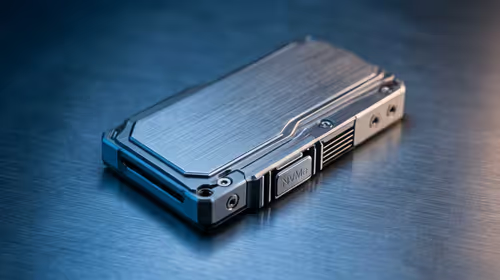
Pair the GPU with at least 16GB of system RAM, and 32GB if you multitask while a model runs. A fast 1TB NVMe SSD matters because model files are large and load from disk; reads above 5,000MB/s shorten the wait. Cooling is the quiet differentiator — sustained AI workloads run the laptop hot, so a chassis with strong thermals holds clock speeds longer than a thin ultraportable. Capable AI-ready gaming laptops at Evetech start from around R28,000.
FAQ
How much VRAM do I need for Stable Diffusion?
8GB runs standard image generation comfortably; 12GB or 16GB lets you use larger models, higher resolutions and SDXL workflows without slowing to a crawl. More VRAM is the upgrade that matters most.
NVIDIA or AMD for local AI on a laptop?
NVIDIA, in most cases — CUDA has the broadest support across local AI tools. AMD works but needs more setup effort for the same result.
Can a thin-and-light laptop handle AI workloads?
It can run them, but sustained generation throttles a thin chassis. A laptop with proper cooling holds performance through long batches far better.
Buyer tip
for VRAM first: a 16GB mobile GPU outlasts a faster 8GB one for AI work. Add 32GB system RAM and a fast NVMe SSD so model loads are not the bottleneck.