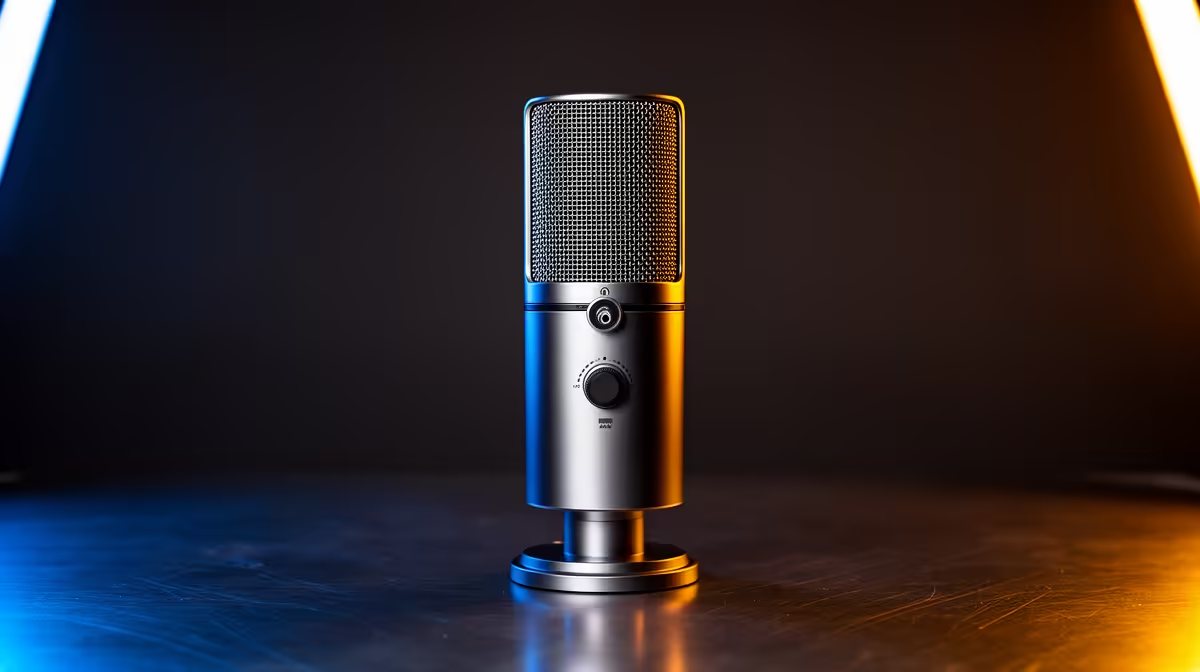
The USB versus XLR debate has a clear answer for most South African content creators, but that answer depends on which stage of the journey you are at. Both systems can deliver 24-bit 48kHz audio at a quality level streaming platforms and podcast hosts cannot distinguish. What separates them is how much hardware they require, how much flexibility they offer when your setup grows, and what happens when a second voice joins the recording. Choosing between USB and XLR is less about audio quality and more about where you are now and where you plan to be in twelve months.
Quick Answer
USB is the right starting point for most solo South African creators. It requires no interface, saves R1,500 to R3,000 upfront, and delivers professional voice quality immediately. XLR becomes worth adding when you need multiple inputs, quieter preamps, or a second host on the same recording.
🔌 What USB Gives You and What It Costs
A USB microphone converts the analogue capsule signal to digital inside the mic body itself, then sends that digital audio straight to your PC over the cable. There is no additional hardware in the chain. Streaming software, recording apps, and video call platforms see it as a standard audio device and accept it without any configuration.
For a solo creator in South Africa, this is a significant practical advantage. There is no interface to buy, configure, or troubleshoot. There are no additional drivers to install. The mic plugs in and works, which means the session time goes toward content rather than setup.
USB quality at the R1,500 to R3,000 tier delivers 24-bit 48kHz audio. That is the format most streaming and podcast platforms accept at their highest quality tier. The argument that USB is somehow inferior to XLR at this sample rate is largely outdated. The onboard analogue-to-digital converters in modern USB mics are good enough that voice recordings are indistinguishable from XLR at equivalent price points when recorded in the same room with the same technique.
The genuine limitation of USB is single-input. One mic per USB port per recording. That works perfectly for a solo show and causes real problems the moment a co-host sits down at the same desk.
🎙️ What XLR Adds and What It Demands
XLR is an analogue output standard. The mic sends an analogue signal through the XLR cable to an interface or mixer, which converts it to digital using its own analogue-to-digital converter and preamp. The quality of that converter and preamp determines how clean the gain is at the top end, which is why premium interfaces matter to professional studios.
For a South African creator at the entry and mid tier, the preamp headroom XLR provides is genuinely useful in one specific situation: recording a very quiet source. A hushed interview guest, a musical instrument at a distance, or a quieter voice that needs significant gain boost will reveal the difference between a clean interface preamp and a noisy USB onboard converter. At normal speaking volume recorded at 15cm, the difference is negligible.
The multiple-input benefit is where XLR earns its place most clearly. An audio interface with two or four XLR inputs lets you record a second host, a panel of voices, or a live instrument alongside a vocal, all captured to separate tracks. That is impossible with two separate USB mics, which appear as separate audio devices and cannot be phase-aligned without additional software work.
The cost to enter XLR is real. An interface capable of two clean XLR inputs runs R1,500 to R3,000 on top of the mic. For a solo creator who does not yet need that capability, that spend produces no audible return.
The Dual USB/XLR Option
A dual USB/XLR microphone routes the capsule signal through two independent output stages in the same body, typically at the same price tier as a USB-only model. This design makes the upgrade path explicit: plug in USB today, add an interface later and plug in XLR, without replacing the capsule.
For most South African solo creators who suspect they will scale, a dual connectivity mic is the correct starting point. It sidesteps the forced choice and lets the decision about interface timing happen naturally when the need actually arises.
Pro Tip ⚡
Before buying an interface for an XLR upgrade, borrow one for a recording session and compare it directly against your USB recording in the same room at the same settings. If you cannot hear the preamp difference on your actual content, you do not yet need the interface spend. Most solo voice recorders cannot tell the difference below R3,000 of interface quality.
🧠 Making the Decision Based on Where You Are
The practical decision tree for a South African creator runs as follows. If you are recording solo content, voice only, at normal speaking levels, USB is sufficient and simpler. If you are already recording a co-host or plan to within the next few months, XLR with a dual-input interface is the better starting configuration even though it costs more upfront. If you are unsure, a dual USB/XLR mic at the R1,500 to R3,000 tier covers both scenarios without forcing a choice.
Room treatment affects both systems equally. Neither USB nor XLR will rescue a recording in an untreated concrete room. Sorting out soft furnishings, closing the door, and positioning the mic at 15cm from the mouth matters more than the connector type at any reasonable budget level.
⚡ The Upgrade Path in Practice
The most common South African creator path looks like this: start with a USB dynamic mic at around R1,500, run a solo show for six to twelve months, then add a second host and switch to XLR with an interface. The dual USB/XLR mic makes that transition require only an interface purchase rather than a full mic replacement.
Adding an interface opens mixing capabilities: per-channel gain control, hardware EQ on some models, the ability to patch in a second mic on a separate track. A compact two-channel interface around R2,000 to R2,500 handles this comfortably for a two-person show.
The trap to avoid is buying the interface prematurely. Many South African creators spend R2,000 on an interface to add zero audible quality to a solo show, then struggle to fill the second channel. If the second host has not joined yet, USB is the right configuration until they do.
Frequently Asked Questions
Should South African creators start with USB or XLR?
Start with USB. It removes the interface cost, simplifies the setup, and delivers professional 24-bit 48kHz audio for a solo voice. A dual USB/XLR mic at the R1,500 tier costs the same as a USB-only model and leaves the XLR upgrade path open without any additional spending. The interface can come later when a second host or quiet-source recording genuinely requires it.
What does XLR offer over USB for content creation?
The main advantages are multiple inputs and cleaner preamp headroom at high gain settings. XLR into a two-channel interface lets you record a co-host or a second source to a separate track. At normal speaking volumes with a single voice, XLR preamps are audibly equivalent to good USB converters. The difference only becomes meaningful with quiet sources or multi-mic configurations.
Is USB audio quality good enough for professional content?
Yes, at the 24-bit 48kHz tier available from R1,500 mics. Streaming platforms and podcast distributors accept this format at their highest quality setting, and listeners on standard playback devices cannot distinguish it from XLR at equivalent price points. The argument that USB sounds worse than XLR at reasonable prices has not been credible for several years.
How much more does an XLR setup cost in Rand terms?
The mic price is similar, but an XLR setup requires an audio interface or mixer on top. A basic two-channel interface capable of clean preamps runs R1,500 to R3,000 depending on quality tier. That makes a USB-only setup around R1,500 to R3,000 cheaper than an equivalent XLR rig for a solo creator starting out.
Can I keep my microphone if I switch from USB to XLR?
With a dual USB/XLR mic, yes. The same capsule feeds both connectors, so switching to XLR means plugging the XLR cable into an interface without changing the mic at all. USB-only mics cannot make this jump and require a full replacement. This is the strongest reason to buy a dual-connectivity model even if you plan to start on USB.
Ready to pick the right audio path for your content?
Browse the USB and dual USB/XLR microphone range at Evetech and build a setup that fits where you are now without closing off where you want to go.