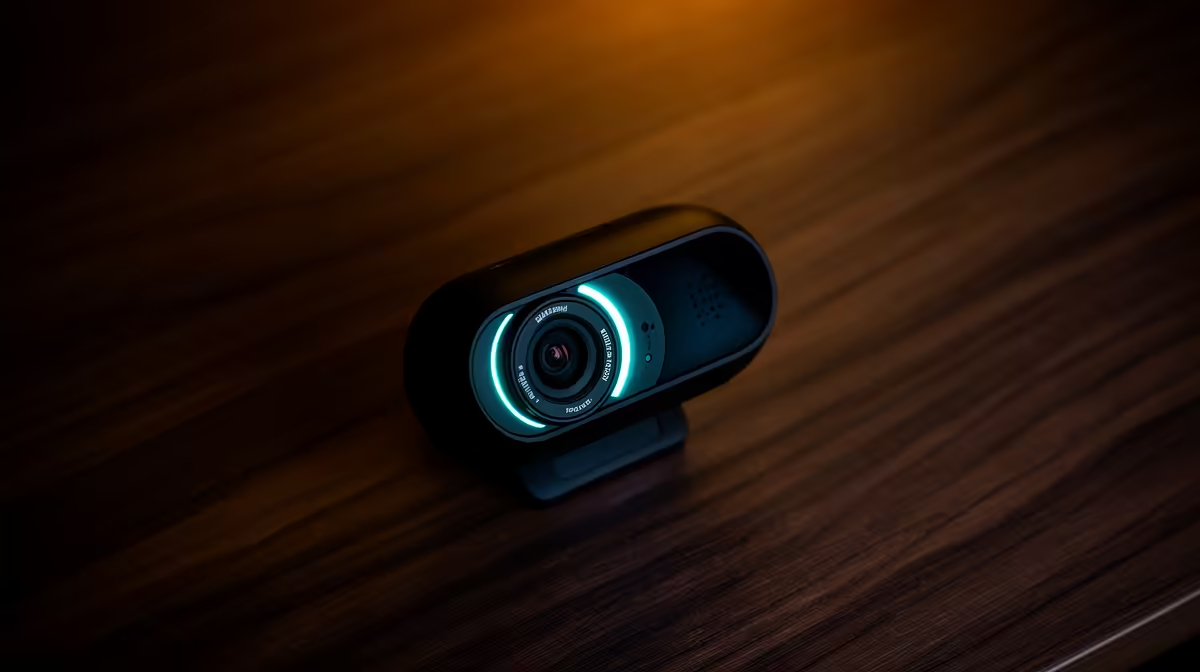
The difference between a grainy, washed-out night stream and a clean, cinema-adjacent frame often has nothing to do with your editing skills or your lighting rig. It sits at the hardware level, inside the sensor itself. Cinematic STARVIS sensors were designed specifically to perform where ordinary webcam chips fall apart, and understanding why comes down to how each sensor type is physically constructed to collect light.
Quick Answer
A STARVIS sensor uses a back-illuminated chip design that captures significantly more light per pixel than a standard front-illuminated webcam sensor. The practical result is cleaner, lower-noise footage in dim rooms. A better lens helps at the edges, but it cannot compensate for a fundamentally less efficient sensor.
🔆 The Engineering Behind STARVIS Sensitivity
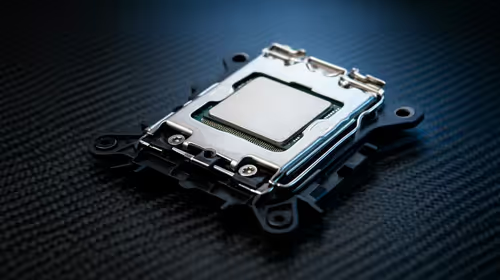
Standard webcam sensors place their wiring layers on top of the photodiodes, the tiny cells that turn incoming photons into electrical signals. Those wiring layers sit between the light source and the cell, blocking a portion of incoming light before it ever reaches the diode. The sensor compensates by pushing gain higher, amplifying both the signal and the noise floor together.
STARVIS flips this architecture. The photodiodes sit facing the lens without obstruction because the wiring is repositioned behind them. That back-illuminated layout means each pixel collects a meaningfully larger share of the available light. When there is less light to work with, the STARVIS chip reaches a usable signal with less amplification, which keeps grain under control.
The difference is invisible in a bright, well-lit room. Point either sensor at a window during the day and you will see comparable results. The gap opens the moment the room dims, because that is exactly the condition STARVIS was engineered for.
What "Back-Illuminated" Actually Means for Your Footage
The practical output is footage that holds shadow detail. Where a standard sensor produces a muddy grey blur in the dark corner of the frame, a STARVIS sensor resolves texture. Skin tones in dim rooms look smooth rather than speckled. Background detail at the edges of your key light stays readable rather than dissolving into noise.
For streamers who broadcast in the evening from a room lit only by monitors and a desk lamp, or for hybrid workers on calls in an office with uneven lighting, this translates directly to a more professional image without adding hardware.
🎯 What a Better Lens Can and Cannot Do
Lens quality affects sharpness, depth of field, and colour fringing at the edges of the frame. A wide-aperture lens gathers light more efficiently than a narrow one, so there is a real relationship between glass quality and low-light capability. The confusion is in treating the lens as the primary fix when the sensor is the bottleneck.
A lens works by concentrating the light hitting the sensor. If the sensor is a back-illuminated STARVIS chip, more light reaches more efficient photodiodes and the image improves. If the sensor is a small, front-illuminated chip, a better lens still concentrates light onto a less efficient receiver. The grain does not disappear. It improves slightly, but the fundamental ceiling set by the sensor architecture remains.
This is why pairing a quality lens with a standard sensor delivers modest gains in dim conditions while the same lens on a STARVIS sensor produces a noticeably cleaner image. The glass and the sensor work together. Neither one operates in isolation.
Focal Length and Field of View Considerations
A wider lens lets more light in at a given aperture number, which does help in low light. For streamers, a 90-degree lens also frames a larger portion of the room, which can show more of the setup or include a co-host. But framing decisions should follow the primary sensor quality choice, not precede it. Choose the sensor first.
Pro Tip ⚡
If you are streaming from a room with inconsistent lighting, a soft key light placed at about 45 degrees to your face and aimed slightly downward costs around R400 to R800 for a basic LED panel. That one light, paired with a STARVIS sensor, delivers a result that a standard sensor cannot match even with the key light. Do the sensor first, then the light.
🧠 Real-World Low-Light Scenarios Across SA
South African home setups vary enormously. A north-facing flat in Cape Town at 18h00 in winter has a completely different ambient light profile than a Joburg suburb home office at the same hour. Coastal humidity and dense window treatments that reduce glare also affect how much light reaches a subject.
In a residence room with a single overhead bulb and a monitor as secondary fill, a standard webcam sensor will push ISO high enough to produce footage that looks almost impressionistic in the dark areas. A STARVIS chip in the same room holds enough shadow detail to frame the shot usably, even if a key light would still be the ideal addition.
Evening streaming without a dedicated light source is where the STARVIS advantage is most visible day-to-day. The chip was designed for surveillance and broadcast cameras that often operate in exactly these conditions, and that engineering has crossed into the consumer webcam category.
🔧 Building a Cinematic Result Beyond the Sensor
A clean sensor gives you the raw material. The rest of the cinematic look comes from three additional elements: framing, a controlled key light, and background management.
Framing means positioning the camera at eye level or slightly above, filling the frame correctly rather than showing too much ceiling or desk. A STARVIS sensor resolves what it sees, so sloppy framing in a clean image still reads as amateur.
A soft key light, even a modest one around R500 to R800, adds contrast and depth that any sensor benefits from. With a STARVIS chip, that light lifts an already clean image into something that reads as intentionally lit rather than accidentally acceptable.
Background management, whether a physical tidy, a curtain, or a softbox-lit bookshelf, gives the clean sensor a subject worth resolving. Grain-free footage of a cluttered, harshly lit background does not read as cinematic regardless of sensor quality.
Frequently Asked Questions
What makes a STARVIS chip perform differently from a standard sensor in dim rooms?
Back-illuminated STARVIS photodiodes sit exposed at the surface with the wiring repositioned behind them, whereas a conventional front-illuminated chip has its wiring in front. More photons reach each cell on the STARVIS design, so the chip produces a usable signal at lower gain. Keeping gain down is what holds shadow areas clean instead of filling them with noise.
Can swapping to a higher-quality lens produce the same result as a STARVIS sensor?
Not in meaningful low-light conditions. A better lens with a wider aperture gathers more light efficiently, but it is still directing that light onto the same less-efficient sensor architecture. The gains are real but limited. A STARVIS sensor with equivalent glass outperforms a standard sensor with the same glass in dim conditions, consistently.
Does a STARVIS sensor eliminate the need for a key light entirely?
It reduces the dependency significantly. In a room with moderate ambient light, a STARVIS sensor often produces clean, usable footage without supplementary lighting. A key light still adds contrast and separation between subject and background, which contributes to a polished look. Think of STARVIS as raising the floor, and a key light as adding the ceiling.
Is the STARVIS advantage visible during daytime or well-lit streams?
Barely. In a bright room with controlled lighting, a good standard sensor and a STARVIS chip produce comparable results, and most viewers would not distinguish between them. The gap opens progressively as light drops. By the time you are streaming in a dim room or at dusk without supplementary light, the difference is clear and consistent.
Does a STARVIS sensor improve the cinematic look on its own?
It handles the technical foundation, specifically the clean, low-noise image that cinematic content requires. The visual qualities people associate with cinematic video, shallow depth of field, intentional framing, and warm controlled lighting, still require lens choice, positioning, and a light source. STARVIS removes the grain obstacle; the rest is craft.
Ready to upgrade to a camera that holds clean detail when the room dims?
Browse the streaming webcam range and look for STARVIS-equipped models built for South African streamers who broadcast in real-world lighting conditions, not controlled studios.