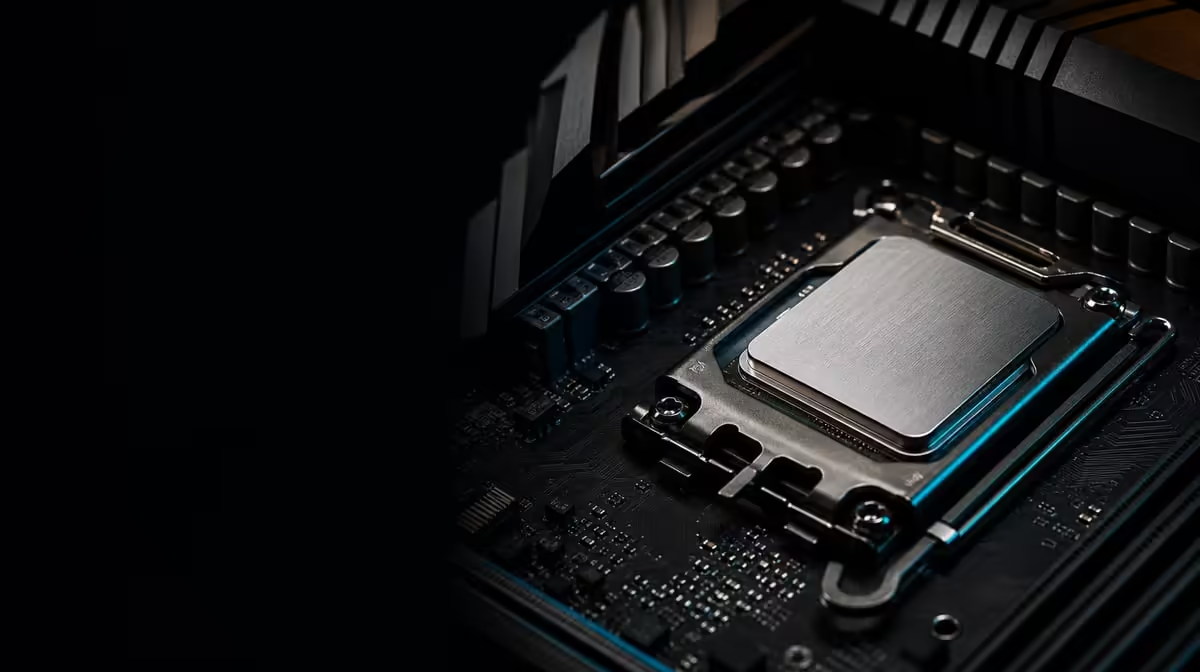
Processor specifications become useful when each number is tied to the work it describes. Zen 3, 100MB cache and gaming performance are three parts of the Ryzen 7 5800X3D story, alongside eight cores, 16 threads and defined clock speeds. At R7,199, the CPU offers that combination on AM4, but the rest of the gaming PC determines how much of it appears on screen.
Quick Answer
Zen 3 identifies the processor architecture, 100MB is its cache capacity, and the clock specification is 3.5GHz base with a maximum boost of up to 4.5GHz. The Ryzen 7 5800X3D also has eight cores and 16 threads. These resources can support strong gaming, yet exact FPS depends on the game, GPU, settings, cooling and complete system rather than the R7,199 CPU alone.
🧬 Read Zen 3 as the design foundation
An architecture name describes how the processor's cores and supporting systems are organised. Zen 3 is therefore more meaningful than a decorative generation label, but it is not a complete performance forecast. The code being executed, memory behaviour, firmware and other parts of the PC all influence what the design delivers in a real workload.
The 5800X3D contains eight cores and can work with 16 threads. Games can use those resources in different ways: one may concentrate its most time-sensitive work on a limited set of threads, while another spreads more activity across the processor. Background tasks and game launchers also share the system, which is why a core count has context beyond the foreground title.
More threads do not automatically double performance, and eight cores do not guarantee one class of FPS. The figures establish available resources. Testing reveals whether a particular game can use them and whether another component prevents the CPU from becoming the visible advantage.
Evetech's AMD CPU selection provides a practical way to compare the Zen 3 option with other processors using full specifications.
🗃️ Interpret 100MB as capacity, not a score
Cache holds data close to the processor cores. When a game repeatedly needs information that remains in that fast storage, some slower memory access can be avoided. A 100MB cache gives the 5800X3D a substantial on-chip resource for that role, but the benefit depends on the working pattern of the engine.
A cache-sensitive game can show a useful improvement even when another title barely changes. Graphics-heavy settings can hide the difference by shifting the limit to the GPU. A frame cap can conceal it entirely. The cache capacity remains the same in every case; the amount of it that becomes useful is what changes.
Cache does not replace system memory. Games, the operating system and other applications still require adequate RAM, and its stable configuration remains important. Nor does cache render frames. The processor needs a discrete graphics card to produce display output, and that GPU has to meet the intended resolution and visual workload.
When comparing cache behaviour, retain the same graphics card, memory arrangement, game version, scene and settings. Examine repeatable averages and frame times. That method separates a probable processor difference from changes elsewhere in the test environment.
The full processor category can help buyers place cache capacity beside architecture, cores, platform and price.
⏱️ Put base and boost clocks in context
This processor's base clock is 3.5GHz, while its maximum boost is specified as up to 4.5GHz. These values describe operating frequency, not a guarantee that every core will stay at the maximum during a game. The workload, number of active cores, temperature, power conditions and motherboard firmware can all affect the clock observed at a given time.
A lower sustained all-core reading does not automatically signal a fault. Begin by confirming stable operation and appropriate temperatures. Use monitoring tools consistently and compare like-for-like workloads rather than chasing a brief peak that may occur under different conditions.
Frequency and cache address different constraints. A higher clock can complete compatible work more quickly, while a larger cache can reduce some time waiting for data. Games combine these needs in different proportions, so choosing between processors from only one figure misses the design balance.
Cooling is part of sustaining that balance. The 105W 5800X3D includes no CPU cooler, so an AM4-compatible solution must be added. Evetech's CPU cooler options can be filtered through actual case clearance, airflow and noise requirements.
🎯 Connect the specification to the whole gaming PC
At R7,199, the processor has the strongest value case when an existing AM4 system is CPU-limited and can reuse a supported board and serviceable memory. The exact motherboard and BIOS must recognise the 5800X3D; the AM4 socket label alone does not establish that support.
The graphics card determines whether prepared frames can be rendered at the chosen resolution and quality. If it is already the active limit, changing the CPU may not raise the visible frame rate. Conversely, a high-frame-rate target in a CPU-sensitive title can reveal processor capability more clearly. Diagnose the constraint before choosing the budget recipient.
Frame consistency belongs beside average FPS. A processor may improve the delivery of difficult frames even when the average does not tell the whole story. Use the same repeatable route before and after an upgrade, note low-percentile behaviour, and control background software.
Zen 3, eight cores, 16 threads, 100MB cache and the stated clocks are factual reasons to shortlist the CPU. They become a buying conclusion only after board support, cooling, graphics, workload and total cost are applied.
The price calculation brings those layers together. R7,199 covers the CPU, while a compatible cooler must be funded because none is included. A discrete GPU is also compulsory for the display path. Existing owners may already have suitable graphics and a supported AM4 board; new builders cannot treat those components as part of the processor price.
This distinction helps compare benchmark charts responsibly. A result produced on a different graphics card or memory setup can illustrate processor behaviour, but it does not reproduce the buyer's finished PC. Use the chart to form a hypothesis, then check the relevant game under conditions that resemble the planned build.
Frequently Asked Questions
What does Zen 3 identify on the Ryzen 7 5800X3D?
Zen 3 identifies the processor's core architecture. It describes the design foundation but must be considered with cache, frequency, core resources and the rest of the system.
How should the 100MB cache figure be interpreted?
It states the CPU's cache capacity. That larger nearby data store can help suitable workloads, but it cannot be converted into one guaranteed gaming percentage.
What are the confirmed clock specifications?
The base clock is listed as 3.5GHz, while boost can rise as high as 4.5GHz. That upper figure is a peak specification rather than a fixed frequency for every core.
Why do eight cores and 16 threads matter beyond gaming?
They give the processor resources for applications and concurrent background work that can use several threads. The exact advantage still depends on software behaviour.
Can these specifications predict a game's exact FPS?
Exact FPS also depends on the GPU, game engine, scene, settings, memory and system conditions. Controlled testing is needed to turn the specifications into a measured result.
Which platform carries this combination of features?
The Ryzen 7 5800X3D uses AM4. Its exact motherboard and BIOS must explicitly support the model, and a discrete GPU is required for display output.
Want to compare CPU architecture, cache and clocks without losing sight of the system?
Explore Evetech's AMD processor range, then match the R7,199 option to a supported board, capable GPU and suitable cooler.