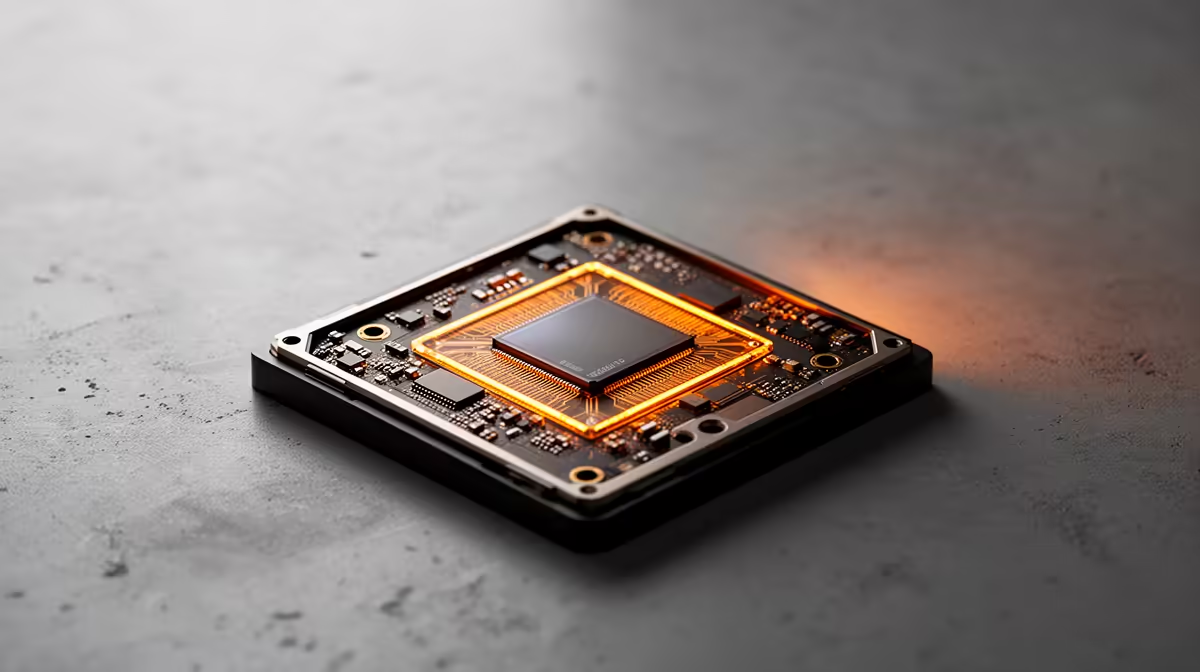
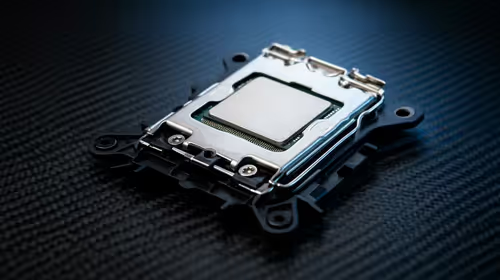
Content creators who shoot in dim conditions know the frustration of footage that falls apart in the shadows. The culprit is almost always the sensor. Sony STARVIS sensors use a back-illuminated architecture that physically repositions the photodiode layer to capture more incoming light per pixel, and the difference between that and a conventional front-illuminated chip becomes visible the moment the room darkens below typical office lighting.
Quick Answer
Sony STARVIS sensors use a back-illuminated design that collects more light per pixel, keeping shadow areas clean and noise-free where standard front-illuminated sensors turn grainy at high ISO. For creators working in dim rooms, moody setups, or evening streams, that advantage is immediate and visible.
🔆 What the Back-Illuminated Design Actually Changes
In a conventional sensor the wiring and circuitry sit in front of the photodiode layer, partially blocking the light that is supposed to hit the pixel. Back-illuminated architecture flips that arrangement so the photodiodes face the incoming light directly, with the wiring moved behind. Each pixel therefore captures a larger share of every photon that arrives.
The practical outcome is a higher quantum efficiency, meaning the sensor converts more light into a usable signal before the camera has to amplify anything. Amplification is where noise enters the picture. A standard sensor in a dimly lit room has to push its ISO further to compensate for the light it is not capturing cleanly, and that amplification lifts both the signal and the underlying noise floor together. STARVIS requires less of that push, so the noise stays lower for the same scene brightness.
The difference is not subtle in controlled side-by-side tests. Shadow regions that hold a clean tonal gradient on a STARVIS chip become a sea of luminance variation on many conventional sensors shooting the same scene at the same shutter speed.
🎙️ Why Creators Specifically Benefit
The use case where STARVIS earns its reputation is the creator who does not want to build a professional lighting rig. Streamers shooting in a bedroom, vloggers recording evening content, or educators filming in a converted spare room all share the same challenge: the ambient light is low, inconsistent, and difficult to balance without adding multiple fixtures.
A STARVIS-equipped camera handles those conditions more gracefully than a standard chip because the effective sensitivity is higher without the noise penalty. A streamer in Cape Town filming after sunset can rely on a single soft key light rather than three or four sources to hold clean shadow detail, which simplifies the setup and lowers the cost of building a workable content environment.
Content recorded for upload compounds the benefit. YouTube and other platforms compress video heavily, and that compression step amplifies noise further. Starting with a cleaner source means the final published video holds more of the intended detail rather than turning soft and speckled after encoding.
What STARVIS Does Not Do
The sensor advantage is specifically a low-light one. In a brightly lit scene, the gap between a STARVIS chip and a well-designed standard sensor narrows considerably. Both will deliver sharp, clean footage when light is plentiful, and a viewer comparing the outputs would struggle to tell them apart on a well-lit stream.
The sensor also cannot compensate for a lens with poor light transmission, inadequate cooling in a warm streaming environment, or poor white balance. A STARVIS chip inside a camera with a very slow lens will still underperform a standard sensor in a camera with excellent glass and a fast aperture.
Pro Tip ⚡
Pair a STARVIS camera with a single broad-diffusion soft box rather than bare LED panels. The sensor handles low light well, but soft directional light still lifts the mid-tones and adds the depth that separates a polished stream from a flat, ambient-lit one.
🌗 How It Compares to Standard Streaming Sensors
Standard streaming sensors in webcams and basic cameras tend to use smaller pixel pitches to fit higher resolutions into compact chips. Smaller pixels gather less light per pixel, making the noise problem worse in anything but ideal conditions. Some manufacturers counter this with aggressive noise reduction processing, which costs fine detail in the shadows, producing that characteristic smeared, waxy look that amateur streamers know well.
STARVIS sidesteps the processing race by collecting the light more efficiently in the first place. The shadows retain genuine texture rather than being smoothed into a uniform grey block. That texture is what makes a stream look natural and broadcast-grade rather than like it was shot on a phone in a dark room.
For creators who do product reviews, the difference is particularly clear. Products with matte or textured surfaces that sit in shadow against a backdrop hold their detail on a STARVIS chip when a standard sensor would reduce them to a flat silhouette.
💰 The Cost Consideration in SA
Cameras carrying Sony STARVIS sensors sit in a higher price band than entry-level webcams in South Africa, typically starting around R3,000 to R4,000 and rising toward R6,000 or more for models with autofocus and wider lenses alongside the sensor advantage. That premium is a real consideration, but it is a one-time hardware investment that removes the ongoing cost of complex lighting.
A basic three-light setup with stands, diffusers, and LED panels can easily exceed R3,000 before factoring in space and setup time. A STARVIS camera that requires only one accent light to look good shifts the economics in favour of the sensor investment, particularly for creators who move between locations.
Frequently Asked Questions
Does a STARVIS sensor work better than a larger lens aperture?
Both improve low-light performance, but they address it differently. The sensor's back-illuminated structure captures more light per pixel regardless of the lens, while a wider aperture gathers more light into the lens system. Ideally you want both, but a STARVIS sensor with a modest lens will outperform a standard sensor with a slightly faster lens in typical dim indoor conditions.
Will a STARVIS camera look identical to a standard one in full daylight?
Almost. In a brightly lit room or outdoor setting both sensor types produce clean, sharp footage, and the STARVIS advantage compresses to a narrow margin. The gap widens progressively as light drops, so bright-condition shooting is largely neutral ground where other factors such as lens quality and dynamic range matter more.
Is the STARVIS benefit visible after YouTube compresses the video?
Yes, and arguably more so. Video compression algorithms amplify noise patterns, so a clean STARVIS source survives encoding with more of its shadow detail intact. A grainy standard-sensor file can look considerably worse after the same encoding pass, making the sensor choice more consequential for uploaded content than for purely live-streamed output.
Can I add a STARVIS camera later to an existing setup?
Yes. A STARVIS camera connects over USB and appears in OBS, Streamlabs, or any capture software just like a standard webcam. Upgrading does not require changing the rest of the rig, and you can keep your existing lighting arrangement and simply reduce how much of it you need.
How dim does a room need to be before STARVIS makes a real difference?
The advantage starts showing at typical evening ambient levels, roughly when overhead ceiling lights are the only illumination and no window light fills the frame. In full daylight the difference is marginal. By the time a room is lit only by monitor glow or a single lamp, the STARVIS sensor holds clean shadow detail where a standard chip starts to show visible grain.
Ready to capture clean video even when the room is dim?
Browse the range of Sony STARVIS streaming cameras at Evetech and find the model that suits your content setup and budget.