Quick Answer
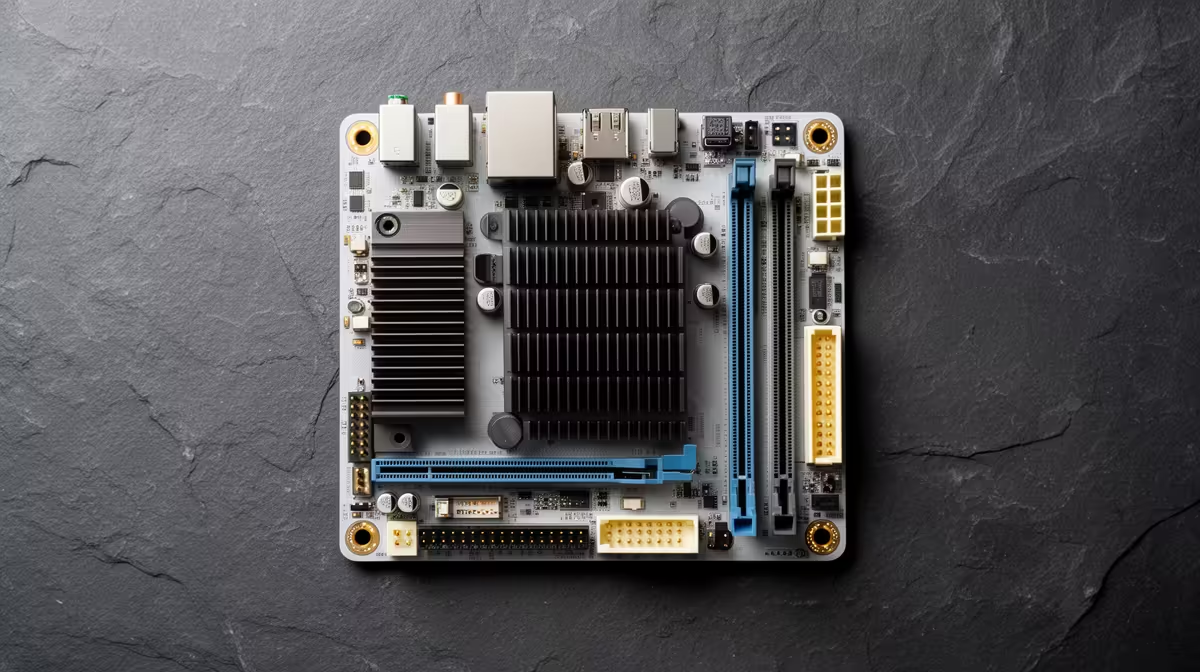
The best mini-ITX motherboard for the Core Ultra 5 245 is the ASUS ROG STRIX Z890-I GAMING WIFI (~R6,500 at Evetech) — a 14-phase VRM handles the LGA 1851 CPU's power needs, Wi-Fi 7 and 2.5GbE are included, and dual M.2 slots (one PCIe 5.0, one PCIe 4.0) provide fast storage in a 170×170 mm form factor. Arrow Lake's improved power efficiency (compared to Raptor Lake) makes it a strong choice for ITX builds where thermal headroom is at a premium.
Why Arrow Lake Suits ITX Builds
The Core Ultra 5 245 (Arrow Lake-S, LGA 1851) has a 125 W base TDP that in practice runs noticeably more efficiently than comparable Raptor Lake CPUs in lightly threaded workloads — Arrow Lake's architecture reduces unnecessary background core activity. In an ITX case, this translates to:
- Lower sustained heat generation during gaming loads
- A 120 mm AIO is adequate for the CU 5 245 at stock in a well-ventilated ITX case
- Quieter operation under typical gaming loads
ITX Z890 Board Options for Core Ultra 5 245
ASUS ROG STRIX Z890-I GAMING WIFI (~R6,500): Wi-Fi 7, Intel I226-V 2.5GbE, 14-phase VRM, PCIe 5.0 M.2 + PCIe 4.0 M.2. PCIe 5.0 x16 GPU slot. The primary ITX recommendation for the Core Ultra 5 245.
MSI MPG Z890I EDGE WIFI (~R5,800): Wi-Fi 7, 2.5GbE, 12-phase VRM, dual M.2 PCIe 4.0. Lower cost with adequate VRM for the CU 5 245's power requirements.
Chipset Choice: Z890 vs. B860 for ITX
Z890 is the overclocking-capable chipset for LGA 1851 — the Core Ultra 5 245 (non-K) has a locked multiplier, so Z890's OC features are unavailable. However, Z890 ITX boards typically offer better VRM, more M.2 slots, and DDR5 memory profile support (XMP 3.0 up to DDR5-9600) which benefits gaming even without CPU OC. B860 ITX boards are less common currently and save minimal cost over Z890 on the ITX form factor.
ITX Build Considerations for the Core Ultra 5 245
Cooling: 120 mm AIO (Corsair H60 ~R900) or 47 mm height tower cooler (Noctua NH-L9i-17xx) for very small enclosures. Verify cooler socket compatibility — LGA 1851 requires updated mounting hardware; most modern AIOs include LGA 1851 brackets.
SFX PSU: 600–650 W SFX required. Seasonic Focus SGX-650 (R2,600) or Corsair SF650 (R2,800).
GPU length: Verify your ITX case's max GPU length before ordering — standard issue for ITX builds.
FAQ
Can the Core Ultra 5 245 be overclocked on an ITX Z890 board?
No — the Core Ultra 5 245 has a locked CPU multiplier. The "245" suffix without a "K" indicates a locked-ratio CPU on the Arrow Lake platform. Z890 provides XMP DDR5 memory overclocking (up to DDR5-9600+) which does benefit gaming, but CPU frequency scaling via multiplier is not available on the 245 SKU. For CPU overclocking on Arrow Lake, the Core Ultra 5 245K or Core Ultra 7 265K is required.
What DDR5 speed is optimal for the Core Ultra 5 245 in an ITX Z890 build?
DDR5-6400 CL32 is the practical sweet spot for the Core Ultra 5 245 — provides full memory bandwidth for the Arrow Lake architecture's E-core cluster and L3 cache design. DDR5-7200+ shows diminishing returns (under 3% gaming FPS improvement) and increases kit cost by R500–R800. Start with DDR5-6000 CL30 from a QVL kit and enable XMP on day one.
What gaming performance can a Core Ultra 5 245 ITX build achieve at 1440p?
With an RTX 4070 (~R11,000) in an ITX build: CS2 at 1440p 150–190 fps, Valorant at 1440p 200–260 fps, Cyberpunk 2077 at 1440p Ultra 75–90 fps (GPU-limited). The ITX form factor does not reduce FPS — GPU performance is determined by the PCIe 5.0 x16 slot and the GPU itself, not the board size. The constraint is cooling and case airflow.
any ITX cooler for the Core Ultra 5 245, confirm LGA 1851 socket compatibility in the cooler manufacturer's compatibility list — LGA 1851 (Arrow Lake) uses a different socket frame than LGA 1700, and some older 2022–2023 coolers require a separate LGA 1851 bracket kit that isn't always included in the retail box.