Ever splurged on a beastly new graphics card, only to find your frame rates in Warzone or Apex Legends are still... disappointing? Before you blame the game, look at your PC’s core. You might be dealing with a classic CPU bottleneck. It’s a common headache for South African gamers where your processor simply can’t keep up with your GPU, throttling your rig’s true potential. Let's get this sorted. 🚀
What is a CPU Bottleneck, Really?
Think of your PC components as a team working on an assembly line. Your Graphics Card (GPU) is the super-fast worker rendering stunning visuals, while your Central Processing Unit (CPU) is the manager, handling game logic, physics, and instructions. A CPU bottleneck happens when the manager (CPU) can't give out instructions fast enough for the worker (GPU) to handle.
The result? Your powerful, expensive GPU sits around waiting, and your frame rate suffers. You’ve paid for 144 FPS performance but you're stuck at 80.
How to Spot a Processor Bottleneck 🔧
Suspect you have a CPU bottleneck? Don't guess... test! The easiest way is to use a monitoring tool like MSI Afterburner while you're in a game.
Here’s what to look for:
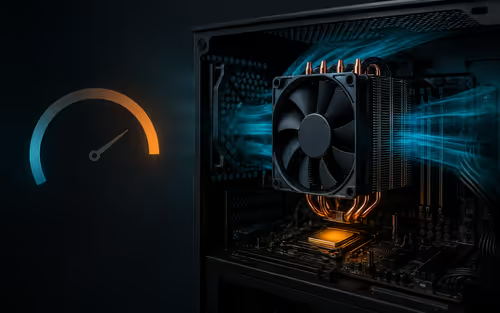
- High CPU Usage: Your CPU is consistently running at 90-100% load.
- Low GPU Usage: Your GPU is chilling, with usage well below 90%.
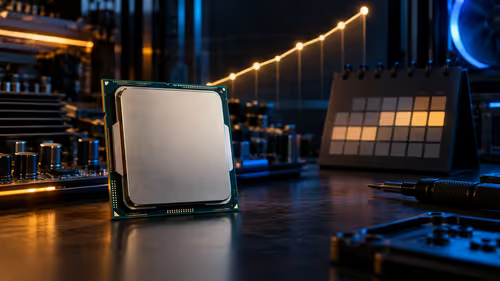
If you see this pattern, especially in CPU-heavy games or at 1080p resolution, it's a clear sign your processor is holding your system back. A balanced system aims for high GPU usage (around 99-100%) as it means you're getting every drop of performance you paid for from your graphics card, supported by the full range of today's powerful CPU processors.
Quick Performance Check
Try lowering your game's resolution to 720p. If your FPS doesn't increase, you've almost certainly found a CPU bottleneck. This is because you’ve reduced the GPU’s workload, but the CPU’s task remains the same... and it’s still maxed out.
Common Causes and How to Fix Them
A CPU bottleneck isn't just about having an "old" processor. It’s about balance. Pairing a brand-new NVIDIA RTX 40-series card with a five-year-old budget CPU is a recipe for disappointment.
Software Tweaks First
Before spending your hard-earned Rands, try these free fixes:
- Close Background Apps: Shut down Chrome tabs, Discord, and anything else eating CPU cycles.
- Adjust In-Game Settings: Some settings, like "object detail" or "physics," are CPU-intensive. Lowering them can help.
- Increase Resolution/Graphics: This sounds counterintuitive, but by increasing graphical settings or resolution (e.g., from 1080p to 1440p), you put more load on the GPU, which can help balance the system and reduce the bottleneck.
The Ultimate Fix: The Upgrade Path ✨
Sometimes, software tweaks aren't enough. The most effective way to eliminate a severe CPU bottleneck explained by mismatched hardware is to upgrade. A modern processor won't just boost your max FPS; it will also improve frame time consistency, leading to much smoother gameplay with fewer stutters.
Whether you're looking for the single-core dominance of a new Intel CPU for pure gaming power or the multi-core value offered by Team Red's AMD CPUs for streaming and gaming, matching your processor to your GPU is key.
Ready to Uncap Your Rig's True Power?
A balanced PC is a happy PC. Stop letting an old processor hold your gaming potential hostage. Shop our full range of CPUs now for performance that leaves lag in the dust.