


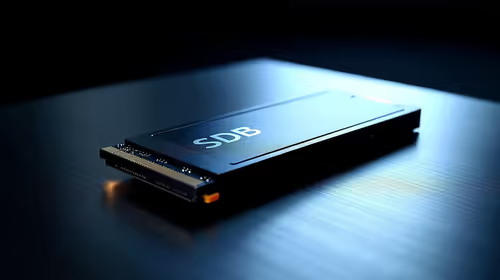
PCIe 5.0 vs PCIe 4.0 for Video editing in 4k in SA
PCIe 5.0 vs PCIe 4.0 for video editing in 4k is mainly about fit, features, compatibility, cost, and upgrade path, not one automatic winner. SA buyers should match the choice to the setup.
Read moreA UPS still matters even with an inverter, since inverter switchover time can be long enough to crash an unprotected desktop mid-task. Evetech recommends pairing a UPS with your inverter for instant, gap-free protection.
You may still need a UPS when an inverter powers the house or office. The deciding question is whether the inverter keeps your desktop running through every transfer, not whether it can supply enough watts after the changeover.
Some inverter systems transfer fast enough for a particular PC. Others leave a gap that makes the desktop restart. A suitable UPS can bridge that gap, handle a short disturbance and give shutdown time if the wider backup system reaches its limit.
Test the exact combination under controlled conditions. Check both makers' connection rules before placing one power-conversion device downstream of another.
An inverter system may run lights, fibre and a computer for hours. That describes energy capacity. A desktop PSU also has to ride through the instant when the supply changes from mains to inverter and back again.
The PSU stores enough energy to tolerate a brief loss of input. Its hold-up time varies with model, load and input conditions. If the inverter transfer takes longer, the PC can reset while lamps appear to stay on. A monitor may blank even when the tower survives.
A UPS is built to detect an input problem and support its outlets according to its design. Online, line-interactive and standby models behave differently. The label UPS does not guarantee that every model will bridge every inverter transfer.
Start with evidence from your desktop. A clean handover during one test is useful. Several tests with the PC at its heaviest normal load tell you more.
Measure wall draw while you game, render, compile or run the work task that taxes the system. Include the display you need for a clean shutdown. Add the ONT or router only if it must share this UPS and the combined plan still stays within the unit's watt and VA limits.
Do not size from the PSU label. A 750W PSU can feed a desktop drawing far less than 750W at the wall. The PSU rating is its output capacity, not a live reading of the computer.
Leave operating margin above the measured load. Battery output, temperature and ageing affect runtime, while a short transient can exceed the average shown on a plug meter. Use the UPS maker's sizing guidance and runtime chart for the exact model.
Runtime can be modest when the inverter is the long-duration source. The UPS needs enough reserve to bridge transfer events and close the work if the inverter shuts down, faults or runs out of stored energy.
Read the inverter's output waveform, voltage regulation, frequency range and transfer specification. Pure sine output is the straightforward target for sensitive computer equipment, yet the complete compatibility decision still belongs to the equipment makers.
Some line-interactive UPS models accept a limited input voltage and frequency window. An inverter outside that window may make the UPS switch to battery even while backup power is available. The result can be repeated clicking, alarms and a battery that drains instead of passing through the inverter supply.
Do not widen sensitivity settings until you understand the trade-off. A wider input window can reduce battery switching, but it also changes what the UPS accepts. Follow the exact manual or support guidance.
Two devices that each work well alone can behave poorly together. A UPS may reject the inverter output, and an inverter may dislike the UPS input or charging behaviour. Earthing and neutral arrangements also matter and belong with a qualified electrician and the equipment documentation.
Ask clear questions before connecting them:
Do not improvise fixed wiring or use unsafe back-feed arrangements. A whole-home installation needs the prescribed changeover, protection and certification route.
Save everything and close storage-heavy applications. Use a non-critical test load first, then the real desktop at idle. Follow the inverter and UPS procedures for a supported simulated input failure.
Watch the PC, monitor and UPS display. Record whether the UPS enters battery mode, how long it remains there and whether alarms appear. Repeat with a controlled heavy PC load only when the first tests are stable and the system stays within rating.
Test return to mains as well as loss of mains. Some problems appear on retransfer or while the inverter starts charging its battery.
Stop if you see repeated switching, abnormal heat, smell, unstable voltage, board trips or a fault code. Use the appropriate installer or maker support route before another test.
A desktop that restarts during transfer has a clear need for a compatible bridging solution. A machine doing paid work, firmware updates or long renders can also justify a UPS because the cost of one interrupted write is high.
A laptop already has an internal battery bridge. Its external screen, dock and fibre equipment may still drop, but the computer itself can keep running if the battery is healthy. That often changes where a separate UPS adds the most value.
If the inverter has a documented fast transfer mode and your exact desktop passes repeated load tests, another UPS may add little for transfer alone. It can still provide device-level monitoring or shutdown, but those benefits depend on the model and software.
Browse UPS options for a measured desktop load, then compare current accessory choices for supported communication and connection requirements. Check specifications by exact model rather than treating a product category as one design.
An inverter can shut down because of overload, low battery, temperature or an internal fault. The UPS should react predictably when that happens. Configure supported shutdown software and test it with a safe timer before relying on it.
Keep autosave and backups in the plan. The UPS reduces abrupt cuts; it does not protect against a damaged drive, a failed application update or accidental deletion.
Record the runtime when both batteries are healthy. Retest after a GPU, monitor or battery change. A system that worked last summer can behave differently after its protected load grows.
Do not place every household device on the desktop UPS. Heaters, kettles, laser printers and motors can overload it or create starting demands the unit was never selected to handle.
Do not assume the inverter's large VA number proves clean handover. Check watts, transfer, waveform and compatible load guidance separately.
Do not bury either device in a closed cupboard. Follow ventilation clearances and battery safety instructions. Stop using a battery that swells, leaks, smells abnormal or becomes unusually hot.
First, measure the PC and required monitor at their real peak task. Second, read the inverter transfer and output specifications. Third, test the desktop through loss and return of mains with work saved. Fourth, add a compatible UPS only when the transfer, shutdown or device-level protection case is clear.
If you use both, document the settings and connection order. Label which outlets are battery-backed. Keep the manuals and service contacts with the installation record.
That gives you a system you can explain and retest. Guessing from the inverter's headline capacity leaves the most important few milliseconds unanswered.
It is the interval between the original supply falling outside limits and the backup output taking over. If the gap exceeds what the desktop PSU can ride through, the PC can restart.
They can when both makers support the arrangement, the electrical installation is correct and the UPS accepts the inverter output. Verify the exact models and use a qualified electrician for fixed-wiring questions.
No. Designs, modes and measured behaviour differ. Use the stated specification and a controlled test for your system.
It can bridge transfer, provide local monitoring and give a desktop shutdown reserve if the house system stops. Whether you need it depends on actual handover performance and work consequence.
A healthy laptop battery already bridges a supply gap. You may choose backup for the fibre chain, dock or external screen instead.
Measure your desktop load, test both inverter transfers with work saved, and confirm exact-model compatibility before adding a UPS downstream.
It is the interval between the original supply falling outside limits and the backup output taking over. If the gap exceeds what the desktop PSU can ride through, the PC can restart.
They can when both makers support the arrangement, the electrical installation is correct and the UPS accepts the inverter output. Verify the exact models and use a qualified electrician for fixed-wiring questions.
No. Designs, modes and measured behaviour differ. Use the stated specification and a controlled test for your system.
It can bridge transfer, provide local monitoring and give a desktop shutdown reserve if the house system stops. Whether you need it depends on actual handover performance and work consequence.
A healthy laptop battery already bridges a supply gap. You may choose backup for the fibre chain, dock or external screen instead. {{PRODUCTS: { facets: { query: "ups" }, limit: 12, title: "UPS vs Inverter Setup", style: "4" } }}
PCIe 5.0 vs PCIe 4.0 for video editing in 4k is mainly about fit, features, compatibility, cost, and upgrade path, not one automatic winner. SA buyers should match the choice to the setup.
Read more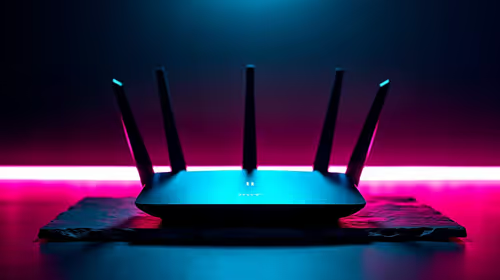
Wi-Fi 7 vs Wi-Fi 6e for competitive esports comes down to router support, latency goals, device compatibility, and coverage. SA buyers should match the choice to the real network setup.
Read more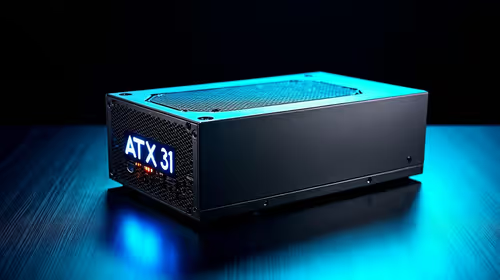
ATX 3.1 vs ATX 3.0 for mMO and live-service games buyers - what changes is mostly about compatibility, budget, upgrade path, and setup fit. SA buyers should check device support and real needs before expecting a clear win from either option.
Read more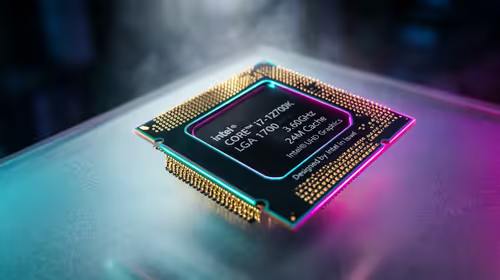
LGA 1851 vs LGA 1700 can affect Twitch and YouTube streaming when gaming and encoding share CPU resources. For SA creators, the real-world difference depends on encoder choice, memory support, motherboard cost, thermals, and upgrade plans.
Read more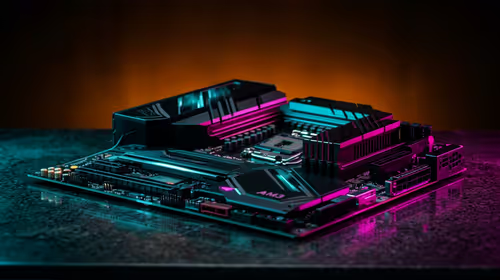
X870E vs X670E for aaa single-player gaming is mainly about fit, features, compatibility, cost, and upgrade path, not one automatic winner. SA buyers should match the choice to the setup.
Read more
Hall Effect switches vs Mechanical switches for mMO and live-service games is mostly about compatibility, budget, upgrade path, and setup fit. SA buyers should check device support and real needs before expecting a clear win from either option.
Read more
A fake 113GB GTA VI ISO reportedly used empty padding around a small malware payload. SA gamers should delete unofficial builds, keep Windows security active and wait for official channels.
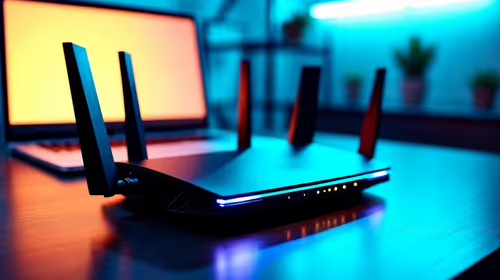
Wi-Fi 6E vs Wi-Fi 6 matters for 4K video editing when files move across a network. The real-world difference between Wi-Fi 6E and Wi-Fi 6 for video editing in 4K depends on NAS access, cloud uploads, router range, and SA creator workflows.

The difference between PCIe 5.0 and PCIe 4.0 for SA gamers is mostly bandwidth headroom. Compare GPU slot needs, NVMe speed, motherboard support, and upgrade timing before paying extra for a newer platform.

Gaming PC stuck pixel checks in South Africa should confirm the monitor fault first. Use colour tests, screenshot comparison, cable swaps, display menu checks, and clear photos before deciding on support.

Shokz OpenFit Air 2 earbuds weigh 7.2g each and use a redesigned dual-driver open-ear layout. SA buyers should choose them for comfort and awareness, not maximum isolation.

AMD's current driver now lists a Radeon RX 9050 4GB, while product coverage details a narrowed memory system. SA buyers should weigh the low VRAM ceiling against current local Radeon options.

Samsung Display has demonstrated a 16-inch 2.5K OLED laptop panel running at 300Hz. SA buyers should wait for a named notebook, full panel specifications and a local price before planning an upgrade.

Microsoft says some Windows 11 game crashes after recent updates are linked to RGB-related drivers. Affected SA gamers should confirm the update and driver before using the published registry workaround.
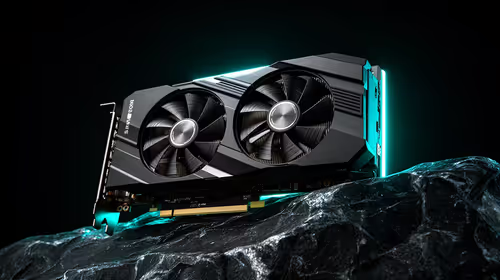
RTX 5090 on a 650W PSU is a tight pairing with very limited headroom. For SA gaming PCs, focus on total system draw, PSU quality, connector support, CPU choice, and avoid OC plans unless the full build is carefully power-limited.
PCIe 5.0 vs PCIe 4.0 for video editing in 4k is mainly about fit, features, compatibility, cost, and upgrade path, not one automatic winner. SA buyers should match the choice to the setup.
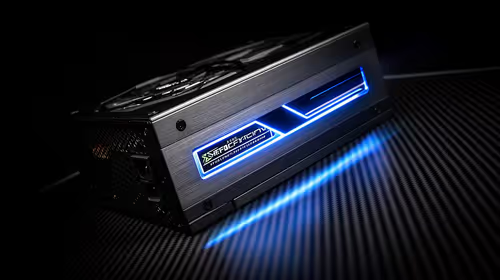
850W PSU safety for RTX 5090 is plausible with a quality unit and balanced parts. In SA, confirm connector support, CPU power draw, case airflow, PSU age, and spare capacity before building around 850W.
Wi-Fi 7 vs Wi-Fi 6e for competitive esports comes down to router support, latency goals, device compatibility, and coverage. SA buyers should match the choice to the real network setup.