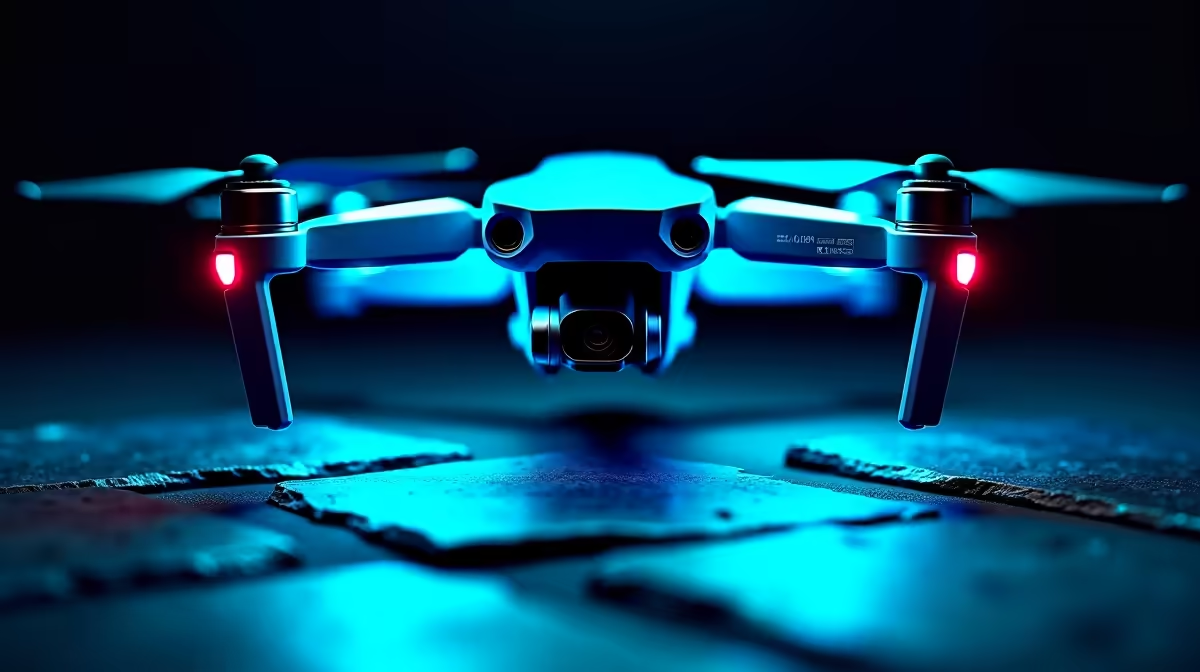
Not all drone collision sensing is equal, and the gap between tiers is the gap between a drone that stops at a tree and one that flies smoothly around it. Drone obstacle avoidance tiers run from basic forward-and-downward detection on entry models, through three-way sensing that halts when it spots a hazard, up to omnidirectional systems like DJI's APAS that sense in every direction and route around obstacles automatically. Knowing which tier a drone offers tells you exactly how much margin for error you are buying.
Quick Answer
There are three broad tiers. Entry drones sense forward and downward only. Mid-tier drones add three-way detection that stops the aircraft at a hazard. Top-tier omnidirectional systems, branded APAS on DJI, sense in all directions and automatically navigate around obstacles rather than just halting. Higher tiers mean more sensors, more processing, and a higher price.
Tier One: Forward And Downward Only
The most affordable drones carry sensors on the front and the underside. Forward sensors help avoid head-on collisions when flying ahead, and downward sensors assist with stable hovering and safe landings by reading the ground beneath the aircraft.
The limitation is everything they do not watch. Fly backward, sideways, or up, and the drone is effectively blind in those directions. For a beginner flying carefully in open space this is workable, but it demands constant pilot awareness, since the aircraft will not save you from a hazard it cannot see.
Tier Two: Three-Way Sensing
The middle tier adds sideways or rearward coverage, commonly described as three-way sensing across forward, backward, and downward axes. This closes the most dangerous blind spots for typical flying, particularly the backward direction where many pilots clip obstacles while pulling away from a subject.
How Three-Way Systems Behave
The defining trait of this tier is that it stops rather than steers. When a sensor detects an obstacle, the drone brakes and holds position, leaving it to the pilot to choose a new path. That is a genuine safety net and prevents a great many crashes, but it interrupts the shot and the flow of flying. You are protected, but the drone is not yet flying intelligently around the world for you.
Tier Three: Omnidirectional Sensing And APAS
The top tier places sensors covering every direction, so the drone perceives obstacles above, below, ahead, behind, and to both sides at once. On DJI aircraft this pairs with Advanced Pilot Assistance Systems, or APAS, the feature that changes the drone's behaviour from stopping to routing.
Why Routing Beats Stopping
With omnidirectional sensing and APAS active, the drone does not simply brake at a branch or a wall. It calculates a path around the obstacle and continues the flight, keeping your shot moving and your subject framed. For tracking a moving subject through a complex scene, this is the difference between a usable clip and a sequence of abrupt stops. It also raises the safety floor dramatically, because the aircraft is actively avoiding hazards in directions the pilot may not even be watching. Drones at this tier sit alongside other connected gear, and you can check the smart home and connected devices range at Evetech to compare how the higher-end models are positioned against the broader kit.
Matching A Tier To How You Fly
Choose the tier by your flying, not by the spec sheet alone. A cautious beginner shooting landscapes in open fields is well served by a forward-and-downward drone and the awareness to back it up. A hobbyist filming in mixed environments benefits from three-way sensing as a safety net against the common backward clip. Anyone tracking fast subjects, flying in cluttered scenes, or wanting the drone to handle avoidance while they concentrate on the shot should look at omnidirectional APAS. The jump in price buys a real jump in capability and in how much the aircraft protects itself. Head to the accessories best sellers to find the props, batteries, and guards that pair with whichever tier you choose.
How Sensors Actually Work
Understanding the underlying tech helps you read spec sheets without being misled. Most consumer drones use vision sensors, small cameras that process images to detect objects. The processing chip looks for discontinuities in the image, shapes that do not match the expected background, and uses stereo pairs to estimate depth. This works well in daylight but degrades as light fades, because the cameras need contrast to see edges.
Top-tier drones add infrared time-of-flight sensors and, more recently, LiDAR. LiDAR bounces laser pulses off objects and times the return, giving reliable distance data down to very low light levels. The DJI Mavic 4 Pro pairs LiDAR with APAS 6.0 for this reason: it can still sense and route around obstacles at dusk or in dim indoor environments where vision sensors alone would struggle. For South African pilots who want to capture the golden-hour coastal light in the Western Cape or fly in the fading light of a Drakensberg sunset, that low-light sensor reliability is a practical edge, not just a spec-sheet line.
The Role of Processing
Sensor coverage means nothing without the computing power to act on the data in real time. The jump from stopping-tier systems to routing-tier APAS is largely a processing jump. The drone must ingest sensor data from multiple directions simultaneously, build a brief model of its immediate environment, identify a viable path around a hazard, and execute the correction, all within a fraction of a second. Entry and mid-tier systems either lack the sensor coverage or the processing headroom to do this confidently, which is why they default to stopping rather than steering.
Practical Scenarios Where Tier Matters
Flying Through Trees
Tracking a mountain biker through a forest is where tier differences become very obvious, very fast. An omnidirectional APAS drone can navigate the gaps between trunks and branches as long as they are wide enough, routing left, right, and even slightly upward to thread through. A three-way drone would stop at the first lateral branch and hold, ending the tracking shot. An entry drone would not detect the lateral hazard at all.
Orbiting a Structure
Orbiting a building, tower, or natural feature requires sideways flight for most of the manoeuvre. A drone with only forward and downward sensing is effectively blind during the sideslip. An omnidirectional system watches the structure throughout the orbit and can maintain a consistent distance, which is the difference between a clean, tightening spiral and a pilot frantically correcting to avoid clipping the wall.
Backing Away From a Subject
Pulling the drone backward for a dramatic retreat reveal is one of the most popular travel shots. It is also when rear sensing saves you, because you are flying in a direction you cannot see. Three-way and omnidirectional systems both cover this, but only omnidirectional APAS reroutes if a tree or wall is behind you at an angle that would catch the aircraft at the side.
Frequently Asked Questions
What is the difference between three-way and omnidirectional sensing?
Three-way sensing covers forward, backward, and downward and stops the drone at a hazard. Omnidirectional sensing covers every direction and, with APAS, routes the drone around obstacles instead of just halting.
Does obstacle avoidance mean a drone cannot crash?
No. Avoidance systems greatly reduce crashes but are not foolproof. Thin branches, wires, and fast unexpected obstacles can defeat sensors, so pilot awareness still matters at every tier.
What does APAS actually do?
APAS, DJI's Advanced Pilot Assistance Systems, lets the drone calculate a path around an obstacle and keep flying, rather than braking and holding position. It keeps your shot moving through complex scenes.
Is forward-and-downward sensing enough for a beginner?
For careful flying in open space, it can be. It protects against head-on collisions and helps with landing, but it leaves the sides, rear, and top unmonitored, so it demands an attentive pilot.
Which tier should I buy?
Match it to your flying. Open-field landscape work suits the entry tier, mixed-environment hobby flying suits three-way, and tracking fast subjects in cluttered scenes calls for omnidirectional APAS.
Picking the right avoidance tier comes down to how and where you fly. Explore the higher-end connected models in the smart home and connected devices range at Evetech, and stock up on guards and spares from the accessories best sellers to fly with confidence.