Quick Answer
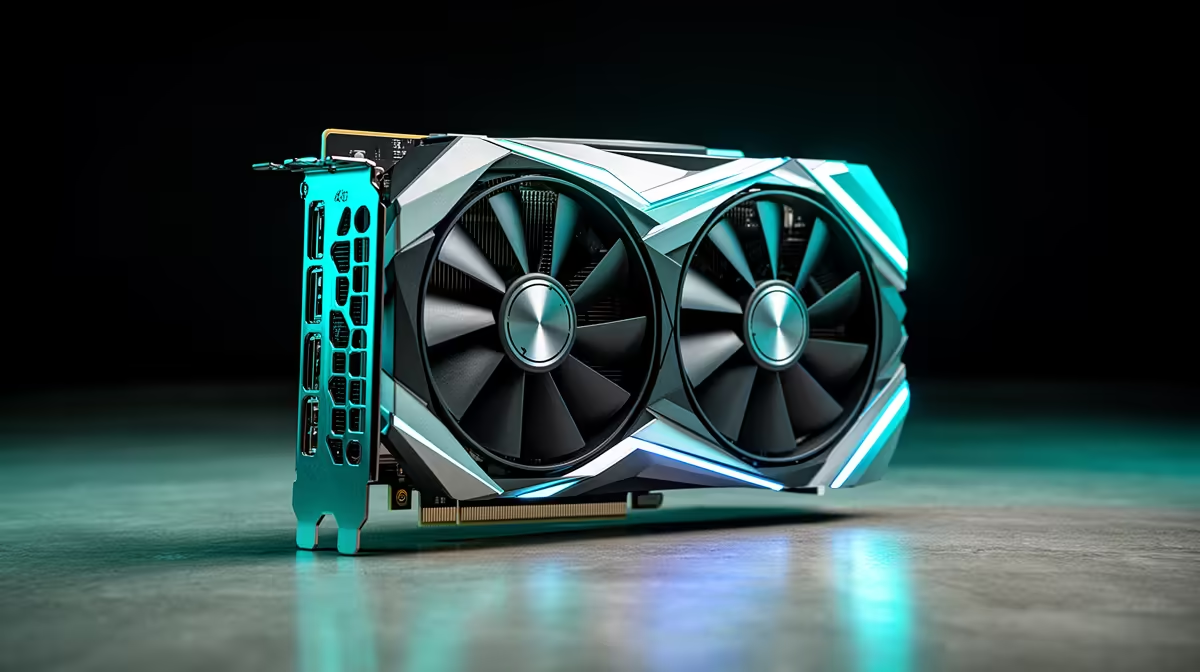
For compact PCs, dual-fan GPU designs are the better fit. They are shorter, narrower, and lighter, making them easier to install in Mini-ITX and Micro-ATX cases with restricted GPU clearance. Triple-fan and large triple-slot coolers offer better thermals but require at least 300 mm of GPU length clearance and two to three expansion slots.
What Dual-Fan GPUs Give You in a Small Build 🔧
Dual-fan GPU designs from Palit, ASUS Dual, and Gigabyte Eagle typically measure 200 to 260 mm in length and occupy two expansion slots. This fits within the clearance limits of popular compact cases including the Cooler Master NR200 and Fractal Design Terra. Weight on dual-fan cards runs under 700 g, eliminating concerns about PCIe slot sag in smaller chassis without additional bracket support.
Acoustically, dual-fan cards with 0-dB mode are completely silent at idle regardless of case size. For SA students using compact builds in res rooms or shared spaces, this is a meaningful quality-of-life benefit during study sessions between gaming sessions.
The Case for Larger Coolers in Bigger Builds 🖥️
A triple-fan, three-slot GPU has more heatsink surface area, more airflow, and lower peak temperatures than a dual-fan card on the same chip. For high-TGP cards above 200W, a larger cooler keeps fan RPMs lower at the same temperature, reducing noise under load.
If your case is a mid-tower or full-tower with 320 mm or more of GPU clearance, a larger cooler is worth the extra cost. Cards with large vapor chamber coolers can keep a high-end GPU 8 to 12 degrees Celsius cooler under sustained load compared to a compact dual-fan design. For SA gamers in Gauteng gaming in summer at ambient temperatures above 28 degrees Celsius, that thermal headroom translates directly into sustained clock speeds.
Choosing the Right Cooler Size for Your Case 💡
Before buying a GPU, measure your case's maximum GPU clearance from the PCIe bracket to the front panel, then confirm the slot count. Most Mini-ITX cases support two-slot cards; some support three-slot designs with slightly wider chassis dimensions.
Add 20 to 30 mm to the stated GPU length to account for the power connector clearance needed at the end of the card. A card listed as 280 mm needs roughly 300 to 310 mm of actual internal clearance. For mid-tower builds there is no reason to avoid a triple-fan design if the card fits within the case's GPU length limit.
Cross-Check GPU Length Against Case Clearance Before Ordering ⚡
GPU dimensions on the box do not include the power connector overhang. Always add 20 to 30 mm when comparing against your case's maximum GPU clearance figure. A card that fits by 5 mm in spec may physically conflict with a front panel fan bracket. Check the case manufacturer's compatibility page for your specific case model where available.
FAQ
Do dual-fan GPUs run hotter than triple-fan cards at the same TGP?
Generally 5 to 10 degrees Celsius hotter under sustained load. For mid-range GPUs with TGP ratings below 150W this rarely causes throttling. For high-TGP cards above 200W the gap is more consequential and a larger cooler is recommended.
Can I install a triple-fan GPU in a vertical mount compact case?
Some compact cases support vertical GPU mounting via a riser cable, which accommodates longer cards using the case width. This requires a PCIe Gen 4 riser cable and adds R500 to R1,200 in cost. Confirm vertical mounting support before purchasing the riser.
Will a dual-fan GPU throttle during SA summer gaming sessions?
In a well-ventilated case with positive airflow, an RTX 5060-class dual-fan card should not throttle even at 30-degree ambient. Ensure at least two intake fans at the front and one exhaust at the rear or top to maintain adequate airflow.
Need a GPU that fits your compact build?
Evetech stocks compact dual-fan GPU designs from Palit, ASUS, and Gigabyte sized for Mini-ITX and Micro-ATX builds. Browse the graphics card category and check length specs to find a card that fits your case.