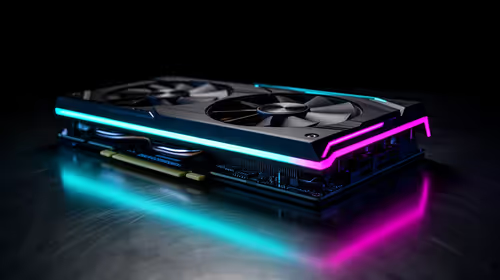
Handhelds and mini PCs are wonderfully portable, then you dock them and wish for desktop graphics power. An eGPU for handhelds and mini PCs bridges that gap, letting a ROG Ally, Legion Go, or compact PC borrow a full desktop graphics card through an external enclosure. The performance you get depends entirely on which port your device exposes and how much bandwidth it carries.
Quick Answer
The ROG Ally X exposes a 40 Gbps USB4 port for eGPU enclosures, while the original ROG Ally and many mini PCs use OCuLink at PCIe 4.0 x4 for roughly 64 Gbps. More bandwidth means less performance lost over the link, so OCuLink generally beats USB4 for eGPU work, though USB4 is more flexible. Either can turn a handheld into a near-desktop gaming rig when docked.
Why bandwidth is the whole story
A desktop graphics card normally sits in a full PCIe x16 slot inside a tower. Connecting one externally to a handheld means squeezing that data through a far narrower pipe, and how narrow decides how much of the card's performance survives the trip. This is why the port matters more than almost anything else in an eGPU setup.
The two connections you will meet are USB4 and OCuLink, and they behave quite differently.
USB4 and OCuLink compared
USB4 at 40 Gbps
USB4 is the more convenient option. It is a standard, increasingly common port that carries data, video, and power, and the ROG Ally X exposes it specifically for eGPU and dock use at up to 40 Gbps. The trade-off is overhead: USB4 reserves bandwidth for other functions, so an eGPU sees less than the full 40 Gbps, and that costs some frames compared with a dedicated link.
Real-world testing with the ROG Ally X bears this out. At 1440p with demanding titles, frame rates through USB4 can dip notably below what OCuLink delivers, particularly with GPUs above the RTX 4070 tier that push more data than the 40 Gbps pipe can comfortably handle. For mid-range cards in the RTX 4060 Ti class, USB4 handles the load more gracefully.
OCuLink at PCIe 4.0 x4
OCuLink is the performance choice. It is effectively a direct PCIe 4.0 x4 connection, delivering around 64 Gbps with far less overhead than USB4, which puts it closer to native desktop GPU bandwidth. The original ROG Ally and many mini PCs offer OCuLink for exactly this reason. The catch is that it is a dedicated port: less common, sometimes needing an adapter, and not carrying power or video the way USB4 does.
In benchmark comparisons, the same GPU tested over USB4 versus OCuLink on compatible devices has shown GPU bandwidth jumping from roughly 2.4 GB/s to over 6.7 GB/s -- a difference that translates directly into higher and more consistent frame rates at 1080p and 1440p.
In short, OCuLink trades convenience for raw throughput, while USB4 trades some performance for being a do-everything connector.
What you need for an eGPU setup
Building one out involves a few parts beyond the graphics card itself.
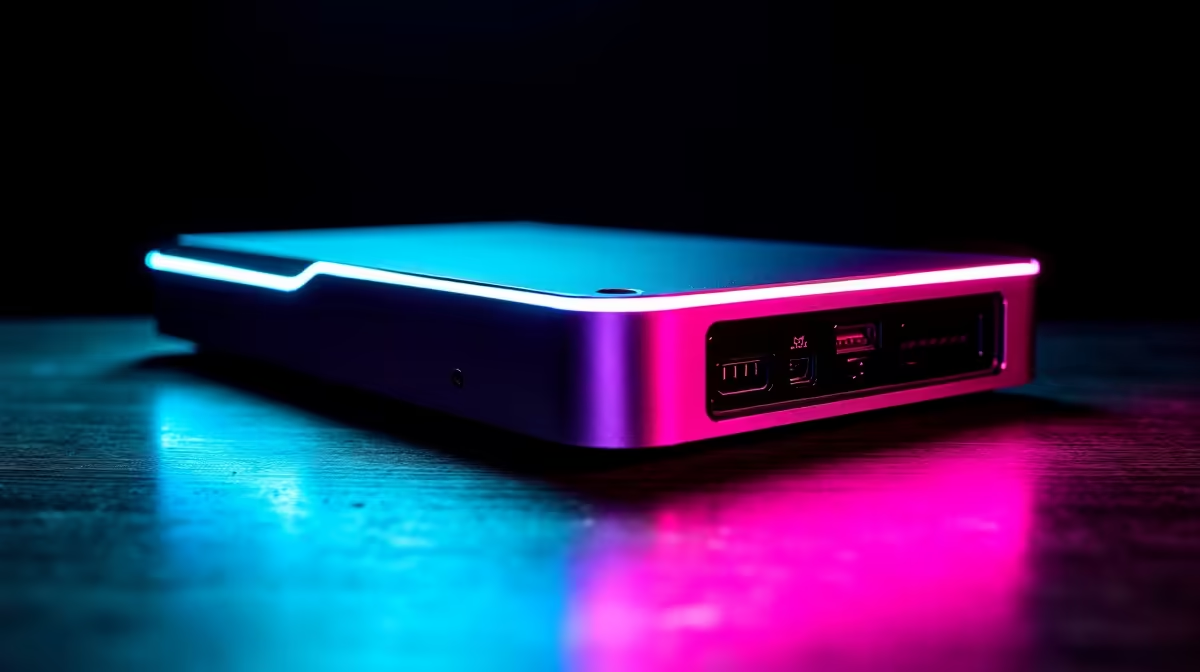
You need an eGPU enclosure or dock that matches your port, USB4 or OCuLink, with its own power supply sized for the card. You need a desktop graphics card to install in it. And you need a device that exposes the right port, which is the part to confirm before buying anything. Evetech's docking station range is a practical place to see what connection types and enclosures are available locally.
Bear in mind that an external link always loses a little performance compared with the same card in a tower, especially at lower resolutions where the CPU and connection matter most. The gap narrows at higher resolutions where the GPU does more of the work.
Picking the right GPU for your link
Not every graphics card makes sense in an eGPU. The bandwidth the link provides caps how much of a card's power reaches your game, so pairing a flagship GPU with a USB4 connection wastes money on performance the pipe cannot deliver.
For USB4 setups, cards in the RTX 4060 Ti or RX 7700 XT range are well matched to the available bandwidth. They get close to their full potential through a 40 Gbps link and deliver strong gaming performance without burning budget on capability that never arrives.
OCuLink setups can justify a step higher. The lower overhead and higher throughput of a direct PCIe 4.0 x4 link mean a more powerful card -- say, an RTX 4070 or RX 7900 GRE -- can actually stretch its legs rather than waiting on the connection. Even so, the mid-range sweet spot still offers the best value per Rand for most handheld eGPU builds.
Who benefits most
An eGPU makes the most sense for someone who wants one device for two jobs: a portable handheld or tiny mini PC on the move, and something close to a desktop gaming experience when docked at home. Rather than owning both a handheld and a full tower, you carry the small unit and dock it into serious graphics power.
It is less compelling if you mostly play at home, where a dedicated desktop will always be cheaper per frame, or if your device only has a slower port that throttles the card heavily. To see which graphics cards people pair with these setups, the GPU best sellers at Evetech reflect popular choices among local buyers.
SA context
For South African gamers, an eGPU can be a smart way to consolidate spend into one capable handheld plus an enclosure rather than two separate machines. Just confirm the exact port on your specific model first, since the difference between OCuLink and USB4 directly shapes what performance you will actually see.
Frequently Asked Questions
Is OCuLink faster than USB4 for an eGPU?
Generally yes. OCuLink runs a PCIe 4.0 x4 link at around 64 Gbps with little overhead, while USB4 tops out at 40 Gbps and shares bandwidth with other functions, so OCuLink usually delivers more GPU performance.
Which ROG Ally supports an eGPU?
Both, but differently. The ROG Ally X uses a 40 Gbps USB4 port, while the original ROG Ally offers OCuLink. Confirm which your unit has, since it changes the enclosure you need and the performance you get.
Will an eGPU match a desktop with the same card?
Not quite. An external link always loses some performance versus the same card in a tower, most noticeably at lower resolutions. The gap shrinks at higher resolutions where the GPU does more of the work.
Do I need a separate power supply for an eGPU?
Yes. The enclosure must power the desktop graphics card itself, so eGPU docks include or require a power supply sized for the card you intend to run.
Can mini PCs use an eGPU too?
Many can, often via OCuLink, which is why it is a popular way to add real graphics power to a compact PC. Check your mini PC's ports before buying an enclosure.