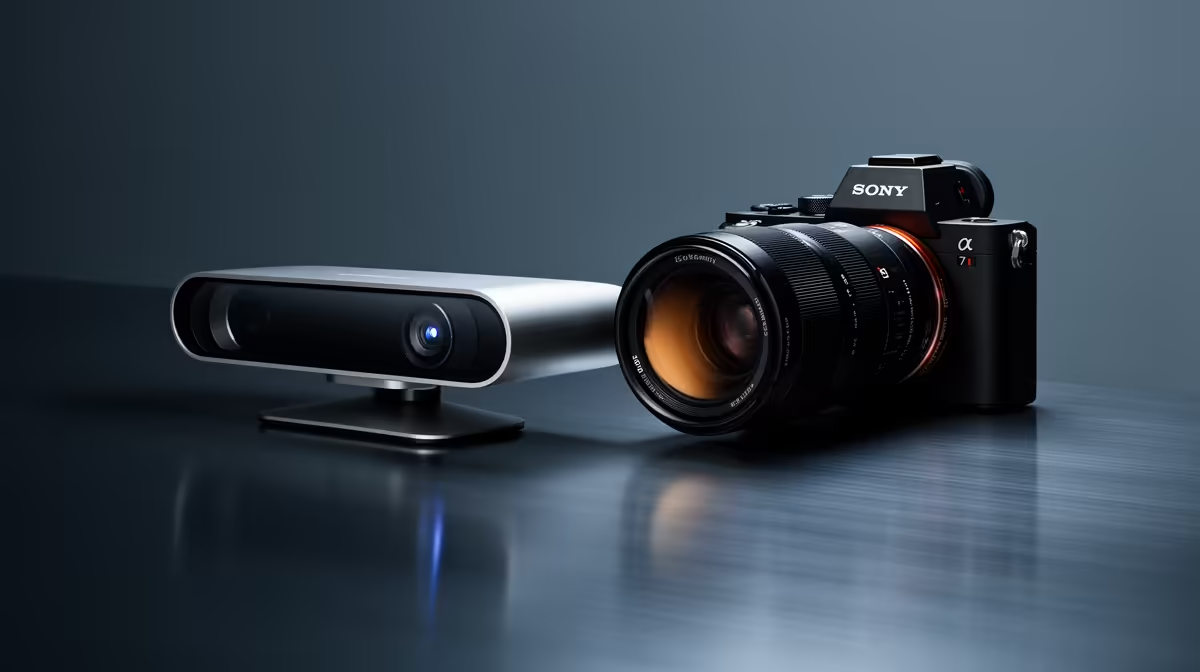
A webcam built for a solo home office is the wrong tool for a boardroom with six seats. The physics of distance and angle mean that a camera designed to capture one face at 50 centimetres struggles to frame a table, and a microphone optimised for a single speaker at arm's reach cannot reliably pick up a colleague at the far end of the room. Professional conferencing cameras solve both problems with hardware choices that are distinct from general-purpose streaming webcams, and understanding what those differences are helps you buy the right device rather than an expensive one that still leaves remote participants straining to see or hear.
Quick Answer
A professional conferencing camera needs a wide adjustable field of view between 90 and 120 degrees to frame a full meeting table, AI auto framing to follow active speakers, a multi-mic array with at least 3 metres of pickup range, and solid mounting hardware for a wall or display installation. Resolution matters less than getting audio and framing right.
📺 Field of View and Room Coverage
The first specification to check in a conferencing camera is the field of view, and more specifically whether it is adjustable or fixed. A standard streaming webcam has a field of view of roughly 65 to 80 degrees, designed to frame one person at a desk. A meeting room with six people around a two-metre table needs a field of view of at least 90 degrees to fit everyone in frame, and a larger boardroom may require 110 to 120 degrees.
The challenge with very wide fields of view is barrel distortion. Cheaper wide-angle optics produce a curved horizon and elongated faces near the edges of the frame, which reads as unprofessional on a video call. Quality conferencing cameras use corrected wide-angle optics that reduce this distortion, keeping faces at the edges of the frame proportionate rather than stretched.
Adjustable field of view is a meaningful feature in a shared space where the camera might serve a four-seat huddle room one day and a larger boardroom the next. A camera that allows the field of view to be narrowed digitally or optically gives the administrator flexibility without needing a separate device for each room size.
Placement and Line of Sight
Where the camera mounts determines whether the wide field of view actually covers the table. The optimal position for a conferencing camera is above the display screen it is connected to, at roughly seated eye level relative to participants. This position minimises the unflattering upward angle of a table-mounted camera and provides a clear horizontal sightline across the meeting table.
Wall mounts and display-top brackets designed for conferencing cameras allow precise horizontal and vertical adjustment after installation. A camera that can be tilted and panned after mounting accommodates the variety of room configurations found across South African offices, where a standardised ceiling height and screen position cannot always be assumed.
🎙️ Microphone Array Design and Range
The audio component of a conferencing camera is where the most significant performance variation exists between consumer-grade and professional devices. A standard webcam microphone captures a single speaker at close range. A conferencing camera is expected to pick up voices from every seat around a table, some of which may be three to five metres from the device.
A professional conferencing camera uses an array of three or more microphones spaced across the housing. The array allows the processing firmware to apply beam-forming, a technique where the arrival time difference of sound at each microphone is used to calculate the direction of the source and amplify it while suppressing other directions. The practical effect is that the camera can focus its microphone sensitivity on whoever is speaking without requiring them to lean toward the device.
AI-based noise suppression in the microphone array handles the ambient noise present in most South African office environments: HVAC systems, street noise through windows, the hum of office equipment. A board meeting in a Johannesburg CBD high-rise or a Cape Town office park involves consistent background noise that the AI model needs to separate reliably from voice.
Effective microphone range for a mid-size boardroom should reach at least three to five metres to cover all seated participants. Some devices designed for larger rooms extend this to eight metres or more, though these typically fall into a higher price bracket.
Pro Tip ⚡
When testing a conferencing camera's microphone coverage, have the most distant participant from the camera read a sentence at a natural speaking volume rather than projecting. Remote meeting participants should be able to hear that voice without straining. If they cannot, the microphone range is insufficient for the room and the camera placement needs to move closer or the array needs upgrading.
🎯 Auto Framing for Meeting Contexts
Auto framing in a conferencing context operates differently from solo-presenter tracking. Rather than following a single moving subject, meeting auto framing typically shifts between two modes: a wide group shot that captures all participants, and a closer crop on the active speaker identified by voice activity.
Speaker tracking, where the camera or its software identifies who is talking and shifts the crop toward them, helps remote participants follow the conversation without the host having to manage camera switching manually. In a five-person meeting where questions and responses move around the table, this feature reduces the cognitive load on the person running the call and gives remote participants a more natural experience.
The limitation is accuracy. Early speaker tracking implementations that relied purely on audio direction could be fooled by a loud noise near a non-speaking participant. Better implementations combine audio direction with face detection, reducing false switches. For a formal meeting where only one person speaks at a time, these systems work well. For a lively discussion with overlapping voices, the tracking may struggle to settle on a clear subject.
🔧 Additional Features Worth Evaluating
Resolution requirements for conferencing cameras are lower than for streaming cameras. A 1080p output at the frame rates used by conferencing platforms is sufficient for face-to-face clarity in most meeting contexts. 4K becomes more relevant when the application involves reading text -- a whiteboard presentation, a document held up for the camera -- where the extra resolution makes fine detail legible.
Privacy features are increasingly relevant in corporate environments. A physical lens cover or an automatic privacy shutter that engages when the camera is off provides assurance to both participants and IT security teams that the device is not active between meetings. Some devices include an LED indicator that is hardwired to the lens circuit and cannot be disabled in software, which is a stronger assurance than a software indicator alone.
USB-C connectivity is becoming standard at the professional tier, which simplifies the single-cable connection to a laptop in a hot-desking room. Some conferencing cameras also support power delivery over USB-C, so the camera can charge a connected laptop while handling video and audio on the same cable.
Frequently Asked Questions
What field of view works best for a standard six-person meeting table?
A 90 to 100-degree field of view covers a standard six-seat meeting table when the camera is mounted above the display at the end of the room. Rooms wider than they are long, or tables with participants at the sides rather than opposite ends, may need a 110 to 120-degree angle to avoid cutting off the corner seats.
How important is the microphone array compared to the camera resolution?
In most meeting contexts, the microphone array matters more. A remote participant who cannot hear clearly because the mic does not reach their seat is effectively excluded from the meeting. A participant who is seen at 1080p rather than 4K loses nothing of practical value. Budget accordingly and do not sacrifice microphone range to afford resolution.
Does a conferencing camera need 4K to read whiteboard text?
For a whiteboard at the far end of a mid-size room, yes, 4K is useful. The extra resolution allows the camera to digitally zoom into the board without losing legibility. For most conversation-focused meetings without document or whiteboard sharing, 1080p is entirely adequate and the encoding overhead of 4K can slow older meeting room hardware.
Should a conferencing camera be USB or network-connected for a South African office?
For a single meeting room, USB to a dedicated room PC or video bar is simpler and reliable. For a multi-room deployment where cameras need central management, or where cable runs are too long for USB, a wired network connection on a properly configured LAN offers distance flexibility and stable throughput on South African fibre infrastructure.
How often does AI speaker tracking misfire, and is it worth enabling?
In well-lit rooms with clear acoustics, current speaker tracking is reliable enough that it improves the remote experience more than it interrupts it. The misfires that occur are typically brief, lasting one to two seconds before the algorithm corrects. For very informal or multi-speaker discussions, disabling tracking and using the wide group shot full-time is a valid alternative.
Ready to upgrade your meeting room to a proper conferencing setup?
Browse the professional webcam and conferencing camera range for South African businesses, and find a device built for the room size and meeting style you actually have.