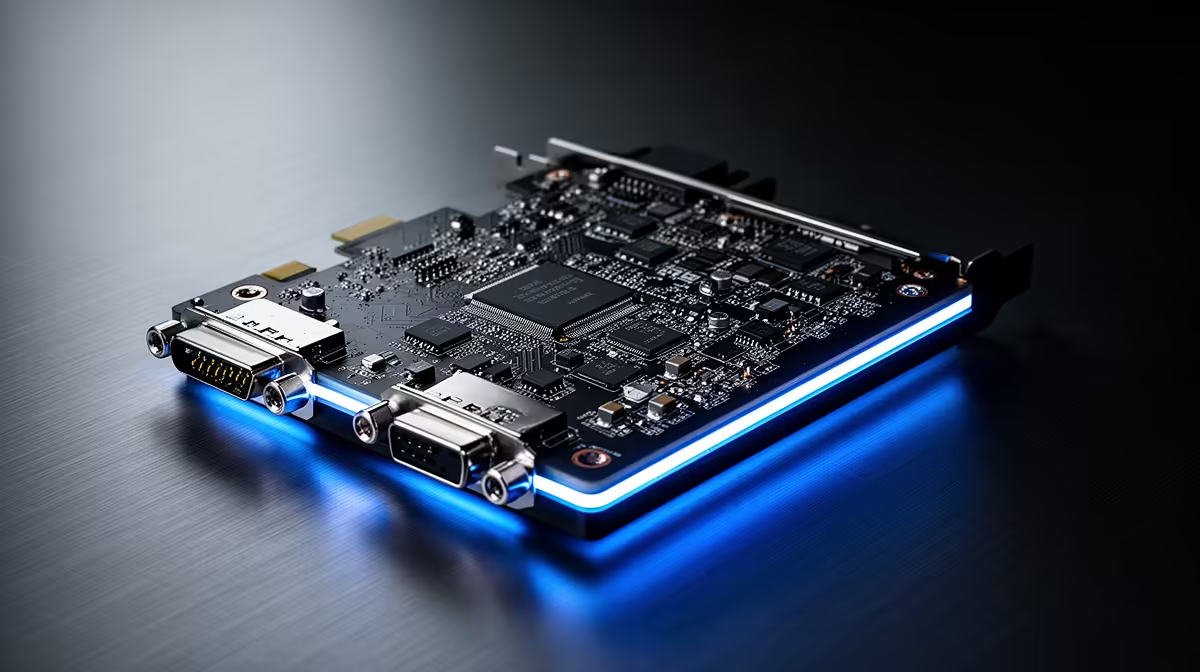
Every capture card with a premium spec sheet lists both 4K60 recording and ultra-HD pass-through, often in adjacent bullet points. They sound related, and they share hardware, but 4K60 video capture and ultra-HD pass-through are doing entirely different jobs. One preserves your gameplay for later, the other makes sure you can play without lag right now. Running both simultaneously is the whole point of the design.
Quick Answer
Capture encodes and saves a video file. Pass-through forwards the live signal to your display without recording anything. Capture applies compression and writes to disk. Pass-through stays uncompressed and adds under 1ms of delay, so your gameplay feels instant while the card records in the background.
🎯 The Capture Path: Encoding for Storage
When a capture card records footage, it is performing active computation. The raw 4K60 signal arriving at the HDMI input is an enormous continuous data stream, typically equivalent to 12 Gbps of uncompressed video. Storing that directly would fill a 2TB drive in under 30 minutes, so the card's hardware encoder converts it on the fly into a compressed format like H.264 or H.265.
H.265 is the more efficient of the two. At a given bitrate it preserves more detail than H.264, which is why high-end cards favour it for 4K capture. A typical 4K60 recording at H.265 runs around 100 to 130 Mbps, roughly a sixth of the raw data rate, while retaining enough quality for archival footage and YouTube uploads.
The compression introduces a secondary consideration: the card must perform this encoding in real time without dropping frames. Entry-level hardware encoders struggle at 4K60, introducing artefacts during fast movement. Cards with dedicated encoding chips handle it cleanly, and the quality of that chip is often a better predictor of recording quality than the sensor resolution on its own.
The encoded file writes continuously to the PC's storage while recording is active. A fast NVMe drive keeps up easily; a slow HDD or a nearly-full drive creates write bottlenecks that drop frames mid-recording. Storage speed is a quiet but important variable in the capture path.
How Compression Affects the Recording
Compression is a trade-off, not a flaw. The goal is a file small enough to manage but detailed enough to withstand editing and re-encoding. For live streaming, the recording is typically a separate higher-bitrate archive alongside the lower-bitrate stream sent to the platform.
Motion is where compression shows its limits. Static scenes compress efficiently because large image areas repeat across frames. Fast gameplay and particle effects generate more unique data per frame, producing blocky artefacts at lower bitrates. Higher bitrate settings, enabled by Gen 2 bandwidth, reduce that degradation significantly.
🔆 The Pass-Through Path: Zero-Delay Display Routing
Pass-through is the opposite of capture in almost every way. Where the capture path compresses and stores, the pass-through path simply reroutes the incoming HDMI signal to a second HDMI output connected to your display. No encoding, no file writing, no compression.
Because the signal is not processed, it introduces almost no delay. High-quality HDMI 2.0 pass-through operates under 1ms, a delay so small it is physically impossible to detect in gameplay. This is why the pass-through output is the display connection you actually play on during a session. Playing through the capture preview in software introduces the latency of the encoding pipeline, which can reach 100 to 300ms depending on the software and computer speed, which is unplayable for competitive titles.
The pass-through output also preserves the full signal. Where capture applies compression, pass-through sends the same signal the console or PC generated, including HDR metadata, chroma values, and the full colour range. What your TV or monitor receives is the original, not a processed copy.
Pro Tip ⚡
Always connect your TV or monitor to the capture card's HDMI pass-through output, not to the console directly. This keeps the card in the signal chain during play so you never need to reseat cables between gaming and recording sessions, and the sub-1ms pass-through delay is imperceptible even in competitive play.
🚀 Running Both Paths Simultaneously
The engineering value of a capture card is that both paths operate at the same time. The incoming HDMI signal is split internally: one copy goes to the pass-through output for your display, the other goes to the encoder for the recording file. Neither path knows about or interferes with the other.
This means you play on your TV via pass-through at under 1ms while OBS simultaneously records a compressed 4K60 file on your PC. The recording does not affect what you see. The display does not affect what gets recorded. The two functions are genuinely independent.
The simultaneous operation demands capable hardware. A card running both paths at 4K60 requires adequate HDMI 2.0 bandwidth on both outputs, an encoder fast enough to keep pace, and a USB-C 3.1 Gen 2 link to transfer footage without throughput starvation.
Cards with HDMI 2.1 extend this further, passing 4K120 to a compatible display while capturing at 4K60 on the recording path. The two paths running at different specs is intentional design, matching each path to what it is actually used for.
🧠 Resolution Mismatches and Why They Happen
One source of confusion is seeing different resolutions listed for the capture path and the pass-through path on the same card. A card might advertise 4K120 pass-through alongside 4K60 capture, or 1080p60 capture with 4K30 pass-through.
This is not a compromise. It reflects the fact that the two paths have different constraints. Pass-through is limited only by the HDMI version and bandwidth of the output connector. Capture is limited by the encoder's processing speed, the USB transfer bandwidth, and the storage write rate. A card can route a 4K120 signal to a display without slowing it down, because routing is passive. Encoding 4K120 to a file is four times the data of 4K30, which requires a substantially more powerful encoder and a much faster storage pipeline.
Understanding this split removes the apparent contradiction. The display path shows you the game at its best. The recording path captures at the highest quality the hardware can encode and transfer efficiently.
Frequently Asked Questions
What is the main practical difference between capture and pass-through?
Capture produces a file you can edit, upload, or archive. Pass-through does none of those things. It just routes the signal to your screen with minimal delay so your gameplay is not affected. Both run simultaneously on a capable card, with the recording happening in the background while you play through the pass-through output.
Does pass-through apply any compression to the signal?
No. The pass-through path does not touch the signal content. It routes the electrical HDMI signal from input to output intact, preserving the full resolution, frame rate, HDR metadata, and colour range exactly as the source generated it. Compression is a feature of the capture path only.
Which path adds latency to gameplay?
The capture path adds latency if you play through the preview in recording software, which introduces the encoding delay. That can reach over 100ms. The pass-through path adds under 1ms, which is why you always play through the HDMI pass-through output on your TV or monitor rather than through the software preview window.
Can the two paths run at different resolutions on the same card?
Yes, and on cards with HDMI 2.1 this is common. The pass-through output might carry 4K120 to a 120Hz display while the capture encoder records at 4K60 to keep file sizes manageable. The card routes the full signal to the display and separately encodes a version suited to storage and streaming.
Is pass-through useful if I am not recording?
For display purposes it works like an HDMI splitter, putting your video on screen without recording anything. But running the card only for pass-through with no recording active is unnecessary. A direct HDMI connection to your display is simpler and identical in quality. Pass-through earns its value when the card is already in the chain for recording, keeping you from reseating cables between sessions.
Ready to record 4K footage without it affecting your gameplay?
Browse the capture card range and find hardware with true simultaneous pass-through and recording so your display and your archive never compete.