Lower-back support is not one universal mechanism. Fixed, adjustable and auto-wrap lumbar support describe different ways a chair can make contact, and each needs to be judged against the user's posture and work. The R7,399 E3 Air represents the auto-wrap approach with three zones spanning 80 degrees.
Quick Answer
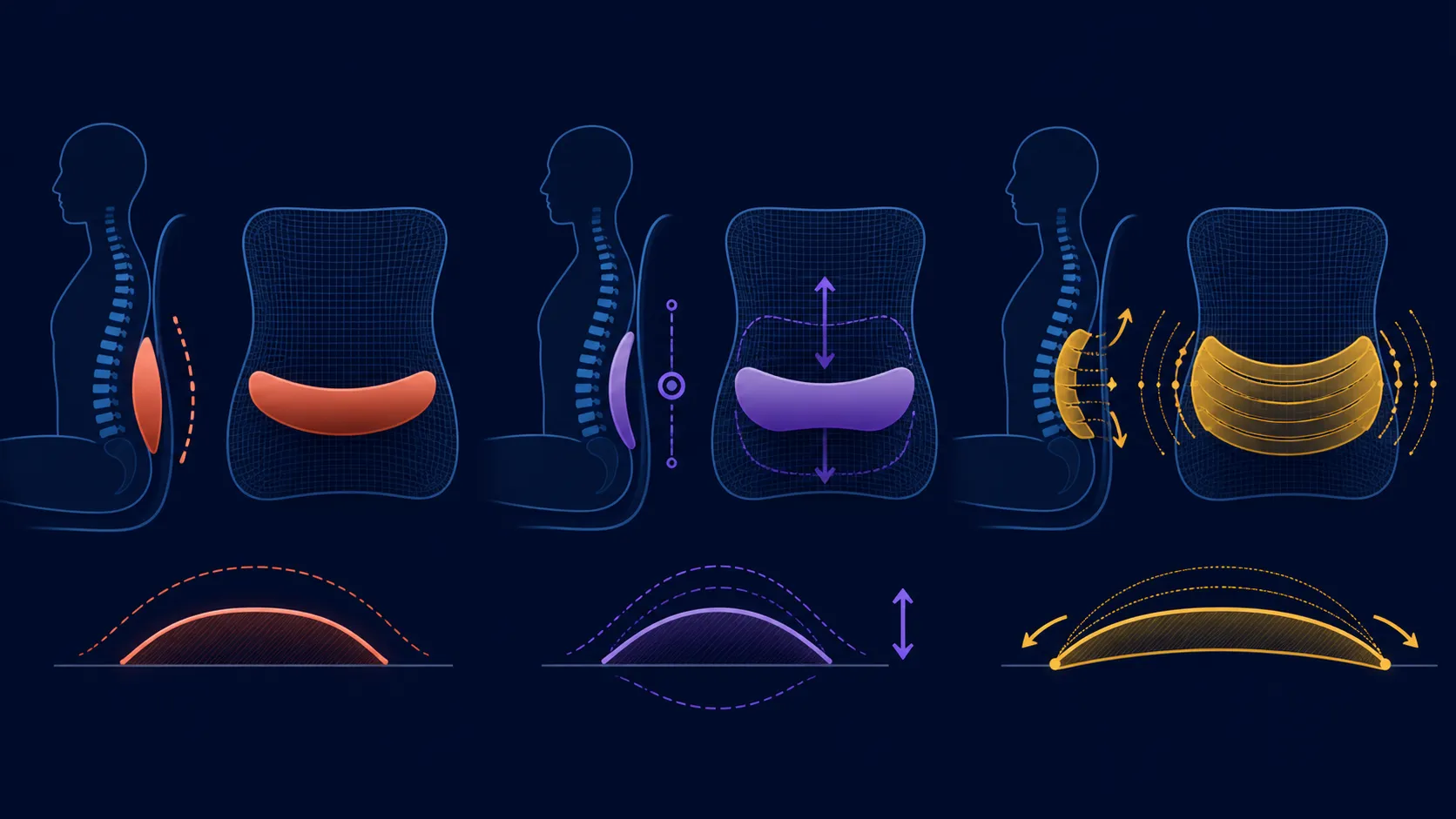
Auto-Wrap on the E3 Air extends fixed lumbar support with 80-degree rotational freedom, six height settings, four depth locks and a 12-degree dynamic flex track.
Fixed lumbar retains a set form, adjustable support lets the user alter some aspect of contact, and auto-wrap is intended to follow farther around the supported area. None is automatically superior. At R7,399, the E3 Air provides a specific three-zone, 80-degree auto-wrap example; buyers should compare coverage and fit without assuming a medical result.
🧱 Understand the fixed approach
Fixed lumbar is built into a chair with a support shape that the user does not reposition. Its strength is simplicity: there may be nothing to tune or forget. Its limitation is equally direct, because the seated person must fit the shape rather than moving that shape toward the body.
A useful check places the chair at the real desk and asks where the fixed contact lands during typing, mouse use and reading. If the support is comfortable only when the user holds an unusual pose, it is not serving the normal routine. Seat height, depth and backrest geometry can alter that relationship, so exact chair dimensions still matter.
Fixed does not mean ineffective, just as more controls do not mean better. Someone whose back meets the built-in form naturally may prefer the low-maintenance arrangement. Another person may need movement that the design cannot provide. The correct conclusion comes from fit rather than the apparent sophistication of the mechanism.
Fixed support can also simplify handover at a shared desk because one setting cannot be left in the wrong position. That advantage disappears if the built-in form suits none of the regular users. Ask each person to perform the same brief task and describe the contact before the household assigns convenience a value.
Start a shortlist in Evetech's HBADA office-chair category by recording where support is wanted and how often settings will be shared or reset.
🎚️ Define what adjustable really changes
An adjustable label is incomplete until the buyer knows which property moves. Depending on the chair, a lumbar system might change position, prominence or another aspect, but those possibilities should not be assumed for a model without checking its exact design. The value lies in matching the available motion to the mismatch the user is trying to solve.
Test one change at a time from a neutral baseline. Perform the same short desk task, note the contact and return to the starting point before trying another setting. This method prevents novelty from being mistaken for improvement and makes a useful position easier to recover.
Shared chairs raise another practical question: can each person restore a suitable setting without a lengthy process? A visible reference or short note can matter more than an extra range that nobody uses. Adjustment should reduce friction in the routine, not become a daily project.
Include the possibility of accidental movement. If a preferred state shifts while the chair is moved or another person sits down, the reset should be clear. A useful control is not merely capable; it is understandable enough to return to the intended relationship without repeated trial and error.
🫂 Interpret auto-wrap coverage
Auto-wrap aims to extend contact around the lumbar area instead of relying on a single central point. On the E3 Air, three zones work across an 80-degree wrap. Evaluate mechanism behaviour, response and individual pressure through a seated trial rather than treating the coverage angle as the answer.
Assess the chair while the user is absorbed in ordinary work. Contact that feels impressive during an intentional lean may become distracting once the person types naturally. Check whether each zone remains acceptable through small posture changes and whether the support encourages frequent shifting for the wrong reason.
The surrounding chair affects the outcome. Mesh of a high-density design, with a cloud-like description, forms this model's seat and deserves its own timed evaluation. The backrest can reach a 140-degree maximum, but a changed angle creates a new contact test; it does not prove that lumbar support follows every posture in a particular way.
Use a short upright work block and a separate changed-angle activity rather than blending both into one impression. Note which area of the back meets support in each. The comparison can reveal that a preferred lumbar approach depends on the task, which is more useful than trying to force one permanent winner.
Keep health language restrained. Lumbar design changes support contact; it neither promises relief nor treats a condition. Symptoms that continue require appropriate attention from a professional.
⚖️ Choose by routine and complete fit
Build a comparison table with four plain questions: where does the support touch, what can the user change, how easily can a preferred state be restored, and does it remain suitable during the main tasks? Apply the same questions to fixed, adjustable and wrap-around candidates.
Then include the other eligibility checks. The E3 Air limits user weight to 150kg and rests on a five-star steel base. Its headrest combines four-dimensional movement with dual axes; the mechanical arm supports move omni-directionally through 360 degrees. These facts do not make its lumbar approach better, but they determine whether the complete R7,399 chair fits the requirement.
Desk fit belongs on the same page. Measure the opening, chair path and room behind the backrest; none of those dimensions can be inferred from the capacity or base material. A lumbar preference cannot rescue a chair that does not enter the intended work zone cleanly.
Once the scorecard is ready, compare support types across Evetech's wider office-chair selection. Keep desk, task and evaluation time consistent. The winning option suits the seated person reliably, even when its label sounds less advanced.
Floating wings change curvature for different builds and aim to reduce concentrated pressure. Fixed support remains simpler, manual adjustment offers selected changes, and this bio-synchronised system moves proactively with the body. Compare contact through upright and reclined tasks.
Frequently Asked Questions
What does fixed lumbar support mean in general?
It refers to a built-in support form the user does not reposition. The practical test is whether that set shape meets the intended person appropriately in the actual working posture.
How is an adjustable design different?
It gives the user some way to alter support contact. Buyers should identify the exact property and range that change on the chair instead of inferring them from the word adjustable.
What is auto-wrap lumbar intended to do?
The approach extends contact around more of the supported area. Coverage can be useful when it fits the user, but comfort and health outcomes remain individual.
Which type appears on the E3 Air?
This chair uses an auto-wrap system across three lumbar zones, with an 80-degree coverage figure. Learn its adjustment sequence and mechanism through the chair's own controls.
Can one lumbar category predict pain relief?
No. A support type cannot diagnose or treat the cause of pain, and individual fit varies. Ongoing symptoms should be discussed with an appropriate professional.
What does the auto-wrap example cost?
Budget R7,399 for this Cloud White E3 Air example. Test that figure against the whole chair, including seat experience, capacity and upper-body adjustment needs.
Ready to compare lumbar types through one fair test?
Browse Evetech office chairs after writing down the contact, adjustability and reset questions that matter to your routine.