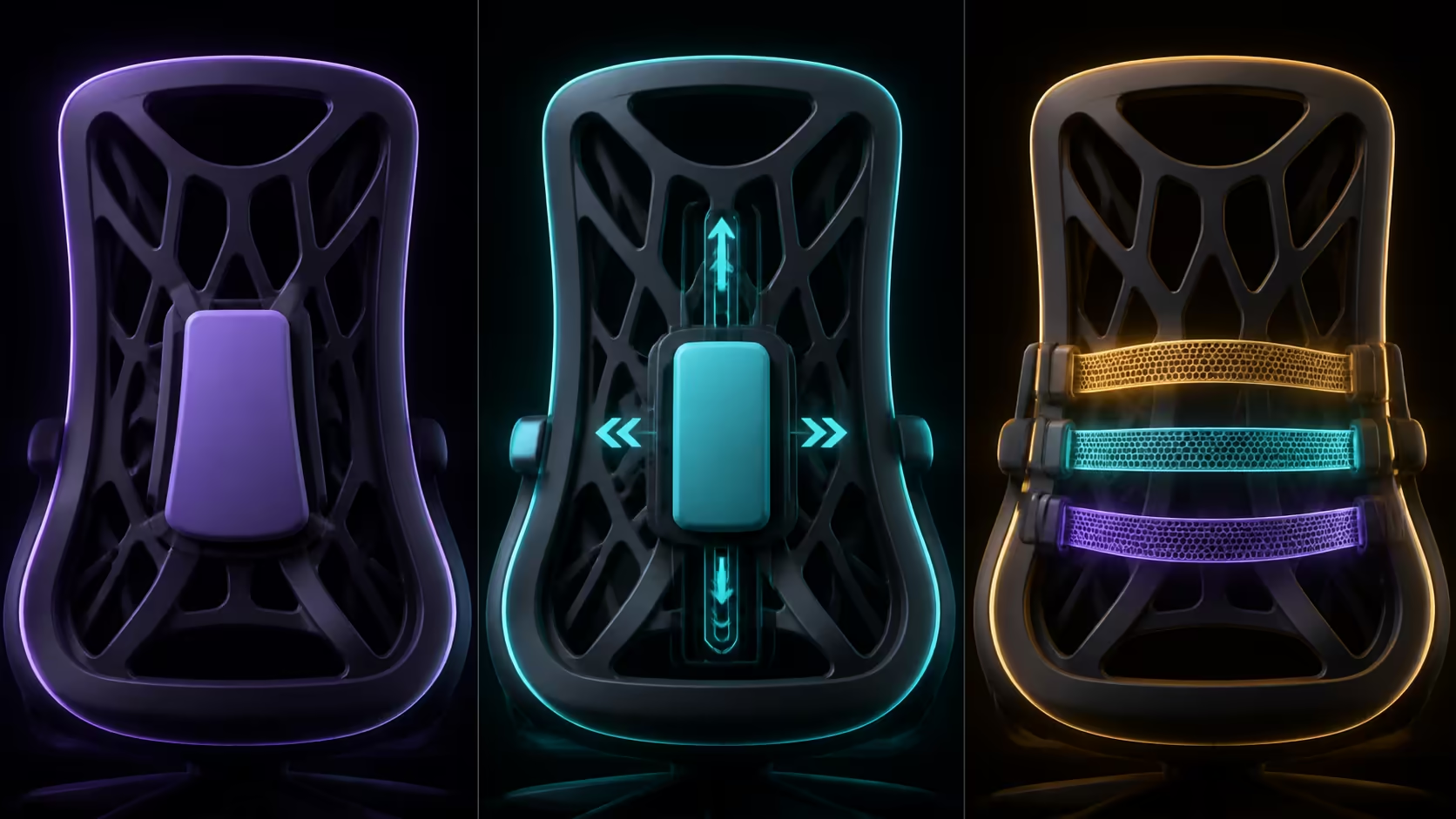
The main lumbar support types - fixed, adjustable and multi-zone - solve fit in different ways. A sound comparison identifies the actual contact and controls on each chair instead of assuming that a larger label is universally more supportive.
Quick Answer
The E3 Ultra belongs to both adjustable and multi-zone lumbar categories: it uses three elastic zones with eight-way movement.
Fixed support retains one built-in contour, adjustable support lets the user change contact, and multi-zone systems divide support into several intended regions. The R9,599 E3 Ultra belongs in both adjustable and three-zone categories through its elastic 8D mechanism.
📍 Understand fixed lumbar contact
A fixed contour retains one relationship with the backrest. That can be simple, consistent and perfectly adequate when its shape and location suit the user. It becomes limiting when the contact misses the lower back or encourages the person to sit away from the support.
Test fixed support with the chair placed correctly at the desk. Sit fully back, type, read and reach. A hand pressed against the contour or a brief showroom lean cannot show whether the user will maintain contact through normal work.
When simplicity has value
Fewer controls can reduce setup effort in a single-user chair whose geometry already fits. That simplicity should be rewarded only after a real trial, not treated as a virtue when the contour is mismatched.
Evetech's HBADA chair range can supply alternatives with different support approaches. Record the actual category for each candidate before comparing price.
🎚️ Evaluate adjustable lumbar systems
Adjustable support provides variables that may change position, contact or another aspect of the lower-back relationship. Exact mechanics differ, so the control must be learned on the specific model. Count usable settings rather than theoretical movement.
The E3 Ultra carries an 8D adjustable designation. Start near neutral, change one element and work long enough to identify the effect. The label should not be converted into an assumed list of movement directions.
Adjustment may be especially useful for shared chairs, varying task postures or users poorly matched to one contour. It does not guarantee better posture or a medical outcome.
Check interaction with the whole chair
Arm and backrest position can change lumbar contact. The E3 Ultra's armrests offer a 720-degree omni range, while its backrest reclines to 140 degrees. Retest lower-back support after setting these for the task, but alter only one component per comparison.
🧩 Define multi-zone support precisely
Multi-zone systems divide support into named areas or regions. Some may use separate controls, different responses or linked structures, but the category does not standardise how this works. Obtain an exact zone map before assuming independence or elasticity.
Three-zone and 8D describe different aspects of the same E3 Ultra mechanism: contact regions and movement range. Preserve both terms so buyers compare the real system.
To test a multi-zone chair, begin with balanced contact, change one region and perform the same tasks used for fixed and adjustable candidates. Ask whether every zone reaches the intended body area without forcing the pelvis or torso.
⚖️ Build one comparison method
Use columns for contact location, control type, useful range, repeatability, task fit, shared-user setup and price. Add seat dimensions and load capacity as non-negotiable filters where required. Keep unknown cells open instead of filling them with category assumptions.
At R9,599, the E3 Ultra should be scored on its 8D system and complete chair fit. Aluminium alloy forms both the support bar and star-shaped base, but that material cannot determine capacity or lumbar performance.
Use Evetech's broader office seating category to apply the same trial to each type. The best lumbar approach is the one that supports a real person through their tasks without demanding awkward compensation.
Compare control effort as well as contact
Ask each user to leave a preferred setting, explore another and restore the original without coaching. This reveals whether adjustment is understandable and whether a supposedly flexible system creates daily friction. Fixed support avoids this reset task, but only when its unchanging contour already fits.
Multi-zone candidates deserve a similar restoration exercise. Mark the starting contact for every region and observe whether one change disturbs another. Do not infer that zones are independent, linked or elastic from the category name; learn the behaviour of the specific chair.
Include time in the assessment. A support that feels pronounced during the first minute may become distracting during work, while subtler contact may prove easier to live with. Run equal-duration trials and insert normal movement breaks rather than using one artificially continuous sit.
Keep the medical boundary clear
Lumbar type can help a chair meet a preferred seated position, but none of the categories diagnoses, prevents or treats a health condition. A user should stop an adjustment that worsens symptoms and seek appropriate professional care when pain, numbness, weakness or another concern persists.
This boundary also improves the buying decision. It keeps the comparison focused on observable chair fit: contact location, control, task use and repeatability, rather than an outcome that furniture cannot guarantee.
Review the notes after a different workday before ranking the categories. Changes in task mix can reveal that one support succeeds only in a narrow posture, while another remains usable across the routine.
For shared spaces, preserve separate user notes. The same fixed contour can suit one person and fail another; an adjustable or zoned design can also miss its intended users. A product category creates options, not universal compatibility.
Add the desk and screen arrangement to each result. A support type should not be praised or rejected for posture created by distant input devices or a misplaced display.
Its floating wings rotate 40 degrees, depth changes by one inch, height by 1.6 inches and dynamic support by 14 degrees. Fixed support cannot offer those corrections. Compare whether the extra axes create broad repeatable contact rather than simply more control activity.
Multi-zone design should be compared with body contact, not medical promises. The E3 Ultra's gravity chassis and 140-degree recline also change how lumbar pressure is experienced, so evaluate each support type upright and during a controlled lean rather than from a static diagram.
For the multi-zone example, E3 Ultra movement is concrete rather than generic: its wings rotate inward or outward through 40 degrees, the support follows posture by 14 degrees, and lower-back contact can move one inch in depth or 1.6 inches vertically. Those ranges make it possible to compare usable contact instead of merely counting zones.
Frequently Asked Questions
Which test keeps fixed and 8D lumbar comparisons fair?
Place both chairs at the same desk and use identical tasks. Compare contact location, ability to remain against the backrest, control effort and how easily a good position returns.
How does 8D lumbar differ from a fixed support position?
The 8D description signals adjustable support, whereas a fixed design preserves one built-in contour. Detailed 8D movements still depend on the chair itself.
What does multi-zone support mean?
It divides intended lumbar contact into multiple regions. The number, response and relationship between those areas must be learned from the exact design.
Which category fits the E3 Ultra?
It fits both categories because its lower-back system uses three elastic zones with eight-way adjustment.
Can one label prove superior support?
No. Fixed, adjustable and zoned designs vary, and their success depends on personal fit, tasks, control usability and the surrounding workstation.
How should the types be compared?
Use a neutral setup, equal trial time and the same work sequence. Note precise contact and behaviour rather than relying on feature counts or first impressions.
Ready to compare lumbar categories without treating labels as outcomes?
Browse Evetech chairs with a consistent trial for contact, control, repeatability and complete workstation fit.