Quick Answer
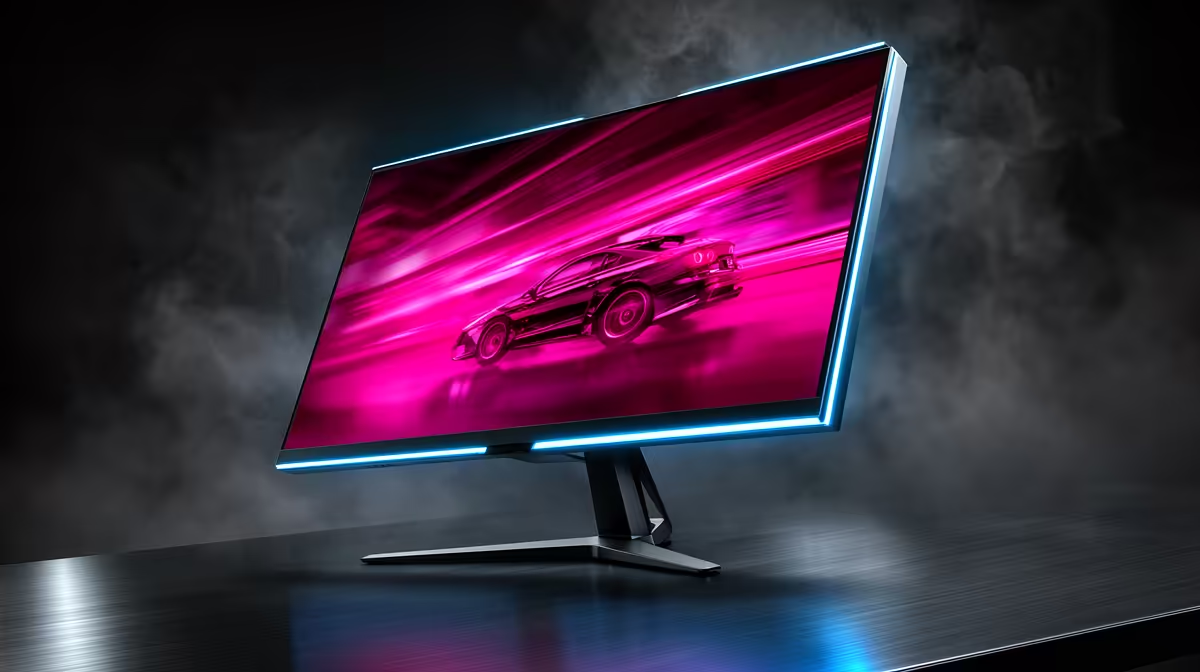
Fast IPS panels deliver pixel response times of 0.5 ms to 1 ms GTG versus 4 ms to 8 ms for standard IPS, which produces noticeably sharper motion in fast-paced games. The trade-off is occasional inverse ghosting (a light halo trailing bright objects) at the highest overdrive settings. For competitive gaming above 144Hz, Fast IPS is the superior choice.
How Fast IPS Reduces Motion Blur 🖥️
Pixel response time is the speed at which a liquid crystal cell changes from one colour to the next. Standard IPS panels run at 4 ms to 8 ms GTG (grey-to-grey), which means at 165Hz (6.1 ms per frame) several frames' worth of the previous pixel state bleeds into the new one, producing a visible smear behind moving objects. Fast IPS panels achieve 0.5 ms to 1 ms GTG by optimising the liquid crystal molecular alignment and using more aggressive overdrive voltages. The result is that at 165Hz, 240Hz, or 300Hz, moving targets, crosshairs, and fast-scrolling environments show sharper edges because the pixel transitions complete within a single frame interval. In practice, a player tracking an enemy moving across the screen at high frame rates sees a noticeably cleaner edge on that enemy model on a Fast IPS panel versus a standard IPS at the same resolution and refresh rate.
Inverse Ghosting: the Cost of Speed 🔧
The overdrive voltage enabling 0.5 ms transitions can overshoot the target luminance, producing a light halo in front of moving bright objects on dark backgrounds, known as inverse ghosting. It is most visible at maximum overdrive. The medium overdrive setting balances speed and overshoot, achieving a 1 ms effective response with minimal artefacts. Test medium versus maximum in a fast game and use whichever shows least artefacting at your target frame rate.
Which Panel Type SA Gamers Should Choose 🎮
For SA gamers running monitors above 144Hz, Fast IPS is the correct choice. Standard IPS at 240Hz or 300Hz would ghost because pixel response cannot keep pace. For 60Hz to 75Hz use in single-player or strategy gaming, standard IPS delivers excellent colour accuracy without the inverse ghosting trade-off. A standard IPS at R3,500 to R5,000 suits creative workstations and casual gaming; a Fast IPS at 240Hz to 300Hz at R6,000 to R10,000 suits competitive play.
Test Overdrive at Your Actual Frame Rate, Not the Maximum ⚡
settings interact with frame rate: an overdrive level that works well at 300 fps can cause visible overshoot at 100 fps on the same monitor. If your GPU produces varying frame rates depending on the game, test overdrive in the game you play most at its typical frame rate, not in a synthetic benchmark where the frame rate is artificially boosted.
FAQ
Is Fast IPS better than OLED for gaming?
OLED offers faster pixel response (0.03 ms) and far superior contrast (effectively infinite). Fast IPS cannot match OLED on those specifications. However, OLED monitors in SA cost R8,000 to R20,000 for gaming-focused models, and burn-in risk on static UI elements is a concern for some use cases. Fast IPS is the better value choice for most gaming budgets.
Do Fast IPS monitors have worse colour accuracy than standard IPS?
Generally, no. Fast IPS panels from established monitor manufacturers cover 95% of DCI-P3 or better and perform well in factory calibration. The response time improvement does not require a meaningful colour accuracy trade-off on quality panels.
Are all monitors marketed as Fast IPS the same technology?
No. "Fast IPS" is a term LG popularised and other manufacturers have adopted with varying interpretations. Always check the stated GTG response time in the specifications rather than relying on the marketing label alone.
Looking for a Fast IPS or standard IPS monitor for your SA gaming setup?
Evetech stocks gaming monitors across both panel technologies in multiple sizes and refresh rates. Browse the monitor section to find the right balance of speed and colour for your build.