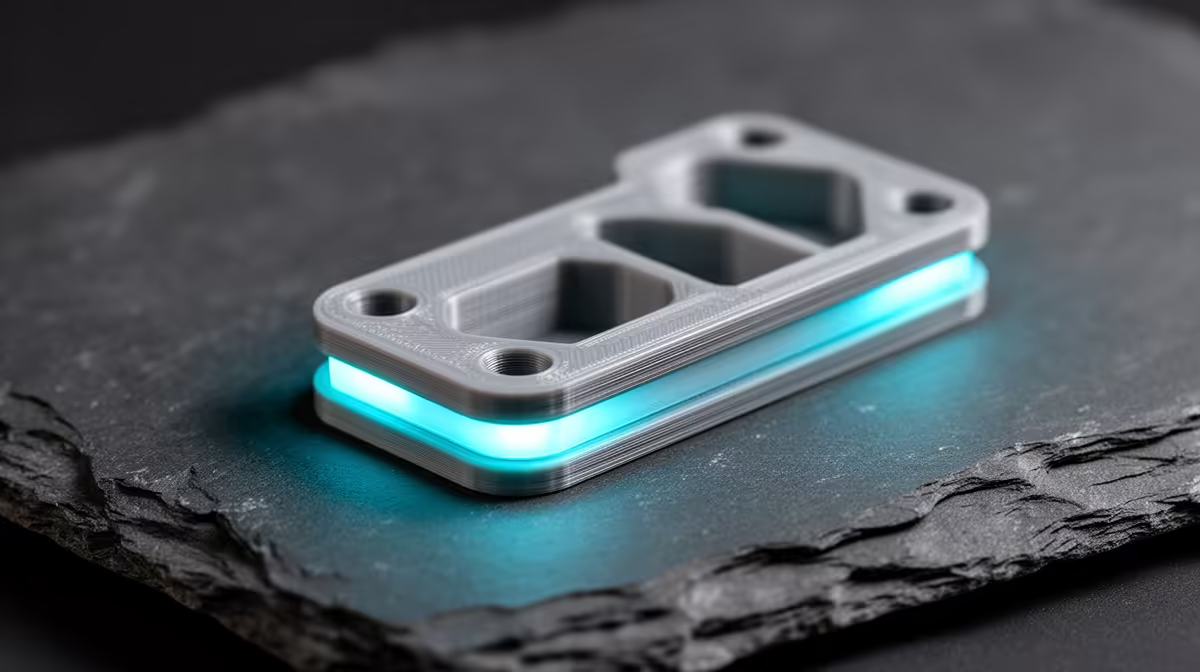
Drop a printed bracket on a concrete floor and you learn fast which 3D printing technology you actually own. For a South African engineer printing jigs, mounts, gears and housings that have to survive heat, vibration and the odd accidental knock, FDM versus resin for functional parts is not a close fight. Filament parts flex and absorb impact; standard resin prints crack. The nuance is in the materials, the machine you buy, and what "functional" means for your specific job.
Quick Answer
For load-bearing, heat-exposed or impact-prone parts, FDM wins. An enclosed printer like the Bambu Lab P1S at around R12,495 prints ABS and PETG that bend before they break, while standard resin stays hard and brittle and yellows under UV. Resin earns its place only for fine-detail, dimensionally precise parts that never take a hit.
Why FDM Tough Plastics Beat Standard Resin Under Load
The difference comes down to polymer chemistry. FDM melts a thermoplastic filament and builds parts layer by layer from the bottom up, so the finished piece keeps the ductility of the base plastic. PETG and ABS will deform under sudden force and spring back rather than shatter. That toughness is exactly what a functional part needs: a drone arm, a bracket bolted to a vibrating chassis, a snap-fit enclosure clipped open a hundred times.
Standard photopolymer resin cures into a rigid, highly cross-linked solid. It captures crisp edges and tiny features beautifully, but it is comparatively brittle and many formulations keep curing under sunlight, growing more fragile and discolouring over months. A resin gear in a sunny Highveld workshop is on a clock. There are tough and engineering resins that close part of the gap, but they cost more per litre, still trail ABS on impact, and demand careful post-curing.
If you are still mapping out which machine class fits your bench, the range of 3D printers at Evetech covers enclosed FDM units alongside other machine types so you can compare options before committing.
The Enclosure Question Most Buyers Miss
ABS is the classic engineering filament: tough, heat-resistant to roughly 90 to 100 degrees Celsius, and machinable. The catch is that ABS warps and cracks if the print cools unevenly, which is almost guaranteed on an open-frame printer in a draughty room. An enclosed chamber traps heat, holds a stable ambient temperature, and lets ABS layers bond properly.
Why the P1S Suits Engineering Work
The Bambu Lab P1S at about R12,495 ships enclosed out of the box, with a hardened nozzle option and a heated bed that handles ABS, ASA and PETG without a separate enclosure build. For an engineer who wants reliable ABS parts rather than a weekend tuning project, that closed chamber is the single most important feature. It also contains the fumes ABS releases, which matters in a shared office or home workshop.
PETG as the Everyday Workhorse
PETG sits between PLA and ABS: tougher and more heat-tolerant than PLA, far easier to print than ABS, and it does not need an enclosure to behave. For brackets, clips, fluid-contact parts and anything that lives outdoors in Cape Town weather, PETG is often the smarter default. It is forgiving, strong in the Z axis when printed warm, and resists moisture far better than nylon.
Beyond the Basics: Nylon and Carbon-Fill for Demanding Parts
When PETG and ABS are not enough, the next step for SA engineers is nylon and carbon-fibre-filled filaments. Nylon (PA12) offers excellent fatigue resistance and can flex repeatedly without cracking, which suits living hinges, cable management clips and parts that cycle under load. Carbon-fibre-filled filaments -- typically nylon or PETG combined with chopped carbon fibre -- are dramatically stiffer and lighter, making them useful for structural ribs, drone frames and any part where stiffness-to-weight matters. Both materials require an enclosed printer and a hardened nozzle, since carbon fill wears brass nozzles quickly. On either the P1S with the right nozzle swap or a comparable enclosed machine, these materials are practical rather than exotic.
Where Resin Still Earns Its Place
None of this means resin is useless for engineers. When the job is a master pattern for casting, a finely detailed connector housing, a dimensionally exact fixture, or a small part where surface finish matters more than impact strength, resin's resolution is unmatched. SLA and MSLA printers hold tighter tolerances on tiny features than most desktop FDM machines.
The overhead is real: resin needs careful handling, washing in IPA, UV post-curing, ventilation and gloves. The consumables and clean-up overhead are recurring costs. For a workshop that values throughput and rugged parts, that overhead rarely pays off. For a prototyping bench chasing detail, it does.
Total Cost and Local Supply for SA Engineers
Both technologies are well supported locally, so you are not importing filament a kilogram at a time or waiting weeks for resin. ABS and PETG spools, hardened nozzles, build plates and resin consumables are all available within South Africa, which keeps a 24/7 prototyping cycle moving. The accessories section covers the spares and add-ons that keep a machine productive.
Factor in failed-print waste too. FDM lets you recover from a bad print with a spool swap and a restart. Resin failures mean cleaning a tank, filtering resin and re-levelling, which costs more time per mistake. Over a year of real engineering use, that resilience tilts the running cost firmly toward filament.
Frequently Asked Questions
Is FDM strong enough for genuinely load-bearing parts?
Yes, within reason. PETG and especially ABS printed on an enclosed machine produce parts that flex under load and resist impact well enough for brackets, mounts and many functional assemblies. For extreme loads you step up to nylon or carbon-fibre-filled filaments rather than switching to resin.
Why does an enclosure matter so much for engineering filaments?
ABS and ASA shrink as they cool and will warp or crack if cooling is uneven. An enclosed chamber holds a stable warm ambient temperature so layers bond reliably, which is why an enclosed unit like the P1S is the practical choice for ABS work.
Does resin really degrade in sunlight?
Standard resin keeps reacting under UV light, becoming more brittle and yellowing over time. A part left in direct South African sun will weaken noticeably over months. UV-stable and tough resins reduce this, but FDM thermoplastics are far more durable for outdoor or sunlit use.
Can I print ABS without an enclosure?
You can try, but warping and layer splitting are common, especially in a draughty or cool room. PETG is the better enclosure-free option for tough parts. If ABS is a must-have, budget for an enclosed printer rather than fighting an open frame.
Which technology is cheaper to run day to day?
FDM, for most engineering workflows. Filament is inexpensive, clean-up is minimal, and a failed print costs little to recover. Resin adds consumables, IPA washing, UV curing and ventilation, all of which raise the cost and time per part.