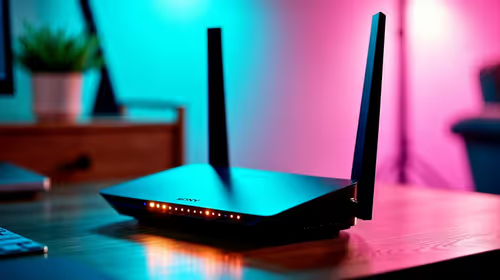
Fibre is the first choice for a South African home when the address can get a reliable service at the speed you need. Fixed wireless remains valuable where trenches have not reached, installation is delayed or a backup connection matters. The router cannot improve the service entering the property, but it can stop a good connection being wasted indoors.
Quick Answer
Choose fibre for steady latency, high data use and gaming when a suitable local provider covers the address. Choose fixed wireless or mobile internet when fibre is unavailable, you move often or setup speed matters more than peak consistency. Test the service at your location, then buy networking hardware for that connection type.
Fibre tends to deliver the steadier line
Fibre carries data over an optical cable to the property. It is not affected by radio congestion between your home and a tower, which helps latency and throughput remain consistent. The actual experience still depends on the network operator, internet service provider, package and local faults.
Upload speed matters for backups, video calls and streaming. Some fibre packages are symmetrical, while others provide a lower upload rate. Read the exact service terms instead of assuming the download number applies both ways.
Installation can be the barrier. Coverage may exist on a map while the complex, street or building still needs work. Confirm the address with the provider and ask what equipment and lead time apply.
Wireless service depends on the exact location
Fixed wireless and mobile broadband connect over radio to a nearby tower or provider site. Terrain, walls, tower load and weather can influence performance. Two houses in the same suburb can see different results.
Test at the place where the router or outdoor receiver will live. Morning and evening checks reveal congestion better than one midday speed test. Record latency and packet loss as well as download speed.
Wireless can be installed faster and can serve areas outside the fibre footprint. It also makes a useful backup for a home office when the primary line fails. Data terms and fair-use rules vary, so read the package.
Compare hardware through the networking range and popular accessory options. Choose the router after confirming whether the service hands off through Ethernet, fibre equipment or a SIM-based device.
Gaming cares about consistency
Online games use less raw bandwidth than downloads, but they dislike latency spikes, packet loss and jitter. A stable 50Mbps connection can feel better than a faster line that changes from second to second.
Use Ethernet from the gaming PC or console to the router where possible. This removes home Wi-Fi variation from the test. If the problem remains on cable, investigate the service and route rather than buying a stronger Wi-Fi router.
Wireless internet can still game well when the local signal and tower are stable. Test the exact games and times you play. A broad statement about one technology cannot describe every address.
The home network can become the bottleneck
A fibre line entering at high speed needs a router with enough WAN and LAN capacity. Gigabit service through a 100Mbps port will stop at the port. Check every link in the chain.
Wi-Fi performance depends on client support, distance, walls and channel use. Place the router high and central, away from metal cabinets. Use wired access points or a planned mesh for a large home rather than asking one box to cross every wall.
Fixed wireless routers may need a window or outdoor antenna position. Keep long radio cable loss and weather exposure in mind. Follow the provider's installation guidance.
Choose the service before the router
Confirm coverage, installation cost, package speed, upload, data conditions and support. Ask neighbours about local uptime, since their experience can reveal street-level issues.
Then choose hardware. Count wired ports, check Wi-Fi standards used by your devices and decide whether failover is needed. A router with dual-WAN or mobile backup can suit a work-from-home setup.
Do not pay for a radio standard no device can use while ignoring placement or cabling. A modest router with wired access points can outperform one expensive unit hidden in a corner.
Test before signing around a speed claim
Ask for the expected installation route, equipment and coverage at the exact address. Wireless performance can change between two streets because terrain, buildings and tower load differ. Fibre availability can also stop at the property boundary or require landlord approval.
Where a trial or cooling-off arrangement applies, read the provider's current terms rather than assuming one. Run tests in the evening, when the network is busy, and record latency variation, packet loss and upload speed. A morning speed test cannot prove a gaming session will stay stable.
Use Ethernet from the provider equipment to one PC as the baseline. Then test WiFi from the normal room. This separates service quality from home coverage. If the wired result is good and wireless is poor, reposition or upgrade the local network before changing provider.
Keep installation cost, data policy and support route beside monthly service performance. A high headline speed can lose value when upload, latency or reliability misses the work you actually do.
Ask how faults are logged and what evidence support needs. A saved evening test with a wired device gives the conversation a useful baseline instead of a vague report that the internet feels slow.
Frequently Asked Questions
For remote work, test the return path as well as downloads. Cloud backup, video calls and sending project files depend on upload speed and consistency. A connection that looks fast during a download can still struggle when several people transmit at once.
Is fibre always faster than wireless?
It tends to offer steadier high throughput, but packages and local networks vary. Test the services available at your address.
Is wireless internet good for gaming?
It can be when latency, jitter and packet loss remain stable at the times you play.
Will a better router improve the internet service?
It can improve the home network. It cannot fix tower congestion, a weak incoming signal or an upstream fault.
Should I connect the gaming PC by Ethernet?
Yes, when practical. It removes Wi-Fi variation and makes service problems easier to diagnose.
Can wireless serve as fibre backup?
Yes. Check router failover support, data terms and signal at the backup device's location.
Confirm fibre and wireless performance at your address, then choose a router that can deliver that service through the whole home.