Fixed crossbars versus portable backdrop stands is a decision that sounds minor until you are staring at four square metres of bedroom that also needs to function as a workspace, a sleeping area, and a studio. The structure holding your backdrop is not a passive fixture -- it is either eating your room permanently or packing away when the camera goes off.
Quick Answer
For tight rooms, a portable stand is almost always the better call. It collapses to around 90cm, stores vertically behind a door, and lets the room breathe between shoots. A fixed crossbar suits a dedicated studio space where leaving the rig up makes operational sense.
🔧 What Each System Actually Looks Like
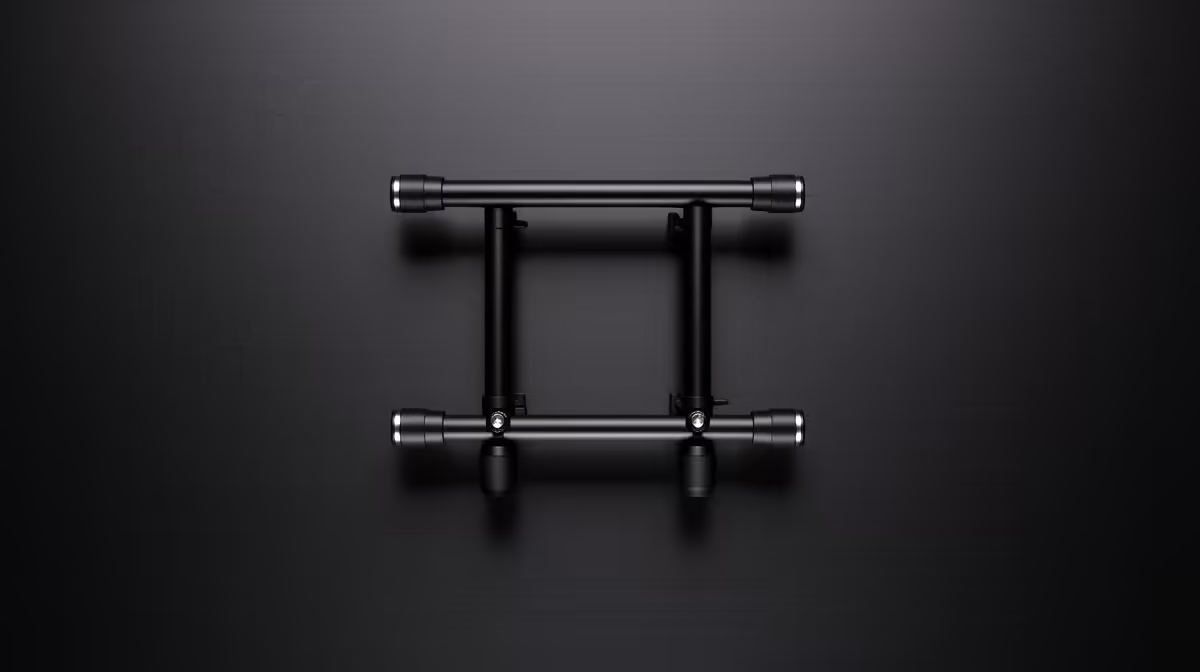
A fixed crossbar runs horizontally between two anchor points -- typically bolted to wall studs or ceiling joists. Once up, it stays up. The backdrop rolls, folds or hangs from it permanently, which makes turnaround between shoots fast: you walk in, swap the backdrop, and shoot. There is no assembly time because there is nothing to assemble.
A portable stand is two telescoping vertical poles that spread into floor-based tripod or T-leg feet, joined by a horizontal crossbar that threads through or clips across the top. The whole system locks together with friction adjusters or thumb screws. Quality versions extend to 199cm height and 300cm width, which is enough to frame a seated portrait or a standing product shot with backdrop to spare. When you are done, the poles retract to roughly 90cm and the crossbar breaks into segments. Most kits roll into a carry bag about the length of a guitar case.
Height and width range
Both systems can hit the same final dimensions. The difference is that a fixed crossbar is built to one specification and stays there, while a portable stand lets you shorten the height or narrow the span shoot by shoot. That adjustability is useful when you are photographing a single coffee mug one afternoon and a full-body garment the next.
📐 The Space Equation
Fixed crossbars are architectural. A wall-mounted rail or a ceiling-hung crossbar does not intrude on floor space while it is in use -- no feet to trip over, no vertical poles in your peripheral vision. That is a genuine advantage in a permanent studio where the room is only ever used for shooting.
The problem appears the moment that room has to be something else. A fixed crossbar keeps the backdrop in place regardless of whether you are shooting. In a Cape Town flat where the spare room doubles as a guest bedroom, or in a Joburg townhouse study shared with a partner, that permanence becomes friction. The backdrop is either rolled up and tucked aside (wasting the fixed mount's main benefit) or it is always visible, making the room feel like a storage unit.
A portable stand disappears. Breaking down a 199cm stand takes about three minutes. The bag slides behind a wardrobe or along a wall corner. The room gets its square metres back, and there is no visual clutter on days when nothing is being shot.
Drilling and rental reality
For anyone renting, fixed crossbars carry a practical penalty beyond the aesthetics. Wall or ceiling mounting requires drilling into surfaces you do not own, which creates complications at lease renewal. Portable stands need no drilling at all, which is a non-trivial advantage for South African renters who cannot easily repair or repaint rental walls.
🏗️ Stability and Load Capacity
This is where fixed systems earn their keep. A wall or ceiling mount removes tipping risk entirely. The structure is only as mobile as the wall it is bolted to, which means it can hold a heavy seamless paper roll -- the kind that weighs five to eight kilograms on its core -- without any concern about the rig shifting mid-shoot.
Portable stands have a tipping threshold. A 199cm stand carrying a wide, light muslin backdrop behaves well in a still room. Add a draught from an open window, or stretch the crossbar to its maximum 300cm with a dense fabric backdrop, and the wide face of the backdrop acts like a sail. The fix is ballast: a sandbag of around five kilograms on each leg foot pushes the centre of gravity down and eliminates most practical risk. With proper ballasting a portable stand handles a 300cm muslin comfortably; the limitation is more about discipline than physics.
For paper rolls specifically, the heavier the roll, the more a fixed mount makes sense. Fabric backdrops are lighter and more forgiving -- a portable stand handles them with less concern.
💰 Cost and Upgrade Path
Entry-level portable stands with a basic crossbar start around R1,500 to R2,500 for a functional two-pole kit. Better-made versions with adjustable legs, solid friction locks, and a carry bag sit in the R3,000 to R5,000 range. Fixed crossbar hardware -- wall brackets, a steel rail, the rail itself -- varies widely but typically costs less in raw materials; the real cost is installation time and, for renters, the risk of deposit deductions.
Portable stands also have a natural upgrade path. You can buy a better crossbar later, switch to heavier-duty legs, or add a second stand for a wider run. A fixed mount is committed to its position from day one.
Pro Tip ⚡
If you are on the fence, start with a portable stand. You will quickly learn how often you actually shoot and whether a permanent install is justified. Most home photographers who upgrade to a fixed system already owned a portable one first.
Frequently Asked Questions
Which option genuinely frees more floor space in a small room?
A portable stand, without question. The legs do occupy a footprint while the stand is up -- roughly 1.5m of width and about 60 to 80cm of depth per side -- but the moment you collapse it, that floor space is fully returned. A fixed crossbar, even when the backdrop is rolled up, occupies wall or ceiling real estate and implies the space belongs to the studio.
How long does setting up a portable stand actually take solo?
Around five minutes from bag to shoot-ready, assuming you have done it a few times. Extending the two legs, locking the height, threading the crossbar through the top sleeve of the backdrop, and tensioning the crossbar adjusters is a straightforward process. The first time takes closer to ten minutes while you learn the locking mechanism.
Is a fixed crossbar meaningfully more stable than a properly weighted portable stand?
For very heavy loads yes, a bolted mount is more secure. For standard fabric backdrops up to about 5kg, a portable stand with 5kg sandbags on each leg is stable enough that the difference is academic in normal studio conditions. The stability gap matters most with heavy paper rolls in rooms with air conditioning or open windows.
What size portable stand fits a standard seated video call frame?
A 199cm-height stand with a crossbar that extends to 280 to 300cm covers a seated head-and-shoulders frame with roughly 30 to 40cm of backdrop width to spare on each side. That headroom means minor positional adjustments mid-shoot do not take you off the backdrop edge.
Can a portable stand work for a renter in a small South African flat?
It is specifically designed for that situation. No wall penetrations, no ceiling hardware, no lease complications. When folded, the 90cm carry bag fits in a cupboard or along a skirting wall. Several South African content creators run portable stands in one-bedroom flats without any permanent modification to the property.
Ready to set up a clean shooting space without committing to permanent fixtures?
Browse the backdrop stand range for South African photographers and videographers and find a portable setup that packs away when the room needs to be something else.