Quick Answer
GPU airflow problems in compact cases usually come down to three fixable issues: blocked intakes from poor fan placement, hot air recirculating because exhaust is inadequate, and GPU cooler fans blowing directly into a solid side panel with no clearance. Solving them requires repositioning fans, adding low-profile intake, or choosing a card with a more compact cooler for your chassis.
Why Compact Cases Create Thermal Pressure 🔧
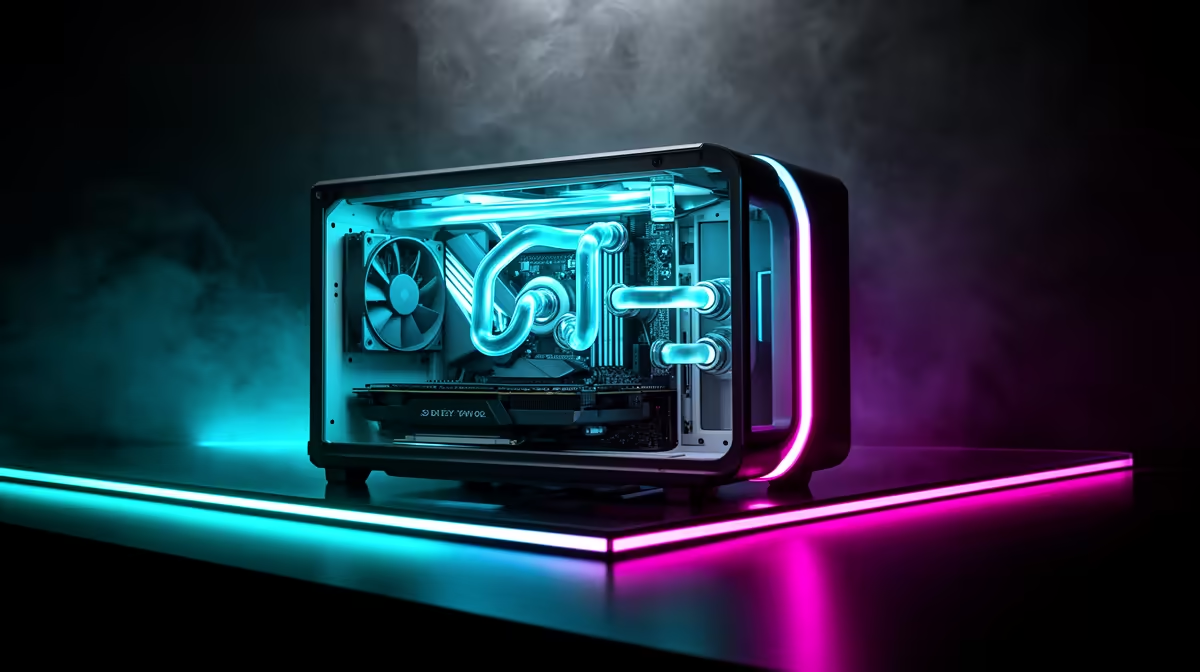
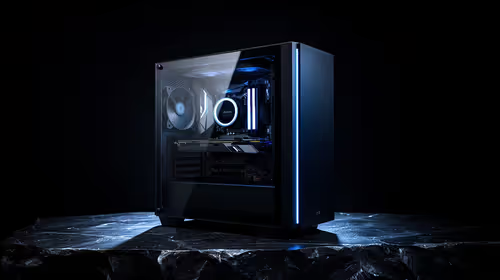
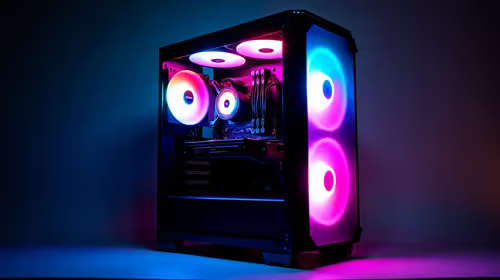
Small form factor and micro-ATX cases prioritise footprint over airflow volume. A standard ATX tower can move 60 to 80 cubic feet per minute of air through generous front intakes, while a compact case may manage half that with the same fans simply because intake area is smaller and the path from intake to GPU is shorter and more obstructed. When a three-slot GPU like the Palit GameRock RTX 5090 sits 5 to 8mm from a solid tempered glass side panel, its bottom fans are pulling in air that has already been partially warmed by the GPU's own exhaust, creating a recirculation loop. Temperatures can climb 8 to 15 degrees higher than in an open-air testbench because of this alone.
Diagnosing the Specific Problem 🖥️
Before buying anything, identify which failure mode you have. Log GPU temperature, fan speed, and CPU temperature simultaneously during a 20-minute gaming session. If GPU temperature climbs steadily throughout the session without plateauing, you have a heat soak problem where the case interior is accumulating warmth. If GPU temperature spikes immediately on load but CPU stays cool, the GPU is starved of fresh air while the rest of the case is ventilated adequately. If both CPU and GPU temperatures rise together, the case exhaust is insufficient and hot air is pooling. Each diagnosis points to a different fix.
Practical Fixes That Do Not Require a New Case 🔩
For heat soak: add a small 80mm or 92mm fan exhausting through any rear or top vent, even at low speed, to break the stagnant air pocket. For GPU air starvation: if your case has a ventilated side panel option, switch to it; alternatively, raise the GPU by using a PCIe riser cable to rotate it so the fans face a vented panel rather than a solid one. For combined CPU and GPU heat buildup: ensure your CPU cooler exhausts upward or rearward and does not fight the GPU for the same air column. South African users in Gauteng summers should also consider leaving 5 to 10cm of space behind the case rather than pushing it against a wall or into a closed desk hutch, which can add 4 to 6 degrees to all component temperatures.
Cable Routing Matters More Than You Think ⚡
In compact cases, a bundle of PSU cables blocking the space between the GPU and the front intake fans can reduce effective airflow by 20 to 30 percent. Route cables behind the motherboard tray and use Velcro ties to keep them flat against the back panel. This single step often drops GPU temperatures by 4 to 7 degrees without any additional hardware.
FAQ
Can a large three-slot GPU physically fit in a compact case?
Length and slot thickness both matter. A card like the RTX 5090 GameRock measures over 340mm in length, which exceeds the maximum GPU length of many compact cases rated for 300mm. Check your case's stated maximum GPU length before purchasing a flagship card, and verify three-slot clearance from the PCIe slot to the drive cage.
Should I use positive or negative pressure airflow in a compact case?
Slightly positive pressure, meaning more intake CFM than exhaust CFM, reduces dust ingress and generally keeps temperatures more stable. For compact cases where every degree matters, positive pressure also prevents hot air from being drawn back in through unfiltered gaps in the chassis.
Is a GPU riser cable safe to use for airflow repositioning?
Yes, provided you use a certified PCIe 4.0 or 5.0 riser cable matched to your card's bandwidth requirements. Budget risers can introduce signal integrity issues at PCIe 5.0 speeds on current-gen flagship GPUs.
Tight on airflow?
Compare compact cases and case fans stocked at Evetech to give your GPU room to breathe.