Quick Answer
Most gaming PC noise comes from fans spinning faster than necessary because of poor airflow or aggressive default cooling curves. Rebalancing your fan curve and improving case airflow almost always reduces noise by 5dB to 10dB without raising temperatures. In most mid-tower setups, this takes under 30 minutes and costs nothing.
Why Fan Curves Are the First Thing to Tune 🔊
Motherboard BIOS fan curves ship configured for maximum cooling safety rather than acoustic comfort. Many boards ramp all system fans to 80% speed the moment the CPU hits 60°C, which is well within normal desktop operating range. Open your BIOS fan control section or install a tool like ARGB software provided by your board manufacturer and create a stepped curve: 30% fan speed up to 55°C, ramping linearly to 70% at 75°C, and 100% only above 85°C. This keeps the system near-silent during web browsing and light gaming while still protecting hardware at full load. The Asus AI Suite, MSI Command Centre, and Gigabyte System Information Viewer all provide user-friendly curve editors if you prefer a Windows interface.
Airflow Quality Reduces Fan Workload 💨
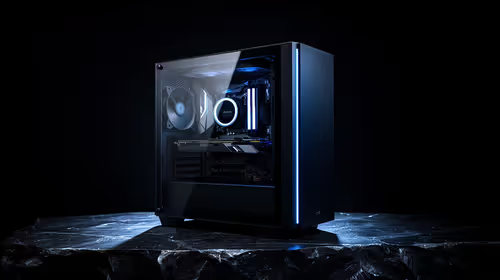
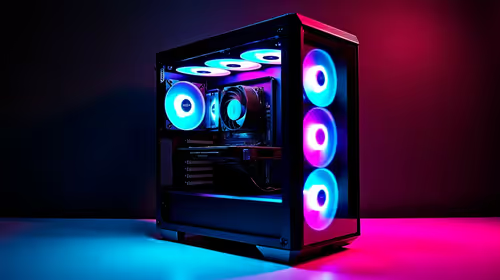
A case with restricted intake forces fans to spin faster to move the same volume of air. The most common restriction in South African prebuilt towers is a solid or near-solid front panel that blocks 30% to 50% of potential airflow. Replacing a restrictive front panel with an open-mesh alternative or repositioning the case away from a wall by at least 15cm allows fans to run 10% to 20% slower at the same thermal load. Positive pressure configurations, with more intake CFM than exhaust, also reduce whistle and resonance noise caused by air being sucked through narrow gaps around the I/O shield or side panel edges.
Identifying the Loudest Component 🎧
Not all PC noise comes from fans. Coil whine from the GPU voltage regulators produces a high-pitched squeal under load that fan tuning will not fix. To isolate it, temporarily run the GPU fans at 100% manually via MSI Afterburner, then listen for whether the irritating frequency follows fan speed or stays constant. If it stays constant, it is coil whine rather than a bearing problem. A GPU with coil whine rarely gets worse over time and does not indicate a defect that affects performance. Hard drive vibration in a system that still runs a mechanical drive is another source, fixed by mounting the drive with rubber-dampened screws or migrating to an NVMe SSD, which produces no mechanical noise at all.
Zero RPM Mode Check ⚡
Many modern GPUs including RTX 50-series cards support zero RPM mode, where the GPU fans stop completely below 60°C. Confirm it is enabled in your GPU's software. If the fans are spinning at idle, disabling zero RPM mode has been toggled off somewhere and re-enabling it delivers immediate noise reduction during desktop use.
FAQ
Why does my gaming PC suddenly get louder than it used to?
Dust accumulation on fan blades causes imbalance and increases bearing noise. Clean all fans with compressed air every three to six months, especially in dusty SA environments. A fan that sounds rattly or grinds slightly usually has a failing bearing and is best replaced before it fails fully.
Can a bigger case actually make a PC quieter?
Yes, because larger cases accommodate bigger, slower-spinning fans that move equivalent air at lower RPM and therefore lower noise. A full-tower running 140mm fans at 600RPM is significantly quieter than a mini-ITX case thrashing 80mm fans at 2,500RPM to achieve the same cooling.
Do acoustic foam panels inside the case help?
They help modestly, typically 2dB to 4dB of mid-frequency deadening, but they also trap heat if applied to areas that interfere with airflow. Only use foam on solid metal panels, never across fan mounting positions or ventilation grilles.
Want a quieter gaming setup? Evetech stocks silent-focused cases, high-airflow mesh towers, and 140mm case fans designed for low-noise builds. Browse the full range and quieten your rig today.