



PCIe 5.0 vs PCIe 4.0 for Video editing in 4k in SA
PCIe 5.0 vs PCIe 4.0 for video editing in 4k is mainly about fit, features, compatibility, cost, and upgrade path, not one automatic winner. SA buyers should match the choice to the setup.
Read moreThe real-world gap between Gen3 and Gen4 ssd drives rarely matches the widening price gap in 2026, since everyday tasks and games barely stress sequential speeds that high. Evetech stocks both tiers, so buyers match the drive to actual workload, not a benchmark number.
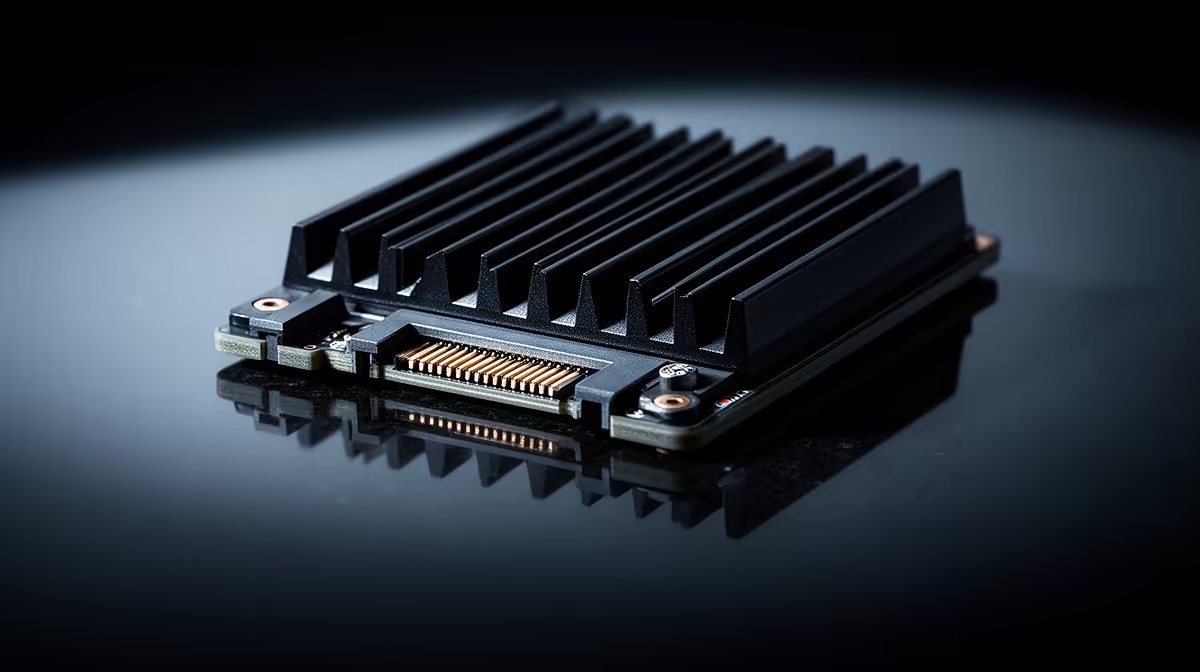
Gen4 SSDs can post several times the sequential speed of Gen3 drives. Your browser, Windows desktop and most games do not become several times faster. In 2026, a widening price gap needs a workload that can turn bandwidth into time saved.
Buy Gen4 when it costs close to a comparable Gen3 drive, you are building on a supported platform or your video, archive and project work moves large files each day. Buy Gen3 when it offers better capacity per Rand and the PC is used for gaming and everyday work. Do not replace a healthy Gen3 drive for game loads alone.
Sequential benchmarks read or write large blocks in order. This suits video files, disk images and archives. Operating systems and games use a mix of smaller requests, CPU processing and decompression, so peak bandwidth is not the only limit.
Both Gen3 and Gen4 NVMe drives provide quick access compared with mechanical storage. That shared low-latency behaviour helps applications feel responsive. Once you already have it, a higher peak number can be hard to notice in a browser or office document.
Boot times also contain firmware, driver and application work. A Gen4 drive cannot remove tasks outside storage. A clean Windows setup can change startup more than replacing one healthy NVMe generation with another.
Compare current products across the solid-state drive catalogue and popular SSD list. The named Dahua V800 512GB SATA SSD gives a lower-interface reference at R1,499 in July 2026, not a quote for either NVMe generation.
A game's loading screen depends on storage reads, CPU decompression, shader work and engine design. A good Gen4 drive can finish its storage part sooner, while the other tasks keep the total gap small.
Check title-specific results. Some new games stream assets in ways that benefit from fast storage, while others show little difference. Average one-second claims across unrelated games tell you less than the titles in your library.
Capacity can be more valuable. A larger Gen3 drive keeps more games installed and leaves room for updates. A small Gen4 drive may force weekly library management while its peak speed sits unused.
If the Gen4 model costs close to Gen3 at the same capacity and quality, take the newer interface. The issue is the premium, not the technology.
Video editors moving large source files, creators building caches and users working with disk images can see clearer gains. Measure how much data moves and how often. Time saved each day provides a return calculation.
Sustained write speed is more useful than a short burst result. Many SSDs use a fast cache and slow after it fills. Check tests that continue through large transfers, along with temperatures and recovery behaviour.
Gen4 can also support a fast scratch drive while Gen3 remains the boot or game drive. You do not need to replace every SSD. Put the faster model in the data path that uses it.
Workstation reliability still depends on backups and a sound exact model. Peak speed does not replace endurance, warranty or a second copy of important files.
The CPU, motherboard and chosen M.2 slot must support Gen4 to reach its link speed. A Gen4 drive in a Gen3 slot can operate at Gen3 speed. This can be sensible when the drive will move to a newer platform later, provided the premium is small.
Read the motherboard manual for lane sharing. Some M.2 slots disable SATA ports or share bandwidth with an expansion slot. Use the recommended primary position for the boot drive.
Gen4 drives can produce more heat under sustained load. Fit the motherboard heatsink or compatible drive cooler when needed. Remove protective film and confirm contact without stacking coolers.
After installation, check the negotiated link and run one health and performance test. Then return to normal work. A benchmark score is a diagnostic, not the purpose of the PC.
Controller design, flash type, cache, endurance and firmware can make a premium Gen3 model better than an entry Gen4 drive under sustained use. Compare exact models, not interface labels.
Fix capacity and warranty, then compare price. Add the value of a motherboard heatsink if one drive includes cooling and the other does not. Include the future role of the old SSD.
If Gen4 costs enough more to force a lower GPU tier or half the storage, Gen3 can win the complete build. If the difference is modest, Gen4 gives useful headroom with no major sacrifice.
Copy a representative project or export a normal cache on the current drive. Record the time and identify whether storage remains busy throughout. If the CPU or application pauses while the drive is idle, more SSD bandwidth will not remove the whole delay.
For gaming, time the same save from menu to control and repeat it several times. Small differences can disappear inside normal run-to-run variation. A stopwatch and your own title are more useful than applying a peak-speed ratio.
If the test shows a storage-bound task every day, Gen4 has a clear return. If the drive waits for other components, spend the premium on capacity or keep the Gen3 model.
Check whether the application writes temporary files to another drive. A fast Gen4 project disk cannot help when the cache remains on a full SATA boot drive.
Map each storage path before judging the benchmark.
Peak benchmarks are much higher, but game-load differences are often small and vary by title.
Only when you also need capacity, drive health or faster sustained transfers. Gaming alone may not justify it.
Yes, to reach Gen4 speed. It can run at a lower link speed in a compatible Gen3 slot.
Users moving large files, editing video or running cache-heavy creation work can see a clearer benefit.
Yes. Controller, flash, cache behaviour and sustained performance matter alongside interface generation.
Compare Gen3 and Gen4 SSDs at the same capacity and quality, then pay for speed only where your workload can use it.
Peak benchmarks are much higher, but game-load differences are often small and vary by title.
Only when you also need capacity, drive health or faster sustained transfers. Gaming alone may not justify it.
Yes, to reach Gen4 speed. It can run at a lower link speed in a compatible Gen3 slot.
Users moving large files, editing video or running cache-heavy creation work can see a clearer benefit.
Yes. Controller, flash, cache behaviour and sustained performance matter alongside interface generation.
PCIe 5.0 vs PCIe 4.0 for video editing in 4k is mainly about fit, features, compatibility, cost, and upgrade path, not one automatic winner. SA buyers should match the choice to the setup.
Read more
Wi-Fi 7 vs Wi-Fi 6e for competitive esports comes down to router support, latency goals, device compatibility, and coverage. SA buyers should match the choice to the real network setup.
Read more
ATX 3.1 vs ATX 3.0 for mMO and live-service games buyers - what changes is mostly about compatibility, budget, upgrade path, and setup fit. SA buyers should check device support and real needs before expecting a clear win from either option.
Read more
LGA 1851 vs LGA 1700 can affect Twitch and YouTube streaming when gaming and encoding share CPU resources. For SA creators, the real-world difference depends on encoder choice, memory support, motherboard cost, thermals, and upgrade plans.
Read more
X870E vs X670E for aaa single-player gaming is mainly about fit, features, compatibility, cost, and upgrade path, not one automatic winner. SA buyers should match the choice to the setup.
Read more
Hall Effect switches vs Mechanical switches for mMO and live-service games is mostly about compatibility, budget, upgrade path, and setup fit. SA buyers should check device support and real needs before expecting a clear win from either option.
Read more
A fake 113GB GTA VI ISO reportedly used empty padding around a small malware payload. SA gamers should delete unofficial builds, keep Windows security active and wait for official channels.

Wi-Fi 6E vs Wi-Fi 6 matters for 4K video editing when files move across a network. The real-world difference between Wi-Fi 6E and Wi-Fi 6 for video editing in 4K depends on NAS access, cloud uploads, router range, and SA creator workflows.

The difference between PCIe 5.0 and PCIe 4.0 for SA gamers is mostly bandwidth headroom. Compare GPU slot needs, NVMe speed, motherboard support, and upgrade timing before paying extra for a newer platform.

Gaming PC stuck pixel checks in South Africa should confirm the monitor fault first. Use colour tests, screenshot comparison, cable swaps, display menu checks, and clear photos before deciding on support.

Shokz OpenFit Air 2 earbuds weigh 7.2g each and use a redesigned dual-driver open-ear layout. SA buyers should choose them for comfort and awareness, not maximum isolation.

AMD's current driver now lists a Radeon RX 9050 4GB, while product coverage details a narrowed memory system. SA buyers should weigh the low VRAM ceiling against current local Radeon options.

Samsung Display has demonstrated a 16-inch 2.5K OLED laptop panel running at 300Hz. SA buyers should wait for a named notebook, full panel specifications and a local price before planning an upgrade.

Microsoft says some Windows 11 game crashes after recent updates are linked to RGB-related drivers. Affected SA gamers should confirm the update and driver before using the published registry workaround.
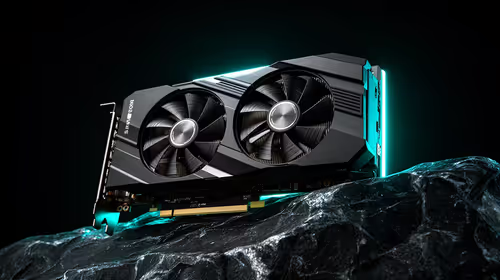
RTX 5090 on a 650W PSU is a tight pairing with very limited headroom. For SA gaming PCs, focus on total system draw, PSU quality, connector support, CPU choice, and avoid OC plans unless the full build is carefully power-limited.
PCIe 5.0 vs PCIe 4.0 for video editing in 4k is mainly about fit, features, compatibility, cost, and upgrade path, not one automatic winner. SA buyers should match the choice to the setup.
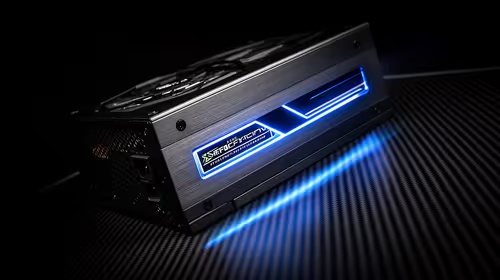
850W PSU safety for RTX 5090 is plausible with a quality unit and balanced parts. In SA, confirm connector support, CPU power draw, case airflow, PSU age, and spare capacity before building around 850W.
Wi-Fi 7 vs Wi-Fi 6e for competitive esports comes down to router support, latency goals, device compatibility, and coverage. SA buyers should match the choice to the real network setup.