Quick Answer
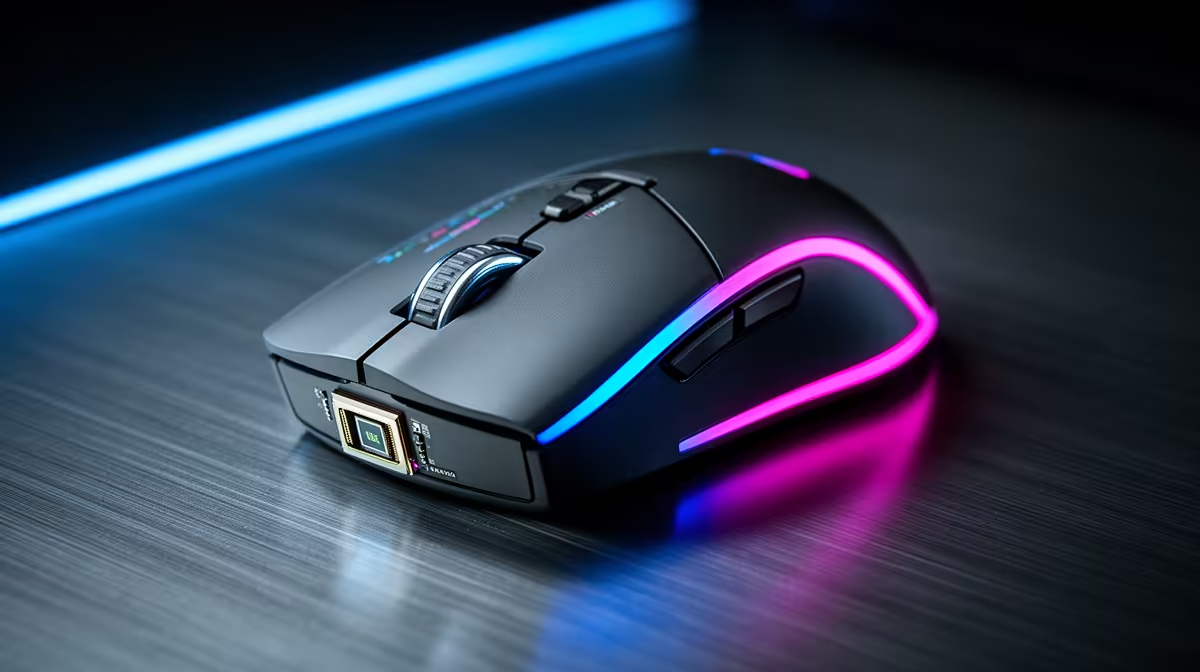
For an 18,000 DPI optical sensor, most competitive gamers perform best between 400 and 1,600 DPI, not at the sensor's maximum. High DPI combined with in-game sensitivity scaling introduces smoothing and jitter on sub-pixel movements. Set DPI to 800 as a starting point and adjust in-game sensitivity to match your preferred physical movement distance per full crosshair rotation.
Understanding What 18K DPI Actually Means 🔬
An 18,000 DPI optical sensor captures 18,000 data points per linear inch of movement. This does not mean higher DPI equals better accuracy: above 2,000 to 3,200 DPI, most sensors apply interpolation to fill in extra data points, which can introduce micro-jitter visible at low in-game sensitivity settings. The HERO 25K sensor in some Logitech G mice and the Razer Focus Pro 30K are engineered to reduce interpolation artifacts, but the principle holds. The 18K ceiling exists to accommodate large high-resolution monitors or specific pointer-speed preferences, not to define where you should operate day-to-day.
Finding Your Optimal DPI Through Testing 🎯
Start at 800 DPI and set in-game sensitivity to 1.5 in your primary title. Play twenty minutes and note where crosshair control feels imprecise. If the cursor feels sluggish and you lift the mouse repeatedly, step up to 1,200 DPI. If tiny movements send the crosshair across the screen, drop to 400 DPI. The goal is a setting where a 30 cm wrist-to-elbow swipe moves the crosshair one full horizontal rotation in-game. This metric, called eDPI (hardware DPI multiplied by in-game sensitivity), is the number serious players track. Most top-ranked FPS players operate between 200 and 800 eDPI regardless of sensor maximum.
Polling Rate and Its Interaction With High DPI ⚙️
A 1,000 Hz polling rate sends 1,000 position updates per second to the PC. At 4,000 Hz, updates are four times more frequent, producing smoother cursor paths on fast swipes. For SA gamers on a tight desk space playing at 1,600 DPI, bumping from 1,000 Hz to 4,000 Hz smooths micro-movements visible at higher sensitivities. However, 4,000 Hz polling increases CPU usage by one to three percent, which matters on older systems. Match polling rate to your monitor: 1,000 Hz for 144 Hz panels, 2,000 to 4,000 Hz only for 240 Hz or 360 Hz displays.
Lock DPI to One Profile Per Game ⚡
Constantly switching DPI between sessions rebuilds muscle memory from scratch each time. Pick one DPI value per game genre and keep it consistent for at least two weeks before evaluating whether an adjustment is needed. This consistency builds the physical precision that no sensor specification can compensate for.
FAQ
Should I ever use the full 18,000 DPI?
Rarely. 18,000 DPI is useful on a 4K monitor at native scaling needing rapid pointer travel. For competitive gaming, operating above 3,200 DPI typically hurts precision more than it helps.
Does a higher-DPI sensor make the mouse more accurate?
Not necessarily. Accuracy depends more on tracking quality at low to mid DPI ranges, maximum tracking speed in IPS, and the ability to handle fast movements without prediction errors.
What is a good starting DPI for FPS games in South Africa?
400 to 800 DPI with an in-game sensitivity of 1.0 to 2.0 is the most common starting range for local FPS players. Match your DPI to the size of your mousepad first: smaller pads under 30 cm require higher DPI to maintain responsive crosshair movement.
Searching for a high-precision gaming mouse?
Browse gaming mice with advanced optical sensors at Evetech to find the right DPI range and form factor for your play style.