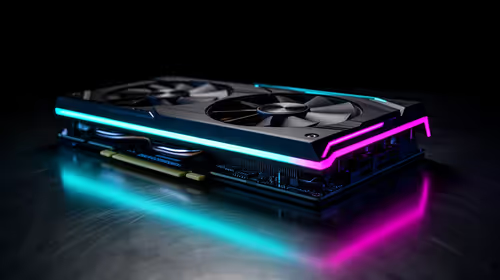
Pick the wrong render engine for your work and you either burn hours waiting or hit a wall your hardware cannot climb. A GPU render versus CPU render build is a choice about one number above all others: how much VRAM your scenes need. GPU rendering is dramatically faster when the scene fits in graphics memory, but a many-core CPU steps in the moment your assets outgrow any single card.
Quick Answer
GPU rendering runs roughly 5 to 15 times faster than CPU rendering when the scene fits inside the graphics card's VRAM, which makes a GPU build the default for most 3D artists. A many-core CPU build avoids the VRAM ceiling entirely and wins for scenes too large for any one card. Choose based on whether your assets routinely push past about 24GB of VRAM.
Why GPU rendering usually wins
A modern graphics card carries thousands of parallel cores, and ray tracing is an embarrassingly parallel problem. Throw a scene at a GPU and it chews through the rays far faster than even a high-core-count CPU. For the vast majority of product visualisation, motion graphics and character work, a single strong card delivers final frames in a fraction of the time a CPU takes.
The VRAM ceiling
The catch is memory. A GPU can only render what fits in its VRAM. Exceed that budget with dense geometry, 8K textures or heavy volumetrics and the render either slows to a crawl as it spills to system memory or fails outright. This is the single hard limit that pushes some artists back toward CPU rendering, and it is why VRAM capacity matters more than raw core count when you spec a GPU workstation.
When a CPU render build is the right call
CPU rendering trades speed for headroom. A workstation CPU addresses your full system RAM, so a build with 128GB or 256GB can render enormous scenes that would never fit on a graphics card. For archviz studios juggling entire city blocks, or VFX work with extreme geometry and volumetrics, that ceiling matters more than per-frame speed.
Many-core CPUs and the scenes they handle
High-core-count workstation processors, the kind built for rendering and simulation, pair dozens of cores with quad-channel or higher memory bandwidth. They will never match a GPU frame-for-frame on a scene that fits in VRAM, but they keep working long after a card has run out of memory. To compare VRAM capacities across current cards, the workstation graphics section at Evetech lists the professional graphics options that anchor either approach.
Hybrid rendering
Most modern engines, Blender's Cycles among them, can render across CPU and GPU together. A hybrid setup uses the GPU for speed and the CPU as extra muscle, and on scenes that fit in VRAM it can shave off a little more time. It does not raise the VRAM ceiling, though, so it is a speed boost rather than a capacity fix.
SA Context: Which Approach Fits the Local Market
For South African 3D artists, the GPU path is the default for good reason. Most local freelance and studio work sits in the product visualisation, archviz and motion graphics space, where scenes are detailed but not at the scale of feature-film production. A current NVIDIA RTX card, from the 16GB class upward, handles the bulk of this work with OptiX acceleration and fits within a realistic Rand budget.
The CPU-only or CPU-primary path carries a meaningful price premium in South Africa. High-core-count workstation processors and the platforms that support quad-channel RAM are expensive here, and the use case that justifies them, scenes consistently exceeding 24GB of VRAM, is relatively rare outside large studios. For most SA artists, the practical answer is to build around the best GPU budget allows and only reconsider the CPU path if scenes regularly crash GPU memory.
The hybrid approach that Blender's Cycles supports, rendering across GPU and CPU simultaneously, is worth enabling for artists who already have a capable processor in their machine. It does not raise the VRAM ceiling, but it uses idle CPU cores to accelerate frames that are within the GPU's memory budget, and on a well-balanced machine it adds a few percent to throughput at no extra hardware cost.
How to choose for your work
Audit your typical scene first. If your projects comfortably fit inside 16GB to 24GB of VRAM, build around the strongest graphics card you can afford and enjoy renders that finish in minutes rather than hours. That covers most freelancers and small studios doing product, motion and character work.
If you routinely blow past 24GB, with massive environments, dense simulations or feature-film-grade detail, lean toward a many-core CPU with abundant system RAM, or a workstation card with an unusually large VRAM pool. The deciding factor is never brand loyalty; it is whether your assets fit in graphics memory. Studios specifying complete machines can browse current PC options at Evetech to benchmark what a balanced workstation build looks like in Rand.
Frequently Asked Questions
Is GPU rendering always faster than CPU rendering?
When the scene fits in the GPU's VRAM, yes, typically 5 to 15 times faster. The advantage disappears the moment a scene exceeds available VRAM, where a CPU with large system memory keeps rendering and a GPU stalls.
How much VRAM do I need for 3D rendering?
For most product, motion and character work, 16GB to 24GB is comfortable. Heavy environments, dense simulations or film-grade detail can push well past that, which is where CPU rendering or a very large VRAM card earns its place.
What is the VRAM ceiling and why does it matter?
It is the point where a scene no longer fits in graphics memory. Cross it and a GPU render slows dramatically or fails, while a CPU using full system RAM carries on. It is the main reason CPU rendering still exists.
Can I use both CPU and GPU to render?
Yes. Engines like Blender's Cycles render across CPU and GPU together for a speed gain on scenes that fit in VRAM. It does not raise the memory ceiling, so it speeds things up rather than expanding capacity.
Which build should a freelance 3D artist buy?
Most freelancers are best served by a strong GPU build, since their scenes usually fit within 16GB to 24GB of VRAM and benefit from the speed. Only artists who regularly exceed that should weigh a many-core CPU workstation.