Quick Answer
Boom mics capture cleaner voice audio in noisy environments because proximity to the mouth gives a better signal-to-noise ratio. Hidden beamforming mics are cleaner aesthetically and suit quieter rooms, casual voice chat, and hybrid work or study use. For competitive gaming in noisy environments, a boom mic remains the stronger choice.
How Each Mic Type Captures Voice 🎙️
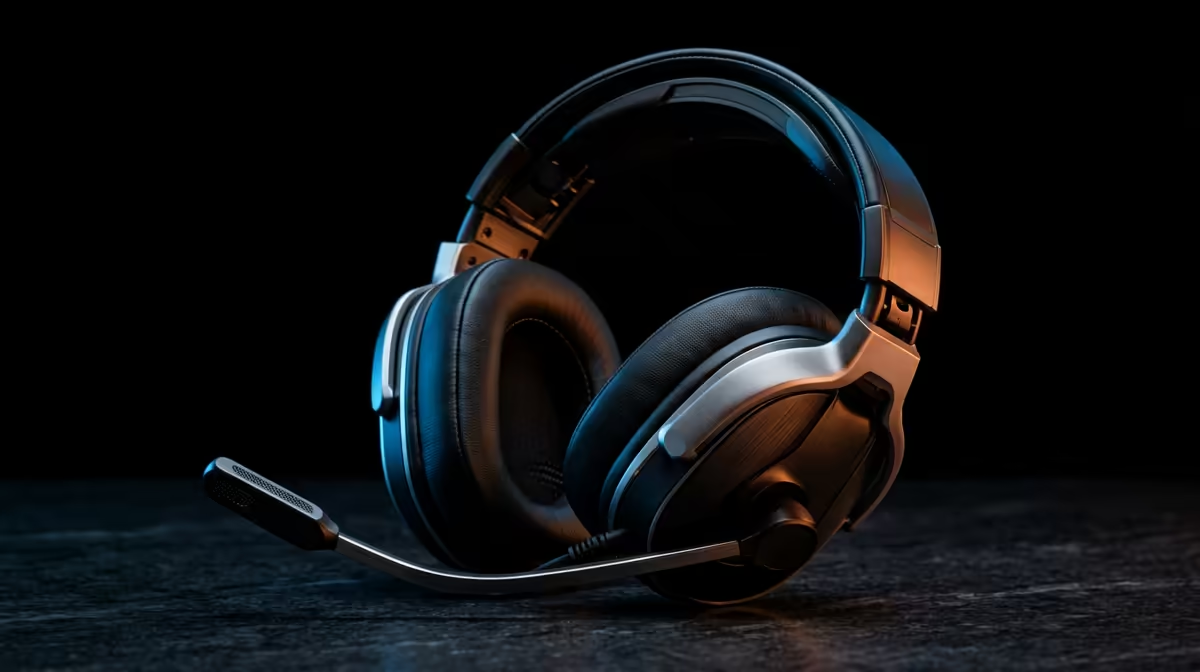
A boom microphone mounts on a flexible arm from the left earcup, positioning a cardioid capsule 5 to 8 cm from your mouth. This close proximity delivers strong direct signal pickup, making software noise processing more effective because the voice-to-background ratio is already high before any filtering begins. Boom mics on gaming headsets in the R1,000 to R2,500 range typically deliver 80 Hz to 12,000 Hz frequency response, adequate for clear voice chat. Hidden beamforming mics use two or more miniature capsules embedded in the earcup or headband and apply DSP to focus pickup toward the user's mouth. They close the gap in quiet rooms but struggle more in environments where noise arrives from many directions simultaneously.
Real-World Performance Comparison 🔊
In a controlled quiet room, modern beamforming arrays produce clarity that most listeners rate on par with a decent boom mic. In a shared student res room with desk fan noise, a roommate playing music, and traffic from an open window, the boom mic maintains intelligibility far better. DSP in beamforming headsets compensates partly with AI noise suppression, but heavy background noise causes suppression artefacts such as voice fluctuations and audio pumping. For SA students gaming in shared res rooms, a boom mic headset around R900 to R1,500 is the more reliable voice tool.
Aesthetic and Use-Case Trade-Offs ✨
Hidden mic headsets look like consumer audio products rather than gaming peripherals, doubling as everyday headphones for campus use, public transport, or library sessions where a boom arm looks out of place. For a South African professional who uses the same headset on morning Teams calls and evening gaming sessions, a hidden mic maintains professional appearance. Boom mic headsets with detachable arms give the best of both: use the boom for gaming, remove it for campus or public use.
Test Your Mic in the Noisy Environment First ⚡
Before committing to a beamforming headset for both gaming and remote work, record a 60-second voice memo in your most typical noisy environment (shared room, home with family noise, open-window setting) and listen back. If voice intelligibility sounds clear without processing, beamforming works for your space. If noise overwhelms the voice signal, a boom mic is the more reliable choice regardless of aesthetics.
FAQ
Can a boom mic headset work without the boom arm attached?
Many gaming headsets with detachable boom mics function for stereo playback when the arm is removed. A built-in microphone activates as a fallback for calls on most models, though not all include this; check the spec sheet.
Do beamforming mics pick up keyboard noise during voice chat?
Beamforming helps suppress lateral keyboard clatter if the keyboard is not in the mic's forward beam direction. Typing directly in front of you (same direction as your voice) can bleed through beamforming more than through a cardioid boom mic positioned near the mouth.
Are there headsets with both a hidden mic and a detachable boom option?
Yes, some premium models include both a built-in hidden mic and an optional detachable boom accessory. These cost more but offer genuine versatility for SA professionals who need one headset for corporate calls, casual voice chat, and competitive gaming.
Not sure whether a boom mic or hidden mic suits your gaming and work lifestyle?
Browse Evetech's gaming headset range, with options covering both mic styles across a range of budgets, available with SA-wide delivery.