Quick Answer
AIO liquid coolers arrive pre-filled and pre-assembled. Installation involves four fan screws, a radiator bracket, and a CPU mount, which most builders complete in 20 to 40 minutes. Maintenance over a 5-to-7-year lifespan is limited to occasional fan dusting and an annual cable check, with no coolant top-ups required.
What AIO Installation Actually Involves 🔧
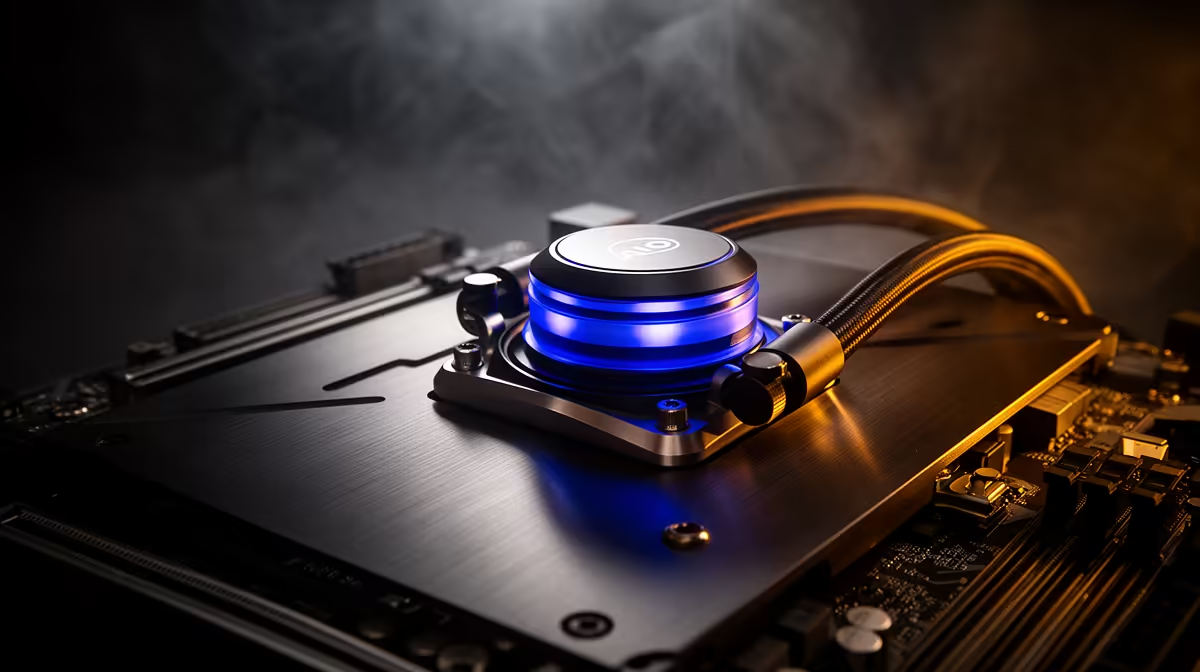
Remove the stock cooler, clean the CPU IHS with isopropyl alcohol, apply a pea-sized dot of thermal paste, mount the backplate, seat the CPU block, and tighten to finger-tight plus a quarter turn. Route tubing to the radiator position, screw the radiator into the case bracket, attach the fans, and connect the pump USB header, pump power header, and fan headers. For 360mm and 420mm builds, confirm radiator clearance in your case before purchase. Popular mid-towers from Lian Li and Fractal Design confirm 360mm front or top support in their spec sheets, accessible on Evetech's product listings.
Why AIOs Beat Custom Loops for Professionals 💼
Custom loops deliver peak thermal performance but demand hours of planning, sourcing, filling, and bleeding, followed by monthly coolant level and algae inhibitor checks. AIOs use a sealed, biocide-treated loop that needs no maintenance. For South African creative professionals billing hourly, the time saved over five years of ownership is measurable. The tradeoff: AIOs cannot cool a GPU block or distro plate, and a failed pump requires replacing the entire unit rather than servicing individual parts.
Long-Term Maintenance: What You Actually Need to Do 🛠️
Dust radiator fans every 3 to 6 months using compressed air, especially if your case intakes are near carpet common in SA home office setups. Check that fan and pump headers are firmly seated annually; vibration can loosen connections in a PC that moves regularly. Monitor pump RPM via HWiNFO64: a drop from the rated 2,000 to 2,800 RPM range to under 1,200 RPM consistently signals bearing wear. Replace thermal paste every 2 to 3 years. Quality paste like Thermal Grizzly Kryonaut or Noctua NT-H2 costs R150 to R300 at Evetech.
Orient Tubing Ports Downward on the Radiator ⚡
Position the radiator tube ports at the bottom rather than the top where your case allows. This prevents residual air bubbles from sitting near the pump inlet and reduces long-term stress on tubing joints. Most AIO installation manuals include guidance on preferred orientations per case type.
FAQ
Do AIOs need coolant top-ups?
No. The loop is pressure-sealed at the factory with a fixed coolant volume. Some minor migration through tubing walls occurs over years but is accounted for in the design and requires no user intervention.
Can I install an AIO in a micro-ATX case?
Many micro-ATX cases support 240mm radiators with 120mm fans on the front or top. Some accept 280mm front-mount radiators with 140mm fans. Check the specific case compatibility table before purchasing a 360mm or larger AIO for a small form-factor build.
How do I know if my AIO pump is failing?
Monitor pump RPM via BIOS or HWiNFO64. A healthy pump holds 1,800 to 2,800 RPM depending on the model. Sudden RPM drops combined with rising CPU temperatures indicate pump bearing failure; replace the AIO promptly to prevent thermal damage.
Ready to simplify your pro build cooling?
Evetech stocks AIO liquid coolers in 240mm, 280mm, 360mm, and 420mm configurations with fast delivery across South Africa.