Ever stared at the price of a top-tier GPU in South Africa and felt your wallet cry? We get it. A flagship card can cost more than a second-hand car! But here’s the secret the big brands don’t shout about: the affordable GPU that powers your 1080p gaming adventures might have started life destined for a far more expensive sibling. This guide reveals how budget graphics cards are made, turning manufacturing quirks into wallet-friendly power for SA gamers. 🇿🇦
Why Budget Graphics Cards Exist: The Art of Binning
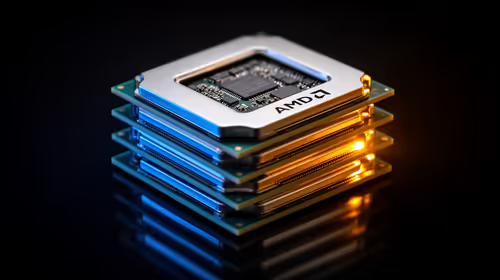
The journey of every graphics processing unit (GPU) begins on a large, thin disc of pure silicon called a wafer. Hundreds of identical chips are etched onto this single wafer. But, like any complex manufacturing process, it’s not always perfect. Tiny imperfections can occur, meaning not every chip performs at the maximum advertised speed.
This is where "silicon binning" comes in. After manufacturing, every single chip is tested for stability and performance.
- The A-Team: The flawless chips that run coolest and fastest become the flagship models (think RTX 4080 or RX 7900 XT).
- The B-Team: Chips with minor flaws, like a defective processing core or one that can't hold a high clock speed reliably, aren't thrown away. Instead, the faulty parts are disabled via software, the chip is clocked a bit lower, and it's "binned" as a lower-tier model (like an RTX 4060).
This clever recycling is the primary reason budget graphics cards can offer such incredible value. You're often getting a chip that's physically very similar to its bigger brother, just tailored for a different performance target. It’s the secret sauce that makes PC gaming accessible to everyone.
Check the Cooler! ⚙️
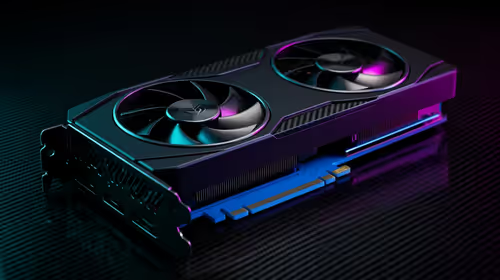
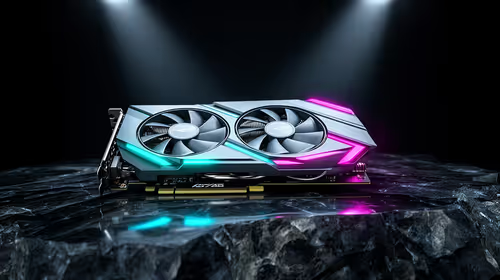
Even on budget cards, the cooling solution matters. A card with a dual-fan cooler or a thicker heatsink will often run quieter and boost its clock speeds higher than a single-fan version of the exact same GPU. Always check reviews to see how the cooling performs under load before you buy!
Putting It All Together: From Chip to Card
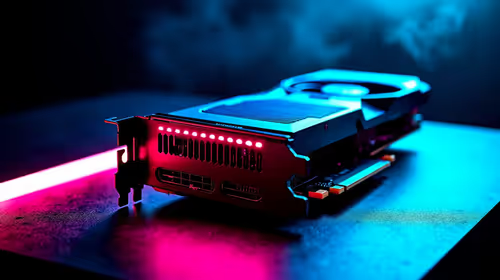
NVIDIA, AMD, and Intel design the core GPU, but they don't usually build the final product you slot into your PC. That job belongs to Add-In Board (AIB) partners like MSI, ASUS, Gigabyte, and Zotac. These companies take the binned chips and build the complete graphics card around them.
This is another area where costs are managed for a budget gaming card. AIBs will design a custom Printed Circuit Board (PCB), add the VRAM (video memory), and attach a cooling solution. For a budget model, they might use:
- A simpler, more cost-effective cooler.
- Fewer power delivery phases (still perfectly safe, but with less overclocking headroom).
- A more basic design without all the RGB bling.
This allows partners like MSI to offer a range of products using the same core GPU, hitting different price points for every kind of gamer. From the entry-level AMD Radeon cards to the new Intel Arc series, this partnership model is what creates the massive variety we see on the market.
What "Budget" Means for a South African Gamer 💡
In South Africa, "budget" doesn't mean "weak." It means smart. It’s about finding the absolute best performance-per-Rand for smooth 1080p gaming. A well-chosen budget graphics card is the difference between watching a slideshow and hitting a consistent 60+ FPS in your favourite shooters.
While these gaming cards are built for fun, the same principles of binning and design apply to specialised hardware like professional workstation graphics cards, which are optimised for creative and scientific tasks, not gaming. For gamers, the goal is always maximum frames for your buck, and understanding the manufacturing process helps you appreciate the incredible engineering in even the most affordable GPUs.
Ready to Level Up Your Rig on a Budget?
Understanding how budget graphics cards are made demystifies the magic and helps you make a smarter choice. You don't need to break the bank for incredible 1080p gaming. Explore our wide range of graphics cards and find the perfect GPU to power your next victory.