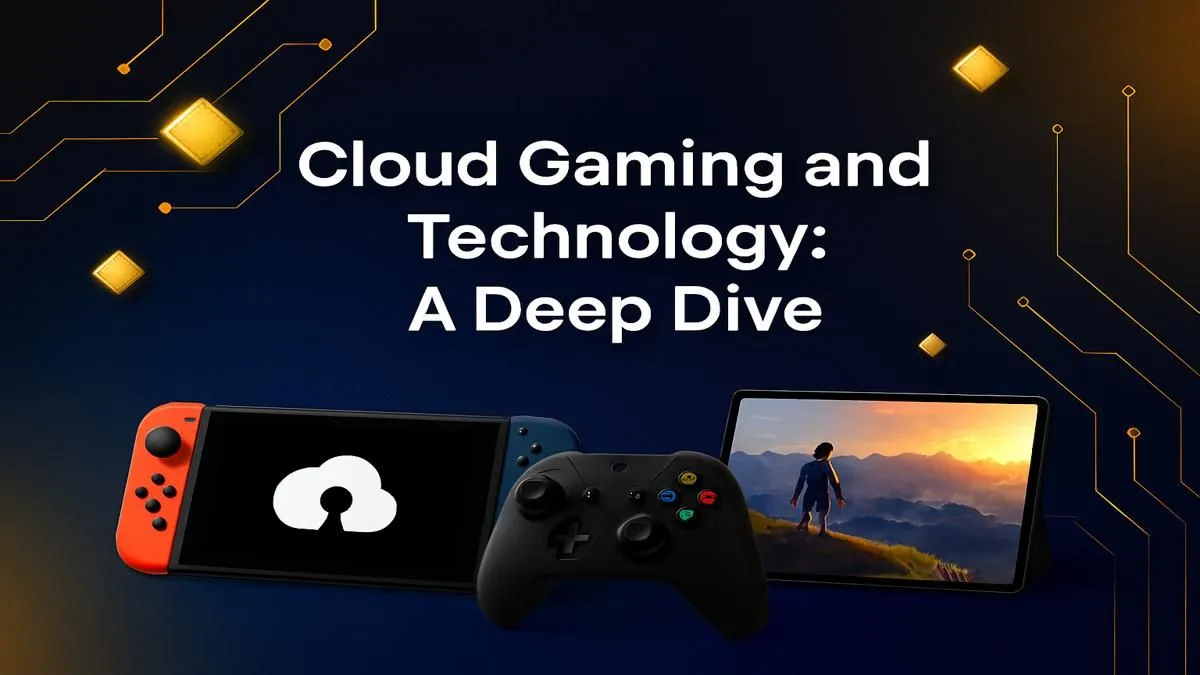
Tired of staring at a 150GB download bar for the latest AAA title, only to find your graphics card can't handle it? You're not alone. Cloud gaming promises to fix this, letting you stream blockbuster games to almost any device. It sounds like magic, but how does cloud gaming work, especially with South Africa's internet landscape?
Let's demystify the tech, break down what's happening behind the scenes, and see if it’s the right call for you. 🚀
So, How Does Cloud Gaming Work Exactly?
At its core, cloud gaming is surprisingly simple. Think of it like Netflix or YouTube, but for interactive video games. Instead of running the game on your local machine, a massively powerful computer in a data centre somewhere else does all the heavy lifting.
Here’s the step-by-step process:
- Your Input: You press a button on your controller or keyboard.
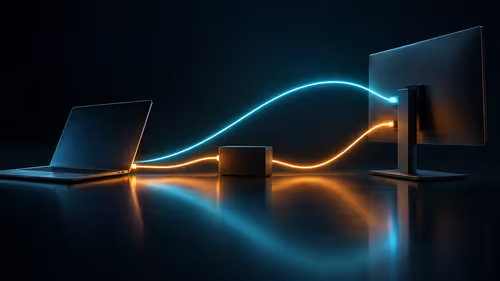
- To the Cloud: That command travels across the internet to a server.
- Server Power: A high-end rig, often part of a cluster of powerful pre-built PCs, processes your input instantly. It renders the next frame of the game—the explosion, the jump, the headshot.
- Back to You: This new video frame is compressed and streamed back to your screen.
This entire round trip happens in milliseconds. When it works perfectly, it feels like the game is running right there on your own PC.
The Tech Behind the Magic 🔧
For this process to feel seamless, three critical pieces of technology have to work in perfect harmony. Understanding how cloud gaming works means understanding these components.
1. Massive Data Centres
The "cloud" isn't some fluffy thing in the sky; it's a physical building packed with servers. Companies like NVIDIA, Microsoft (for Xbox Cloud Gaming), and Amazon build these data centres with thousands of top-tier GPUs and CPUs. They are essentially warehouses full of the most powerful gaming hardware imaginable, far beyond what you'd find in even high-end rigs over R20k.
2. High-Speed, Low-Latency Internet
This is the big one for us in South Africa. The speed of your connection (bandwidth) determines the quality of the video stream (think 1080p vs 4K), but the responsiveness (latency or "ping") is what truly matters. Latency is the time it takes for your command to reach the server and for the result to come back. High latency means noticeable input lag, which can make fast-paced games unplayable. A stable fibre connection is almost non-negotiable.
Check Your Latency! ⚡
committing to a cloud service, test your connection's stability. A great real-world test is to check your ping to local game servers like the Johannesburg or Cape Town servers for Valorant or CS:GO. Run a continuous ping test using the Command Prompt (ping 8.8.8.8 -t) to see if you have any packet loss or spikes. A stable, low ping (under 40ms) is a good sign!
3. Advanced Video Compression
To send high-resolution gameplay over your internet connection without crippling your data cap, providers use sophisticated video compression algorithms (codecs) like H.264 and H.265. These codecs are masters at shrinking video data in real-time while preserving as much visual quality as possible. It's a delicate balancing act between image clarity and performance.
Cloud Gaming vs. A Dedicated Gaming PC
So, with this tech in mind, should you ditch the idea of a local rig? Not so fast. While cloud gaming is impressive, a dedicated PC still holds major advantages, especially for serious gamers.
For many, the reliability and raw power of local hardware are unmatched. Owning the hardware means you have zero input lag, can play any game you own without worrying if it's on the service, and you aren't at the mercy of your ISP's network stability. You can mod games, tweak settings to your heart's content, and use the PC for so much more than just gaming.
Even great gaming PCs under R20k can offer a fantastic 1080p experience without monthly subscription fees. And if you're just starting out, affordable budget gaming PCs provide a solid entry point into the world of PC gaming.
Here’s a quick breakdown:
| Feature |
Cloud Gaming |
Dedicated Gaming PC |
| Upfront Cost |
Low (requires a basic device) |
Higher (investment in hardware) |
| Performance |
Dependent on internet & server |
Consistent & Controllable |
| Input Lag |
Always present (can be minimal) |
Near-zero |
| Game Library |
Limited to the service's catalogue |
Virtually unlimited |
| Ongoing Cost |
Monthly subscription fees |
None (besides new games) |
| Flexibility |
Gaming only |
Gaming, productivity, creativity |
Ultimately, the best choice comes down to your needs and internet connection. Cloud gaming is a fantastic technology that offers incredible convenience. However, for the ultimate, no-compromise experience in South Africa, a dedicated rig from the best gaming PC deals remains the undisputed champion. ✨
Ready to Own Your Power?
Cloud gaming is an exciting frontier, but nothing beats the raw, lag-free performance of a dedicated gaming rig. For ultimate control, graphical fidelity, and endless choice, local hardware is king. Explore our massive range of gaming PCs and find the perfect machine to conquer your world.