Quick Answer
Place the spirit level on the top edge of the installed GPU to check that the card sits perfectly horizontal, then adjust the holder height until the bubble centres in the vial. If the level shows the card tilting toward the far end, raise the bracket. If tilting toward the PCIe slot, lower it slightly. The goal is a card that is level without upward pressure on the PCIe connector.
Why Alignment Matters More Than Just Stopping Sag 🔧
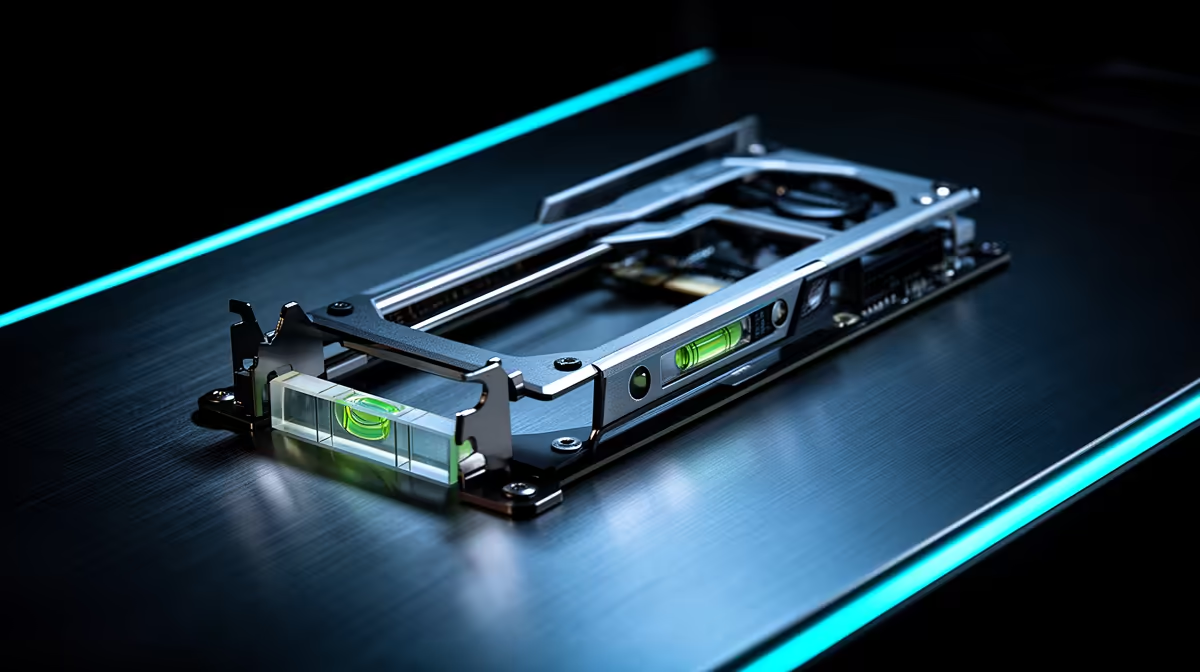
A GPU support bracket that is set too high lifts the card, reversing the stress from downward sag to upward lever pressure on the PCIe slot's retention clip. This is equally damaging over time and harder to detect visually because the card still looks supported. A bracket set too low does not stop sag and provides only a mechanical stop during transport rather than continuous support. Using a spirit level eliminates guesswork: you can set the holder to within one or two millimetres of correct height and verify the card is truly horizontal rather than relying on visual inspection through the tempered glass panel. Some GPU holders such as the Lian Li AGRB bracket range include a built-in bubble level on the bracket post, saving the need for a separate tool.
Step-by-Step: Using a Spirit Level to Align the Holder ✨
Start with the GPU fully seated in the PCIe slot and secured with the slot retention clip. Place the spirit level flat on the top face of the GPU (not on the cooler fan blades, but on the flat shroud surface near the middle of the card). Observe the bubble position: if the card sags at the far end, the bubble drifts toward the PCIe slot side, indicating the far end is lower. Install the bracket under the GPU at approximately two-thirds of the card's length from the PCIe slot for maximum leverage.
When Built-In Spirit Levels on GPU Brackets Are Worth It 🏗️
Built-in spirit levels on the bracket post or arm let you see alignment without removing the side panel or retrieving a separate tool. This is particularly useful in compact mATX cases where inserting a standard spirit level between components is difficult. Models with integrated bubble levels cost R200 to R400 locally, compared to R80 to R150 for basic brackets without. The extra cost is justified for first-time builders or for cases where the case floor is not perfectly flat relative to the PCIe slot, which happens in some budget mATX cases with uneven PSU shroud heights. SA builders doing repeated LAN builds or workshop clients will use the built-in level on every job, making it worth the one-time cost.
A Mini Spirit Level Works Best in Tight Builds ⚡
Standard spirit levels are 150 mm to 300 mm long and may not fit cleanly on a GPU inside a compact case without touching fan cables or RAM. A small keyring-sized bubble level (60 mm long) works perfectly and costs under R30 at any hardware store. Keep one in your PC building toolkit alongside your Phillips screwdrivers.
FAQ
What if the GPU top surface is angled or uneven and won't hold a spirit level?
Place the level on the flat metal bracket strip at the rear of the card (the PCIe slot bracket end) rather than on the cooler. This strip is always machined flat and parallel to the PCB, giving a reliable reference surface.
Can I align a GPU holder without a spirit level?
Yes, using a digital angle gauge app on a smartphone laid flat on the GPU. These apps use the phone's accelerometer and are accurate to within one degree, which is sufficient for GPU bracket alignment. A spirit level is simply a more traditional and immediately available option.
Does GPU alignment affect display output or system stability?
Not directly. A sagging GPU may eventually cause intermittent PCIe contact issues, but the angle of the card relative to the case has no impact on GPU performance or signal output under normal conditions.
Want a GPU holder with a built-in level for precise installation?
Browse Evetech's GPU support bracket range including models with integrated spirit levels, all available online with South African delivery.