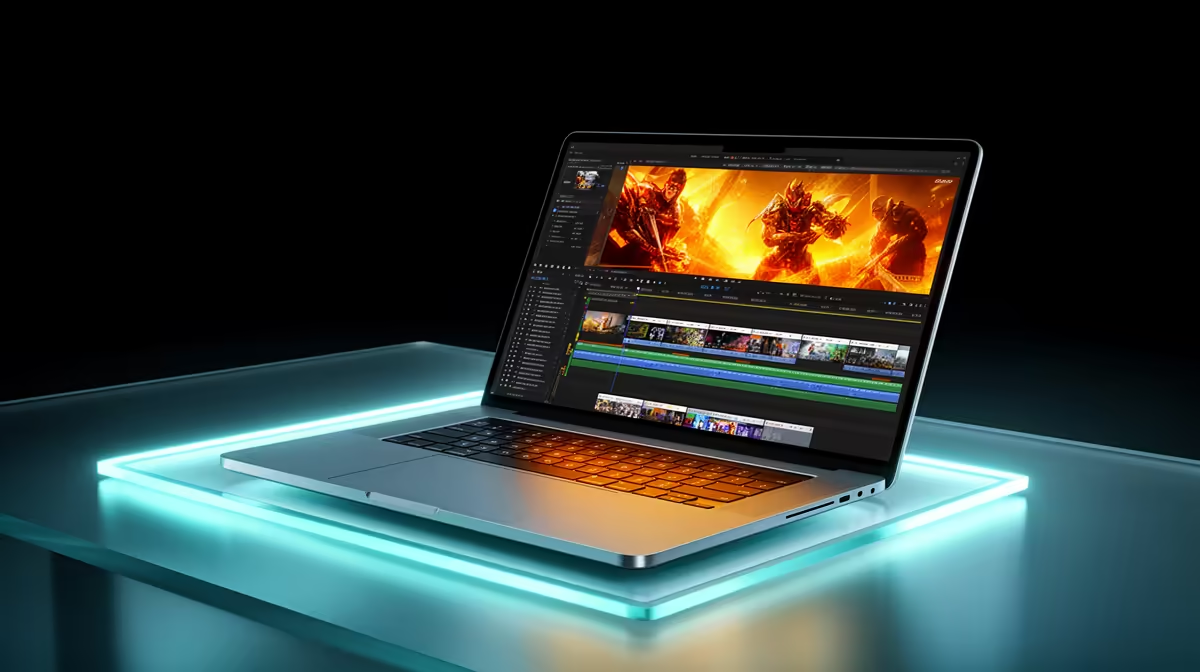
Buy a 512GB MacBook for video work and the disk fills before your first project wraps. 4K ProRes is gorgeous and edit-friendly, but it is also enormous: roughly 110GB for a single hour of ProRes 422 footage. Do the arithmetic before you spend, because storage is the one MacBook spec you cannot upgrade after purchase.
Quick Answer
A 512GB MacBook holds fewer than four hours of raw 4K ProRes 422 footage once macOS and your apps take their share. At about 110GB per hour, the disk is gone fast. Video professionals should plan for 1TB or more of internal storage, or commit to an external SSD scratch drive from day one.
The maths on 4K ProRes 422
ProRes is an editing codec, not a delivery codec. It keeps quality high and decoding light so your timeline scrubs smoothly, and that comes at the cost of large files. One hour of 4K ProRes 422 lands around 110GB. Higher-quality variants such as ProRes 422 HQ or 4444 climb well past that, while the lighter ProRes 422 LT comes in lower.
On a 512GB drive you never actually have 512GB. macOS, applications, caches, and working headroom claim a meaningful slice, so plan on roughly 400GB usable for footage if you keep the system lean. At 110GB per hour, that is under four hours of raw 4K ProRes 422 before the disk is full, and a single shoot can produce that easily.
How much storage do editors really need
The honest answer depends on your workflow, but a few clear tiers help.
The 512GB trap
512GB suits students, casual shooters, and anyone editing compressed formats like H.264 or HEVC rather than ProRes. For sustained 4K ProRes work it is a constant juggling act of offloading and deleting, which is exactly when accidents happen.
1TB as the practical floor
For a working video editor, 1TB internal is the sensible minimum. It gives you room for an active project plus the system, caches, and a margin so you are not editing on a disk that is 95 percent full, where performance and stability both suffer.
2TB and up for heavy projects
Multi-cam shoots, long-form documentary footage, and ProRes 422 HQ or 4444 push you toward 2TB or beyond, or a robust external workflow. If a project routinely exceeds your internal disk, external storage stops being optional.
The external SSD strategy
Apple's internal storage upgrades are expensive, so a fast external SSD is often the smarter spend. A high-speed NVMe SSD over Thunderbolt or USB can act as a scratch and project drive, keeping the internal disk for the system and active media. The key is sustained write speed: a slow drive will stutter during ProRes playback. If you want to see the laptops most editors actually pair with external storage, the MacBook range at Evetech lets you compare configurations and pricing before committing to a model.
A practical hybrid for many South African creators is a mid-storage MacBook plus a fast external SSD for footage. You get a capable machine without paying Apple's premium for every terabyte, and you can move the external drive between machines. To gauge which models other local creators are choosing right now, the laptop best sellers list shows where demand is sitting across the range.
ProRes variants and how they change the maths
The 110GB-per-hour figure applies to ProRes 422 at standard quality, but ProRes has several variants with different data rates that shift the storage arithmetic considerably.
ProRes 422 LT
ProRes 422 LT is the leaner variant, sitting at roughly 60 to 70GB per hour of 4K footage. Broadcast operators and run-and-gun shooters who need the edit-friendliness of ProRes without the file bulk often use this format. It works well for web delivery and social content where the destination is compressed anyway.
ProRes 422 HQ
ProRes 422 HQ pushes closer to 150GB per hour at 4K. It is the choice for colour-critical work where you need the maximum quality floor before grading. On a 512GB MacBook, even a short HQ project can fill the internal drive during an active grade.
ProRes 4444
ProRes 4444 carries alpha channel data for compositing and motion graphics and runs at data rates that can exceed 300GB per hour at 4K, depending on the frame rate. This format is generally not shot to camera directly but it can appear in a workflow when rendering visual effects layers for finishing. Planning a ProRes 4444 pipeline on a laptop requires an external storage strategy from the outset.
Understanding which variant your camera outputs and which your edit suite requests lets you size storage against the actual format rather than a generic estimate.
What macOS itself consumes
A fresh macOS installation occupies around 15 to 20GB, but that grows over time as system updates, language packs, cache files and app logs accumulate. Add a standard creative application suite and the system footprint easily reaches 40 to 60GB before any project data. This is why the usable space on a 512GB drive is comfortably under 400GB for a working editor, not 500GB. Factor this overhead into every storage calculation, not just the footage estimates.
Plan before you buy
Storage is the one decision you lock in at checkout. RAM and storage on modern MacBooks are soldered, so there is no adding a drive later. Estimate your typical project size in hours of ProRes, multiply by 110GB, add the system overhead, and buy the tier that leaves comfortable headroom. It is far cheaper than discovering mid-deadline that you cannot ingest a card.
Frequently Asked Questions
How big is one hour of 4K ProRes 422?
Roughly 110GB. ProRes 422 HQ and 4444 are considerably larger, while ProRes 422 LT is smaller. Always size your storage off the specific variant you shoot.
How many hours of 4K ProRes fit on a 512GB MacBook?
Fewer than four hours of ProRes 422 once macOS and apps take their share, leaving around 400GB usable. A single shoot can fill that, which is why editors outgrow 512GB quickly.
Can I add storage to a MacBook later?
No. MacBook storage is soldered and cannot be upgraded after purchase. Your only path to more space later is an external drive, so choose the internal tier carefully at checkout.
Is an external SSD good enough for editing 4K ProRes?
Yes, provided it delivers high sustained write speed over Thunderbolt or a fast USB connection. A slow external drive will stutter during ProRes playback, so prioritise sustained throughput over headline peak figures.
What internal storage should a serious editor buy?
1TB is the practical minimum for sustained 4K ProRes work, with 2TB or a strong external workflow for multi-cam and high-bitrate projects. 512GB is fine only for compressed formats or light use.
Does ProRes 422 LT offer a practical storage saving?
Yes. At roughly 60 to 70GB per hour versus around 110GB for standard ProRes 422, LT gives you close to double the recording time on the same drive. The visual quality difference in most web and social delivery contexts is small, so it is a sensible trade for shooters who are storage-constrained without a dedicated external drive.
Does the camera or the MacBook determine which ProRes variant is used?
Both can. If you shoot to ProRes on a camera that records it natively (such as certain Sony, ARRI or camera accessories used with iPhone or iPad), the variant is set in camera. If you transcode compressed footage to ProRes in Final Cut Pro or DaVinci Resolve on the MacBook, you choose the variant in your export or optimised media settings. Either way, knowing the target format before the shoot helps you size storage accurately.
Speccing a MacBook for video? Compare storage tiers across the MacBook range at Evetech (https://www.evetech.co.za/macbooks/l/3284) and pick the configuration that fits your real footage load, since you cannot add space later.