Quick Answer
For South African buyers in 2026, a capable lightweight wireless gaming mouse sits in the R800 to R2,000 range. Under R800 you start compromising on wireless quality or sensor accuracy; above R2,500 you are paying for flagship polling rates and premium brand aesthetics rather than meaningful performance gains.
The R800 to R1,500 Range: Value Sweet Spot 💰
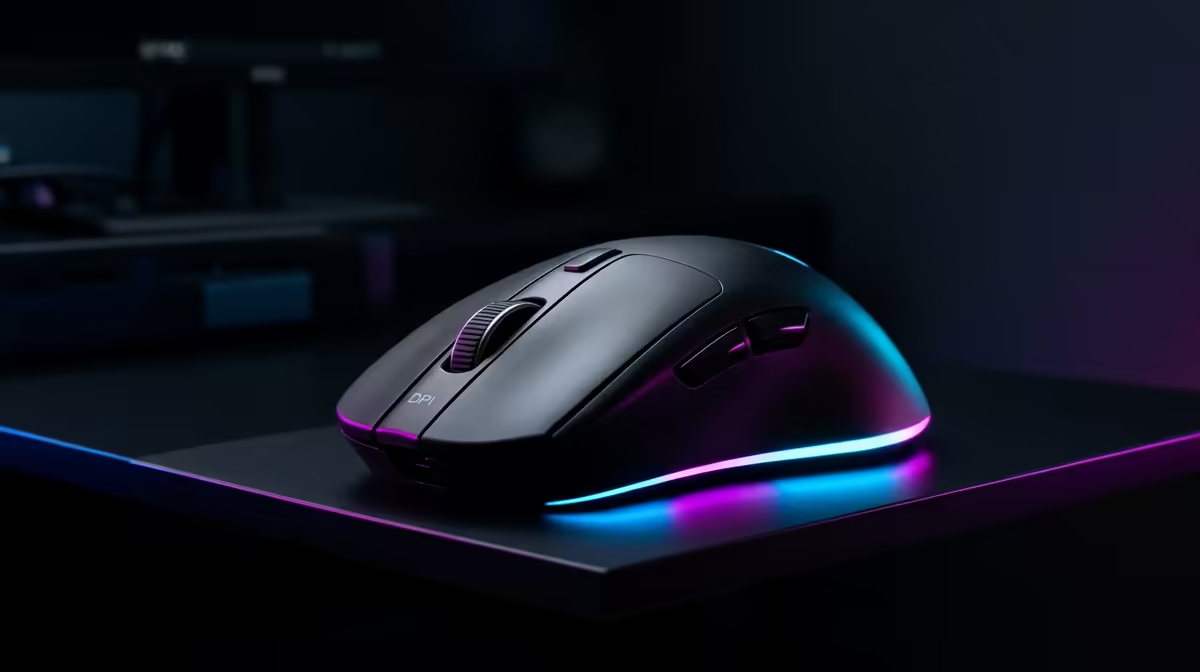
This bracket delivers dual wireless (2.4 GHz and Bluetooth), optical sensors rated at 12,000 to 18,000 DPI with no hardware acceleration, and weights between 55 and 80 g. The Razer Orochi V2 falls in this band and offers 18,000 DPI, dual wireless, 60-million-click switches, and AA-battery convenience. At this price tier, you get a reliable sensor, clean wireless performance, and a build that survives daily transport. Compromises at the lower end include no RGB, basic ergonomics (often ambidextrous only), and limited side-button configurations. For a South African university student or mobile professional, this range gives the best performance-per-rand ratio available locally.
The R1,500 to R2,500 Range: Performance Uplift 🎮
Moving into this bracket buys more ergonomic shaping (right-handed contoured grips or larger ambidextrous shells), better stock mouse feet (PTFE rather than generic plastic), higher-resolution sensors like the Pixart 3395 or Focus Pro 30K, and in some cases 4,000 Hz polling via HyperSpeed Wireless or equivalent protocols. If you play competitively in ranked FPS queues or attend SA LAN events, this investment is justified by the measurable reduction in input lag and sensor jitter. Build quality also steps up, with more premium plastics, rubber grip inserts, and longer warranties.
What You Gain and Lose Above R2,500 📊
Above R2,500, gains are incremental rather than transformative. You may get USB-C charging with 30-minute top-up to 3-hour play, premium fabric charging docks, more programmable buttons, per-key RGB with thousands of effects, or ultra-lightweight honeycomb shells below 50 g. These are genuine features but they matter primarily to professional or semi-professional players and hardcore enthusiasts. For casual to mid-serious SA gamers, spending above R2,500 on a mouse while still gaming on a 1080p 60 Hz monitor is misaligned: upgrade the display first for a larger overall performance impact.
Check Local Warranty Coverage Before Buying ⚡
Always verify that the mouse you purchase is supported by a local South African distributor rather than a grey-import parallel import. Local warranty means repairs or replacements are processed in-country, often within 7 to 14 business days. Grey imports require shipping to international service centres, which can take 6 to 12 weeks and sometimes costs more than the mouse. Evetech stocks warranty-covered products from authorised channels.
FAQ
Is there a good lightweight wireless gaming mouse under R600 in South Africa?
Options exist below R600 but typically involve budget sensors without acceleration-free tracking, micro-USB charging, or basic 125 Hz wireless that is noticeably laggier than competitive 1,000 Hz options. For pure office and browsing use they are fine; for gaming they are a compromise.
Does spending more on a mouse improve my aim?
A better mouse removes hardware limitations: smoother tracking, more consistent click registration, and lower wireless latency. It will not improve aim beyond what your current sensor already delivers if your sensor is already accurate. A R1,000 sensor is effectively as accurate as a R3,000 sensor for 95 percent of players.
Should I prioritise mouse weight or sensor quality when on a tight budget?
Prioritise sensor quality. A heavier mouse with a clean sensor is more accurate than an ultralight mouse with a jitter-prone sensor. A 75 g mouse with a Pixart 3370 outperforms a 50 g mouse with an interpolating budget sensor in real competitive scenarios.
Not sure which tier suits your gaming style and budget?
Browse Evetech's wireless gaming mouse range, with options across every price band, including locally-warranted models for SA buyers.