South African streamers searching for a professional streaming light setup often collide with two problems at once: prices listed in USD that convert uncomfortably, and advice calibrated to large purpose-built studios rather than a corner bedroom in Johannesburg or Cape Town. The honest answer is that you can look genuinely polished at almost every budget tier if you spend the money in the right order and understand what each additional light actually adds to the picture.
Quick Answer
A single high-CRI bi-colour key light in the R600 to R1000 range handles most solo streamers. A matched pair for key and fill runs around R1500. A full three-point rig with stands and softboxes starts near R3000. Buy one quality light first, not three weak ones.
💰 The Entry Level: One Good Key Light (R600 to R1000)
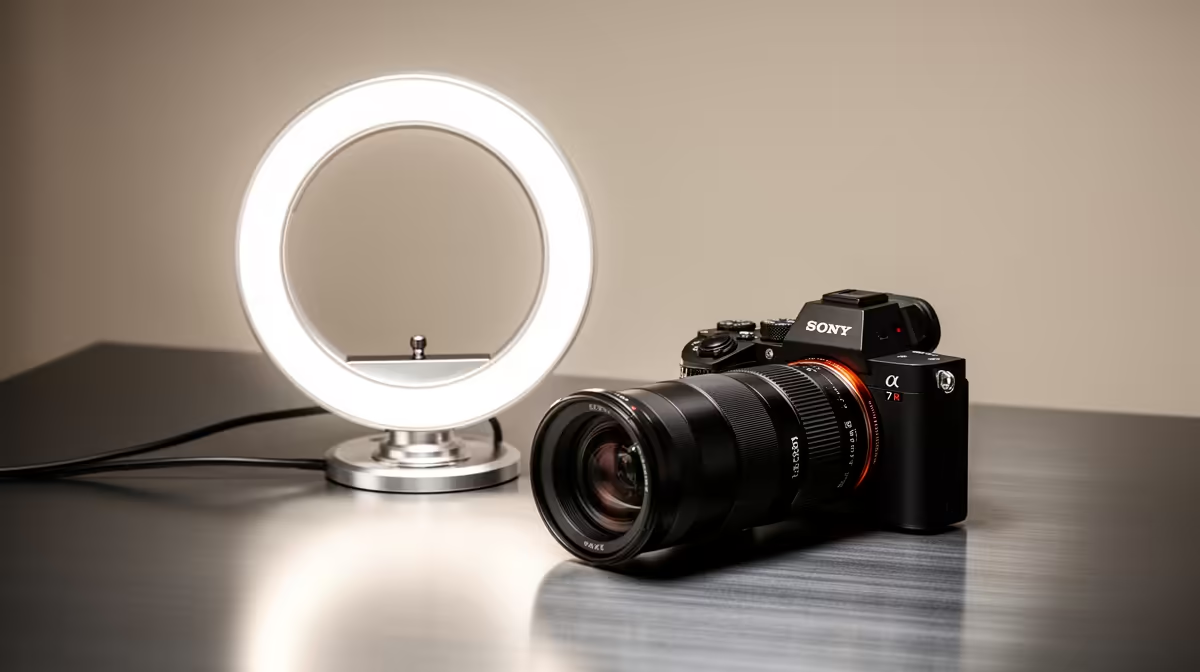
The single biggest jump in stream quality is going from no dedicated light to one well-positioned key light. A ring light, a square LED panel, or a softbox-style unit in the R600 to R1000 range transforms a face lit by a random ceiling bulb into something that reads as deliberate and professional on screen.
The specification that matters most at this tier is CRI, the colour rendering index. A CRI above 90 means the light records skin tones close to how they look in real life. A cheap LED with CRI under 80 often renders faces with a slightly green or magenta cast that takes heavy colour correction to fix, and even then the result can look unnatural.
Bi-colour capability at this price is common and genuinely worth having. The ability to shift from roughly 3000K warm to 5600K daylight means you can match the panel to whatever ambient light exists in your room, whether that is a tungsten lamp, an afternoon window, or evening overhead lighting.
Place one quality light at roughly 45 degrees to the side of your camera, slightly above eye level, and point it toward your face. Most of the work happens in that positioning, not in the hardware.
The Free Tool You Already Own
A pale wall directly opposite the key light acts as a bounce fill. It reflects some of the key light back across the darker side of your face, reducing the shadow without adding a second piece of hardware. In a white or light grey room, this trick can get you to a near-professional two-light look for the cost of a single panel.
✨ The Step Up: Key and Fill Pair (Around R1500)
A matched pair adds a second, lower-powered light on the opposite side to the key. Its job is not to illuminate you a second time but to gently lift the shadow side of your face so it does not drop into darkness on camera. The ratio between key and fill is what gives your image depth without looking flat.
A common starting ratio is the key light at full power with the fill set to roughly 30 to 50 percent of that intensity. This preserves natural-looking shadow that makes faces three-dimensional while keeping detail on both sides of the frame.
At roughly R1500 for a pair, you are buying a genuinely significant upgrade. Two lights with stands also give you more freedom to reposition for different content types, shifting from a talking-head stream to a product review setup without starting from scratch.
🔧 The Full Rig: Three-Point Lighting (R3000 and Above)
A three-light rig adds a backlight, sometimes called a hair or rim light, which separates you from the background by throwing a subtle glow around your shoulders and hair. On camera it creates a sense of depth that a two-light setup cannot replicate.
At this tier you are also typically investing in light stands rather than desk clamps, softboxes or diffusion panels rather than bare LEDs, and probably a better quality key light with a higher wattage output. The R3000 figure covers the lights themselves; stands at R150 to R400 each, softbox frames and diffusion fabric, and additional USB-C cables push the real total to R3500 or more.
This level makes clear sense for multi-camera setups, product photography, or creators running both streaming and photography from the same space. For a single-camera talking-head stream, it is more than most people need, but it is a natural destination as your setup matures.
Pro Tip ⚡
In South African homes with warm-toned walls, even a neutral-coloured bounced fill light picks up an orange cast. Check your white balance after you set up with the bounce technique and adjust your key light cooler to compensate if skin tones look too warm.
🎯 Hidden Costs SA Buyers Should Plan For
The light itself is rarely the total spend. Stands, diffusers, clamps, and cables add R200 to R500 even at the entry level, and that figure grows with the size of the rig. Desk clamps are the cheapest starting point if you have a solid desk edge; a basic tripod stand in the R150 to R250 range suits a first upgrade.
USB-C cables are a commonly overlooked line item. If your lights charge and power over USB-C but the included cables are short, you may need a second set to reach your power strip comfortably from the shooting position.
Frequently Asked Questions
What does one capable streaming light actually cost in South Africa?
Set aside R600 to R1000 for a single high-CRI bi-colour panel that delivers a genuinely professional result for a solo talking-head stream. Below that range you encounter CRI figures under 80, no colour temperature control, and build quality that does not survive regular repositioning. One well-chosen light at R800 beats three R200 bargains.
Why does a two-light pair look better than simply brightening one?
Two lights control shadow. Raising the brightness of a single key makes the shadow side of your face darker in proportion, not lighter. A second fill light lifts that shadow independently, so you gain detail on both sides of your face without washing the image flat by over-exposing the key side.
When does a three-light rig justify the spend over R3000?
When you want the separation that only a backlight provides, or when you are running different content formats from the same space. A rim light gives depth that editing cannot replicate after the fact. For a streamer who also shoots product reviews or tutorial content with varied framing, the flexibility of three placed lights pays for itself quickly.
What accessories do SA buyers often forget to budget?
Light stands, diffusion fabric, and USB-C cables are the most common oversights. Budget an extra R200 to R500 for accessories at the entry level and closer to R800 at the three-light tier. Stands in the R150 to R400 range are available locally; buying them upfront avoids the situation where your light is propped against a stack of books for the first two months.
Can a single diffused light really look professional on stream?
Yes, in a room with at least one pale wall. Position the light off to the side rather than behind the camera, and let the opposite wall carry the bounce fill. The result on screen reads as a natural, well-lit talking-head shot. The wall does not know it is not a studio softbox, and neither does your viewer.
Ready to set up a streaming light that fits your actual budget?
Browse the full video lighting range for South African streamers, from single key lights to complete three-point rigs, and build your setup one step at a time.