Spend too little on VRAM and your AI art workflow stalls with out-of-memory errors on the model you actually wanted to run. Spend too much and you have paid for headroom you never touch. The right call is not "buy the most you can"; it is matching the capacity to the heaviest model in your pipeline. How much VRAM you buy for AI art comes down to three honest tiers in 2026: 16GB, 24GB, and 32GB, each drawing a clear line about what it can and cannot generate.
Quick Answer
Buy 16GB (RTX 5080) for SDXL and FP8 Flux image work, 24GB (RTX 4090) for full FP16 Flux and entry-level 720p video, or 32GB (RTX 5090) for full-quality local video generation and the heaviest batch workflows. Pick the tier that covers your most demanding model, not your average one.
What VRAM Actually Limits in AI Art
VRAM is the wall, not the speedometer. A model either fits in your card's memory or it does not. When it fits, generation runs; when it does not, you get an out-of-memory crash or you are forced into slow workarounds that offload to system RAM. That is why capacity, more than raw speed, decides which models you can run at all.
Image generation is comparatively light. Video generation is the memory monster. The jump from making still images to making even short video clips is where most people discover their card is undersized, so plan around the heaviest thing you intend to do rather than where you start.
16GB on the RTX 5080: The Image Tier
Sixteen gigabytes is plenty for the bulk of AI image work. The RTX 5080 handles SDXL single-image generation comfortably and runs Flux in its FP8 form thanks to NVIDIA's quantised path, which squeezes a large model into a smaller memory footprint. For someone whose work is portraits, concept art, product mockups, and SDXL pipelines, this tier does the job without overspending.
Where 16GB Runs Out
The limit shows up the moment you want full-precision FP16 Flux or any serious video model. Local video tools want 24GB as a practical floor, and 16GB simply cannot hold them. If video is on your roadmap at all, treat 16GB as an image-only card and look higher.
24GB on the RTX 4090: The Crossover Tier
Twenty-four gigabytes is the sweet spot for most serious creators. The RTX 4090 runs Flux at full FP16 within its memory, handles SDXL with refiner pipelines, and opens the door to entry-level video generation at around 720p. It remains an excellent value for speed, turning out SDXL images in seconds and managing Flux without the FP8 compromise.
This is the tier to choose if you want one card that does ambitious image work and dips into video without immediately hitting a wall. It covers far more of the modern model landscape than 16GB while costing less than the top tier.
32GB on the RTX 5090: The Video Tier
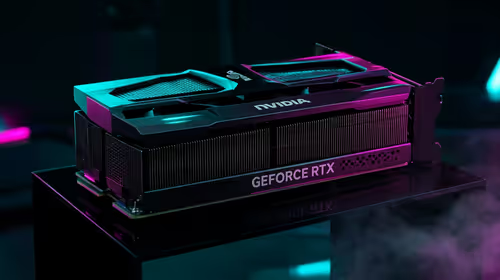
Thirty-two gigabytes is what full-quality local video generation needs. The RTX 5090 carries 32GB of GDDR7 and the memory bandwidth to match, so the VRAM-hungry video models push into higher resolutions and longer clips without running dry. It also chews through batch image workflows, multi-ControlNet setups, and high-resolution outputs that make a 24GB card sweat.
Who Actually Needs It
If your work is centred on local video generation, large batch jobs, or experimental high-resolution pipelines, 32GB stops being a luxury and becomes the requirement. For a creator who only makes still images, it is more capacity than the work demands, and the 24GB or 16GB tier is the smarter spend.
Matching the Tier to Your Work
Work backwards from your heaviest model. SDXL and FP8 Flux only? 16GB is enough. Full FP16 Flux and the occasional 720p clip? 24GB. Serious, full-quality video at home? 32GB. The point is to buy for the demanding job, because VRAM is the one spec you cannot add later. You can compare these cards side by side in the AI PC range at Evetech, where each build lists the GPU and its memory clearly. If you would rather start from the card itself, the top-selling graphics cards show which models local creators are buying right now.
Quantisation Changes the Maths
Before you assume a model is out of reach, look at whether it runs in a lower-precision form. Quantisation shrinks a model's memory footprint by storing its weights at reduced precision, which is how a 16GB card runs Flux in FP8 when full FP16 would not fit. The trade-off is usually small: FP8 output is close enough to full precision that most creators cannot tell the difference in a finished image.
This matters for your buying decision because it softens the tier boundaries. A card that cannot hold a model at full precision may run it comfortably quantised, so a 16GB or 24GB card stretches further than the raw numbers suggest. The catch is that the very heaviest work, full-quality local video especially, still wants the headroom of 32GB even with quantisation in play. Treat quantisation as a way to get more from a tier, not as a reason to drop down one.
Frequently Asked Questions
Is 16GB of VRAM enough for AI art?
For SDXL and FP8 Flux image generation, yes. The RTX 5080's 16GB covers the bulk of still-image work. It falls short only for full FP16 Flux and any video generation, which need 24GB or more.
What VRAM do I need for local AI video generation?
Treat 24GB as the practical minimum and 32GB as ideal. Video models are the most memory-hungry AI workload, and short clips alone can demand 16GB to 24GB, with higher resolutions pushing past 32GB.
Why not just buy the 32GB card to be safe?
If you only generate still images, 32GB is more than the work needs and the money is better spent elsewhere. The 24GB or 16GB tier covers image-only workflows fully. Buy 32GB when video or heavy batch work is the goal.
Can I run Flux on 16GB of VRAM?
Yes, in its FP8 form. NVIDIA's FP8 path lets a 16GB card load Flux by reducing its memory footprint. Full FP16 Flux at maximum quality wants 24GB.
Is VRAM more important than GPU speed for AI art?
Capacity decides what you can run; speed decides how fast it runs. A model that does not fit in VRAM will not run at any speed, so match capacity to your heaviest model first, then consider speed.
Pick the VRAM tier that fits the AI art you actually make. Compare cards and complete builds in the AI PC range at Evetech and get a rig sized for your most demanding model from day one.