Quick Answer
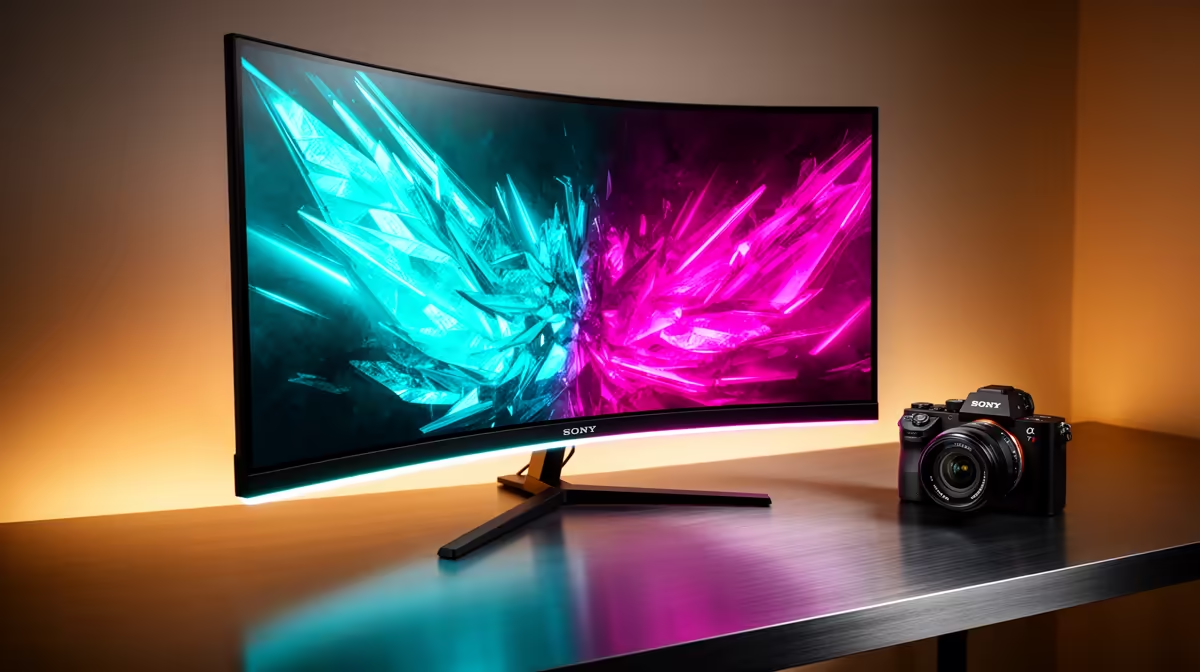
Sit roughly 90 cm to 110 cm from a 49-inch 1800R curved monitor for the curvature to match your natural field of view. Tilt the panel back 5 to 10 degrees and raise it so the top edge sits just below eye level. Those three adjustments together eliminate most neck strain and edge distortion.
Understanding What 1800R Curvature Actually Means 📐
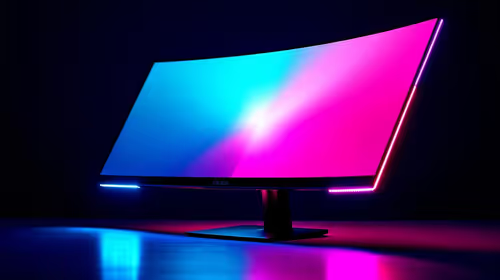
The R-value is the radius of the curve in millimetres. An 1800R panel curves to match a circle with an 1,800 mm radius, placing the sweet spot at around 1.8 metres from the screen. On a 49-inch display that spans roughly 1,200 mm wide, 1800R is aggressive enough for full peripheral immersion but forgiving enough that sitting slightly closer, around 90 cm, still feels natural. A tighter 1000R curve would require you to sit even closer and works better on 27-inch panels. Understanding this helps you choose desk depth before purchasing: a standard 60 cm deep desk puts you too close, while a 80 cm to 100 cm deep desk lands you in the ideal zone.
Getting Desk Distance Right 🪑
Measure from the bridge of your nose to the centre of the screen. Target 90 cm as a minimum and 110 cm as a comfortable maximum for a 49-inch 1800R panel. If your desk is shallower than 80 cm, push the monitor to the very back edge and consider a monitor arm that lets you pull the screen forward without losing desk space. Many South African home-office setups use 160 cm by 80 cm desks, which give enough depth but not much margin, so a monitor arm becomes genuinely useful here.
Setting Tilt and Height for Long Sessions 🔧
Tilt the panel 5 to 10 degrees backward so the bottom of the screen angles slightly toward you. This counters the natural downward gaze angle without forcing your neck upward. Set height so your relaxed eye level lands one quarter of the way down from the top bezel, not at the centre of the panel. A 49-inch display is tall enough that centering it pushes the top edge above comfortable gaze range. If your monitor stand only adjusts height in fixed steps, a monitor arm with full tilt and height control gives far more precise positioning and typically costs between R800 and R2,000 for a quality unit currently available locally.
Arm Extension Check ⚡
Before buying a monitor arm confirm its weight rating exceeds your monitor's spec. Many 49-inch displays weigh 10 kg to 14 kg, and budget arms rated for 8 kg will sag over time, ruining your carefully set tilt angle. Check the product spec sheet and match accordingly.
FAQ
How far back should I push a 49-inch monitor on a 60 cm deep desk?
A 60 cm desk puts you around 60 cm to 70 cm from the screen, which is too close for 1800R to feel comfortable. Push the monitor flush to the back, which gains you roughly 10 cm, but for the full benefit consider a deeper desk or a monitor arm that reaches over your keyboard tray.
Does viewing angle change colour accuracy on the curved edges?
Slightly, but less than on a flat panel. VA curved displays shift colour noticeably past 30 degrees off-axis, while IPS curved panels hold colour better toward the edges. Sitting at the correct distance and centring yourself horizontally reduces off-axis shifts to a minimum.
Can I wall-mount a 49-inch ultrawide instead of using a desk?
Yes, provided the wall bracket is rated for the weight and supports 100x100 VESA or the monitor's specific pattern. Wall mounting fixes depth perfectly but removes any tilt adjustment unless you choose an articulating arm bracket, which is worth the extra cost for a screen this size.
Want to see 49-inch ultrawide options for your desk?
Evetech stocks a range of 1800R curved monitors with adjustable stands and VESA mounting support, find the right one for your setup today.