Quick Answer
Frame-rate instability caused by fluctuating GPU voltage is fixed by replacing an inadequate PSU, undervolting the GPU by 50 to 100mV in software, and ensuring clean modular cable connections. In South Africa, also check for mains voltage sags during high-demand evening hours, which can compound the issue even with a quality PSU.
Diagnosing Whether GPU Voltage Is the Actual Cause 🔬
Before replacing hardware, confirm that GPU voltage is the culprit. Download HWiNFO64 and run it in the background during a gaming session in a demanding title. Watch the GPU voltage sensor: stable voltage should remain within a tight band of 0.95V to 1.05V during boost. If you see the voltage dropping below 0.9V during intense scenes that coincide with frame-rate dips, the power delivery chain is the issue. Also check the PSU 12V rail sensor in HWiNFO64: readings below 11.7V under full gaming load indicate the PSU's 12V rail is drooping, which starves the GPU's on-board voltage regulators of headroom. Document the lowest readings you see, as these numbers guide the fix.
Fixing the Issue: Software First, Hardware Second 🔧
Start with the GPU itself before touching hardware. Open MSI Afterburner and reduce the power limit by 10 percent, then test for 30 minutes. Most RTX 5000-series and RX 9000-series cards lose only 3 to 5 fps at the top end of the frame-rate range with a 10 percent power limit reduction, while the peak current spikes the PSU must handle drop by nearly that same percentage. If instability persists, apply a mild undervolt using the voltage-frequency curve editor: drop the maximum voltage by 50mV and lock the frequency at the card's stock boost clock. This reduces the magnitude of transient spikes dramatically.
Hardware Fixes: Cable, PSU, and Mains Checks 🛠️
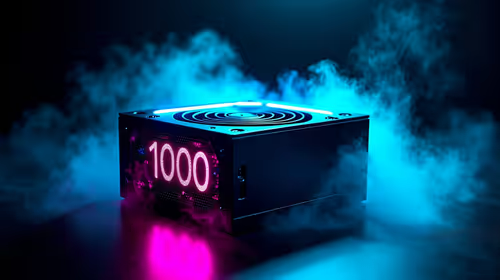
If software tuning does not resolve the dips, inspect the GPU power cable. For 12V-2x6 connections, fully disconnect and reseat the connector until you feel the latch click. For older 8-pin adapter setups, ensure all pins are fully engaged. Try a different modular cable from the same PSU if available; cable resistance degrades over years of thermal cycling. If the PSU is over four years old and originally rated at a lower wattage tier than your current GPU requires, replacement is the next step. Budget R2,800 to R4,500 for an 850W ATX 3.1 Platinum unit locally.
The Easiest Test: Swap the PSU Cable First ⚡
Before spending money on a new PSU, try swapping the modular PCIe cable to a different port on your existing PSU if one is available. Corrosion or a bent pin in the modular connector can cause intermittent resistance that worsens under heavy current draw. This 5-minute test has saved SA builders a PSU purchase more than once.
FAQ
Can thermal throttling mimic frame-rate instability from GPU voltage issues?
Yes, the symptoms are similar: sudden fps drops during heavy scenes. Check the GPU temperature sensor alongside voltage in HWiNFO64. If temperature spikes above 85 degrees Celsius at the same moment as the fps drop, thermal throttle is the cause. If temperature stays stable while voltage dips, power delivery is the issue.
Will adding a UPS fix mains-related GPU voltage instability?
A line-interactive UPS that performs automatic voltage regulation can smooth minor mains sags, which helps when the issue is purely mains-side. It will not compensate for an undersized or ageing PSU's own regulation failure. Fix the PSU first; add a UPS for secondary protection.
Does setting a custom fan curve help with frame-rate instability?
Indirectly. A more aggressive GPU fan curve reduces GPU temperature, giving the on-board voltage regulators more thermal headroom. This can reduce the frequency of voltage droop events caused by thermal interaction, but it does not address PSU-side voltage delivery issues directly.
Frame drops ruining your gaming sessions?
Browse Evetech's ATX 3.1 power supplies to get your GPU the clean, stable power delivery it needs for consistent frame rates.